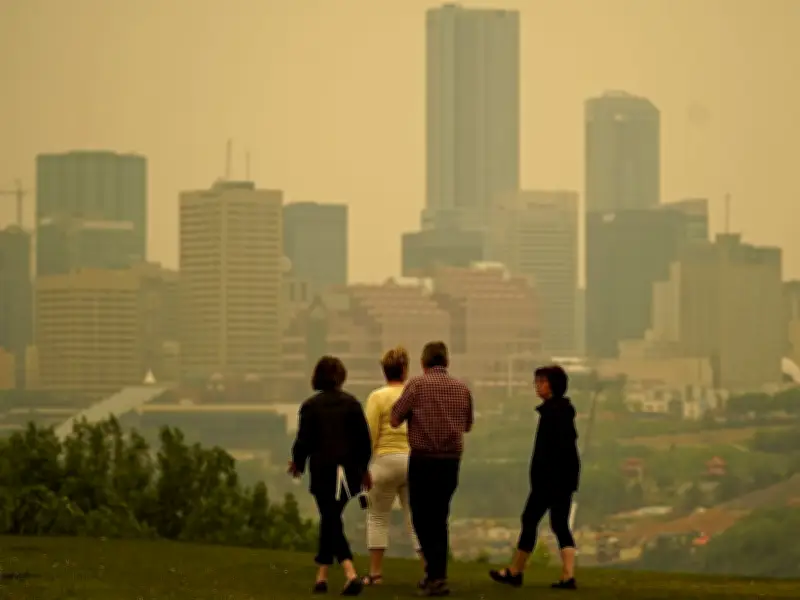
The spring of 2019 was a memorable moment in Alberta’s ongoing conflict between nature and politics. It was the early days of then-premier Jason Kenney’s new UCP government, which was eager to tout its first major accomplishment — the repeal of the provincial carbon tax. A media event was set up at an Edmonton Esso station, where Kenney was set to point to the lower price at the pumps as a victory for Alberta consumers.
Nature, however, had other ideas. A blanket of wildfire smoke engulfed the city that day, as thick and acrid as the irony of its timing. The government cancelled the event, purportedly for health and safety reasons, though the risk of the premier literally choking on his own words about carbon may have also played a role.
Seven Years On: The Same Tension Persists
Seven years later, the same tension persists, though the connection between climate change and wildfire activity has only intensified. The burning forests of 2019 — not to mention earlier disasters in Fort McMurray and Slave Lake — can no longer be viewed as freak anomalies but rather as harbingers of a new reality producing more frequent air quality warnings, more societal costs, and further destruction.

And yet, as the risks and impacts mount, climate change has become a bit persona non grata in our discourse these days — the party guest who won’t leave but no one wants to talk to. The malaise has been unnerving enough that an alliance of 300 municipal leaders from around Canada has formed to put climate change back on the agenda.
Summit in Edmonton Draws Attention
The group recently held a “summit” in Edmonton, this being the event where a spontaneous standing ovation was given to former federal environmental minister Steven Guilbeault, who has himself been something of a persona non grata around these parts. That surprising moment aside, the event also featured appearances by, among others, Mayor Andrew Knack, former mayor Don Iveson, former Montreal mayor Valérie Plante, and the current mayors of Yellowknife and Jasper — two communities that have experienced wildfire first hand.
In many ways, such an alliance makes sense. Municipal leaders are often the best positioned politicians to advocate on this issue since cities and towns are where the causes and effects of climate change are often most pronounced — and not just the extreme events of Fort McMurray, Jasper and the like.
Local Impacts and Infrastructure Stress
Cities, in particular, contribute a lot to the country’s overall emissions, which are affected by local government policies on transportation and development. Municipal infrastructure is coming under increasing stress due to higher temperatures and more frequent extreme weather. Edmonton’s High Level Bridge, as one example, is marked for demolition in the coming years, in part because of increased degradation from climate change.
The people most vulnerable to climate change’s effects — health conditions, displacement, rising prices for food and insurance, etc. — often end up in the streets and shelters of major cities. The summit highlighted these lived local experiences, emphasizing the need for coordinated action across all levels of government.