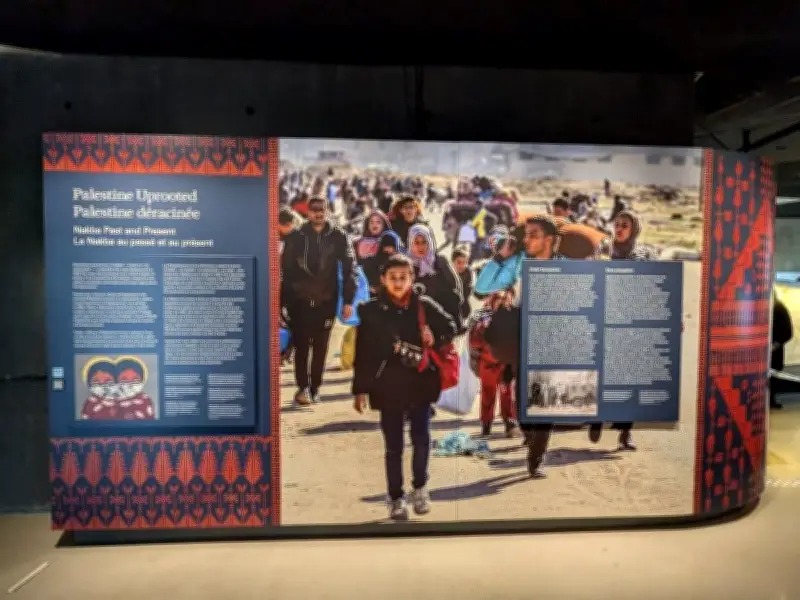
WINNIPEG — Our government is officially failing Jews and Palestinians. That’s what I came away with thinking after touring the Canadian Museum for Human Rights’ newest exhibit, Palestine Uprooted: Nakba Past and Present.
At first glance, this may appear to be another disagreement over the Israeli-Palestinian conflict. It is not. It is a question about the responsibilities of a democratic government and the values it chooses to advance through institutions that speak with its authority. A federally supported national museum is entrusted with pursuing historical truth through accuracy, balance, and scholarly rigor. It is not another advocacy organization free to advance a political narrative as settled history.
Exhibit’s framing criticized as biased
That obligation is precisely what makes Palestine Uprooted so alarming. The exhibit, which opened to the public on Saturday, does far more than recount the “catastrophe” of mass Palestinian displacement during the 1948 Arab Israeli War, as the official website’s definition of the “Nakba” term states. It’s important to note that this definition has only been in popular use for about 40 years. Originally, the Arabic term was used to describe the Arab League’s embarrassing military defeat largely at the hands of Jewish socialist farmers, Holocaust survivors, and former refugees, all with little international support.

Rather than inviting Canadians to wrestle with one of the world’s most complex conflicts, it teaches visitors to understand the conflict as solely a consequence of Israel’s creation. In doing so, genuine Palestinian suffering is transformed into a perpetual weapon targeting everything related to Israel, and encourages the public to view millions of Jews as the beneficiaries and defenders of an ongoing historical injustice.
Holocaust gallery placement raises concerns
Walking through the museum, located in the heart of Winnipeg, one design choice immediately stood out. The Nakba exhibit is physically positioned after the museum’s Holocaust gallery, meaning visitors move directly from one of history’s best documented genocides into a highly politicized presentation of the 1948 Arab Israeli conflict.
That transition creates a subtle but unmistakable emotional and interpretive bridge between two entirely different historical contexts, carrying visitors from a universally recognized moral framework into a contemporary political narrative with the implication that the same categories of understanding naturally apply. While the implicit promotion of Holocaust Inversion certainly informs the conclusions visitors are invited to draw.
Exhibit presents one-sided narrative
Inside the exhibit, that framing quickly becomes more pronounced. The material is not presented as a set of competing historical interpretations or unresolved debates. Instead, it is organized around a single guiding premise: that Palestinian displacement in 1948 is not simply a historical event with several causes, but the beginning of an “ongoing” Jewish Israeli-imposed tragedy that entirely ignores Palestinian suffering when Israel cannot be blamed.
This is not the pursuit of historical truth. It is a toxic political instruction delivered with the authority of the Canadian state. According to Adam Katz, the exhibit is propaganda endorsed by the Canadian state, and it is every bit as anti-Jewish as feared.