What began as a cold, misty morning with the sun occasionally peeking through the clouds seemed destined to be just another uneventful day. The temperature hovered around -12°C, and the landscape was swathed in a blue mist, creating a serene but uninviting atmosphere. I set out east from the city, hoping to find birds, particularly snow geese, which are rarely seen close to urban areas. My destination was the sloughs and shallow lakes of Alberta, where I anticipated spotting a few avian visitors.
Initial Stops Yield Familiar Sightings
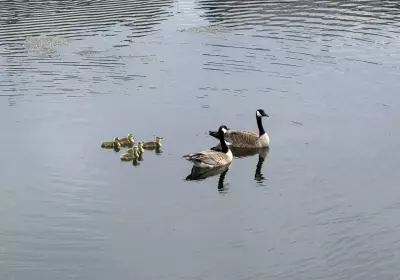
My first stop was Weed Lake near Langdon. I knew it would have some open water, but I was disappointed to find it freezing over again. Despite this, there were plenty of birds: tundra and trumpeter swans, a mix of pintails, wigeons, and mallards, along with Canada geese and ring-billed gulls. However, they were huddled far from the road, making photography challenging. While it was nice to see them, these were species I had encountered before, and I was eager for something new, like snow geese. None were present, so I continued east and south.
The ponds I visited next were frozen and snow-covered, with no birds in sight except for two small groups of Canada geese in a barley field. Feeling a bit discouraged, I changed plans and headed to the Carseland weir on the Bow River. The light was hazy but bright, and most of the ice had melted from the main flow, leaving plenty of open water. Yet, there were surprisingly few birds: no pelicans, very few geese and swans, and only common ducks like goldeneyes, pintails, wigeons, and mallards. An eagle soared overhead, but nothing I hadn't already seen that day.

An Unexpected Cormorant Sighting
One exception was a double-crested cormorant perched on an ice-lined log, spreading its wings toward the hazy sun. This was a genuine surprise, as cormorants are fish eaters and lack the oily feathers that other waterbirds use to shed water. After diving, they must haul out to dry off, which is challenging in temperatures around -8°C. I hoped it was managing somehow, but the sight added a unique twist to the day.
The Journey to McGregor Lake
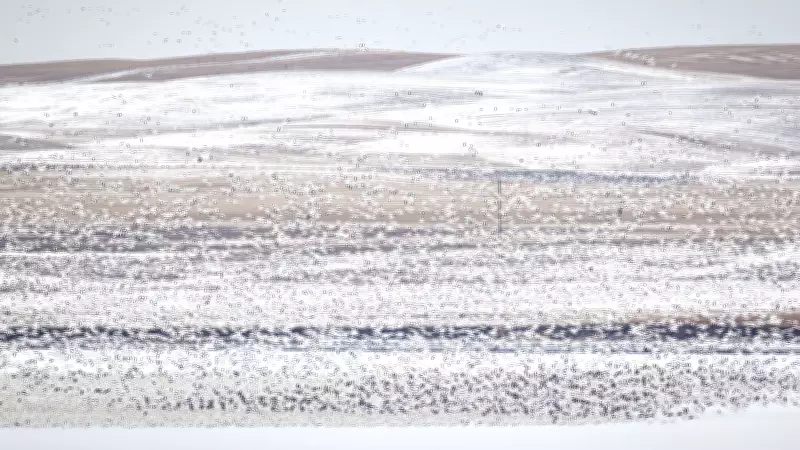
Unsure of what to do next, I realized I was already about halfway to Milo and McGregor Lake. The countryside was snowy and un-springlike, and the lake was mostly ice-covered. However, there was some open water near the boat launch, and I could hear the ice moaning and grumbling as it flexed. Robins and a meadowlark added to the sounds, but then I heard an undulating, high-pitched honking that grew louder. Through my long lens, I saw a dark cloud rising from down the lake—thousands of birds, which turned out to be snow geese as the cloud shifted.
There were two huge flocks: one sitting on the ice and another in flight over the open water, both about a kilometre away. The sound of their cries and the roar of their wings indicated many thousands of them. I wanted a better look, but the lakeside land was private and snow-covered, so I took the main road south along the lake. The mist made everything at a distance appear white on white, and the geese blended into the snowy hills, distinguishable only by their ivory colour.
A Breathtaking Spectacle Unfolds
I spent time going back and forth, stopping at open-water bays where I saw thousands of pintails and wigeons. As I headed south, the snow cover diminished, giving way to yellow and brown grass and stubble. I saw dozens of harriers hunting, horses in pastures, and old farm buildings, but there were few birds on the water. At Travers Reservoir and Williams Lake, the water was ice-free but had very few birds, except for a single flock of snow geese. I decided to head back to McGregor.
By then, the mist had mostly dissipated, and I found a killdeer hunting in bright sunlight. Further north, snow geese were rising from the big flock near the middle of the lake, catching the late afternoon sun. The sound was incredible, overwhelming everything else, and as a few passed overhead, I could hear the wind in their wings. Pintails and wigeons flew out to feed in nearby fields, and I could hear meadowlarks, though I missed seeing one.

Estimating the Magnitude of the Flock
Capturing the extent of the flock with my camera was challenging. Out on the water and ice to the north was a swath of birds about two hundred metres wide and at least a kilometre long. I estimated there had to be at least 50,000 birds in that flock alone, with smaller bunches further south and along the shore. It was way too much to take in.
The geese were on the move now, with a thousand or so in a field I could get fairly close to, and waves of them heading across the sun and further west. Flocks of pintails and wigeons flew with them. I just sat and watched, their poop spattering down like thick rain as they lightened their burdens above me. Their constant calls were cacophonous but lovely, and the hiss of their wings added a beat to their rhythm.
Transforming a Dull Day into an Unforgettable Experience
When I left in the morning, it sure looked like it was going to be just another dull day. But ending as it was with thousands of birds around me, it definitely was not. The spectacle of snow geese at McGregor Lake near Milo, Alberta, on that cold March day in 2026, turned an ordinary outing into an extraordinary wildlife encounter, highlighting the beauty and resilience of nature in the face of winter's grip.