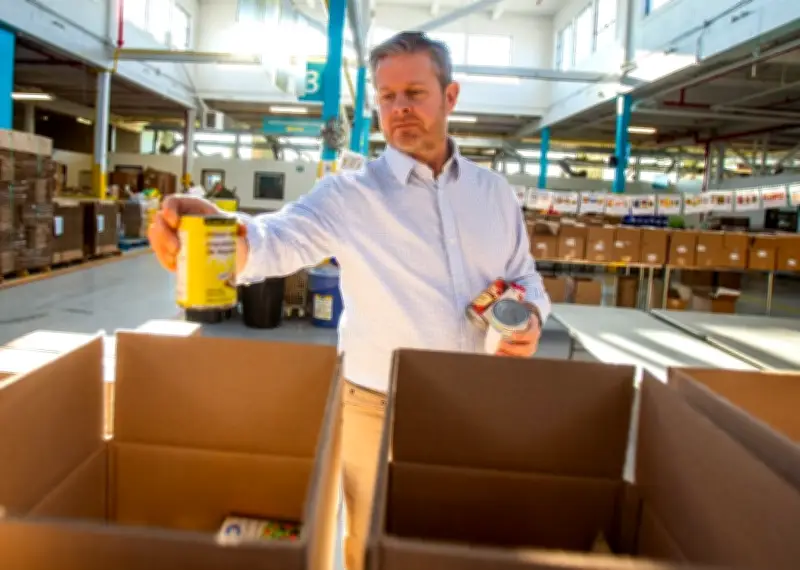
Daily Bread Food Bank CEO Neil Hetherington described the current food bank usage rate in Toronto as “abhorrent” and urged voters to press politicians on how they plan to reduce reliance on emergency food services. With the municipal election approaching, Hetherington said voters can ask a “very simple question” about what candidates will do to ensure food bank usage starts to decrease.
One in Ten Torontonians Rely on Food Banks
“You can ask, ‘I heard one in 10 Torontonians have to use the food bank. What are you going to do to make sure that food bank usage starts to decrease in our city?’” Hetherington said in an interview Wednesday. “It’s that simple. One in 10. That’s abhorrent and we need to change that.”
His comments come as politicians at all levels continue to grapple with the cost-of-living crisis, which has led to recent food security policy announcements. In March, the City of Toronto launched a pilot project to establish four not-for-profit, city-run grocery stores in neighbourhoods with lower average household incomes and limited access to full-service businesses.

Federal Food Security Strategy Announced
Two months later, the federal government unveiled its National Food Security Strategy, which is expected to invest $3 billion over 10 years into new and expanded food terminals and hubs. The strategy aims to support independent businesses, boost domestic food production, and cut red tape for the agricultural sector. Both initiatives seek to make food more affordable for consumers.
While some observers have praised the federal plan for addressing long-ignored issues, Agri-Food Analytics Lab director Sylvain Charlebois criticized it for lacking a “clear vision, measurable objectives and a long-term commitment.”
Hetherington: Lineups Unlikely to Shrink Quickly
Hetherington described the federal strategy as a “very necessary exercise in making sure that we are a sovereign state when it comes to food,” but he cautioned that it won’t necessarily shorten food bank lineups. “What will occur, though, from this investment is that from a food security perspective, from a national security perspective, we will grow our food,” he said. “We will be less dependent on the international fluctuations that occur because we are investing in things like food terminals; we’re trying our best to increase competition in grocery stores.”
Regarding the city’s grocery store pilot, Hetherington expressed skepticism about their ability to compete with the private sector without “mass subsidies,” noting that the issue will boil down to “what is the level of subsidy that the city wants and for who.”
Root Causes: Income Disparity and Housing
Hetherington emphasized that food insecurity is a symptom of income disparity. Tackling the city’s historic food bank usage—a record 4,124,313 visits last year, a more than three-fold increase since the start of the pandemic—requires adjustments to policies such as the National Housing Strategy, disability benefits, and inflation controls. “Those are the root causes and, you know, there’s ways for all levels of government to participate in solving them,” he said.
Voters will have an opportunity to hear Toronto mayoral candidates discuss the issue on August 24, when Daily Bread hosts the city’s first mayoral debate. “It’s critical that each of the candidates comes to the plate and talks about what is the city’s role in poverty alleviation, how can they negotiate with the province, how can they work with the feds in order to make sure that … what we have currently, with one in 10 Torontonians using the Daily Bread Food Bank, how do we see that reversed,” Hetherington said.