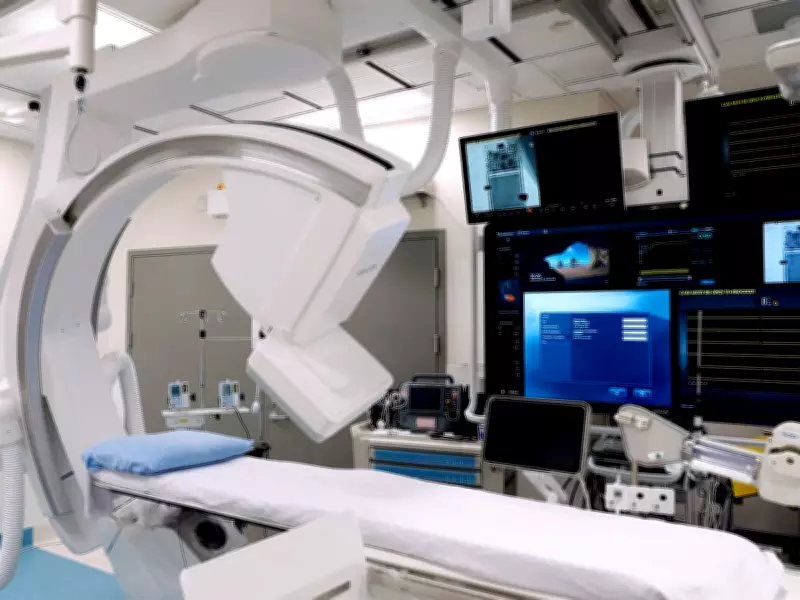
A $1-million donation to the Calgary Health Foundation will fund the renovation of a cardiac catheterization laboratory at the Foothills Medical Centre. The gift from Lorne and Kristi Jacobson and the Jacobson Family Foundation will see the facility renamed after the family's organization.
The space, informally known as a cath lab, houses advanced imaging tools used to diagnose and treat heart and blood vessel conditions without surgery. Treatment usually involves minimally invasive procedures that deploy thin, flexible tubes inserted through the wrist or groin, which a cardiologist guides to the heart.
Philanthropy in healthcare
"Philanthropy is in our DNA," Lorne said. "I personally was blessed to receive life-saving care in this very cath lab following a heart attack and cardiac arrest in 2009."

Dr. Bryan Har, director of the lab, welcomed the donation, saying, "Not only will it allow us to offer patients the latest in cardiac diagnostic and treatment options, but it will reduce procedural delays and boost staff morale and productivity." He added, "Physicians will get to work in a newly renovated lab where they can address complex cases with greater precision and safety."
The renovated space will be the second of six labs at Foothills Medical Centre to be restored. The first was completed in the fall of 2023 and was also funded by donors of the Calgary Health Foundation, which says it is continuing to raise money for the city's cath labs. "With a life span of 10 to 12 years, each lab will need ongoing philanthropic support to continue to offer cutting-edge health-care technology," it wrote in a statement.
Non-profits increasingly covering financial gaps in health care
The announcement comes at a time when non-profits have been increasingly funding essential health-care costs. Recently, Calgary Health Foundation also seeded a minimally invasive spinal surgery program at Foothills Medical Centre with $8.2 million that allows doctors to drastically minimize pain for patients undergoing complex procedures.
Meanwhile, real per-capita hospital funding by the province declined by four per cent between 2014 and 2023, from $2,252 to $2,169, according to a report by the Canadian Centre for Policy Alternatives. Alberta Health Services, in its 2024-25 business plan, said most of its expenses — 52 per cent — go toward salaries, while making the case for further cuts to certain programs.
"Amortization expenses are also increasing as they represent the cost of assets spread out over their expected useful lives. As AHS replaces clinical equipment and invests in new equipment facilities... costs grow," the report stated. "Between 2023-24 and 2024-25, AHS annual expenses will increase by 3.6 per cent. Wage, inflationary, and population growth increases are projected to be higher than the 3.6 per cent funding available. Program reviews and efficiencies are required in order to achieve a balanced budget."