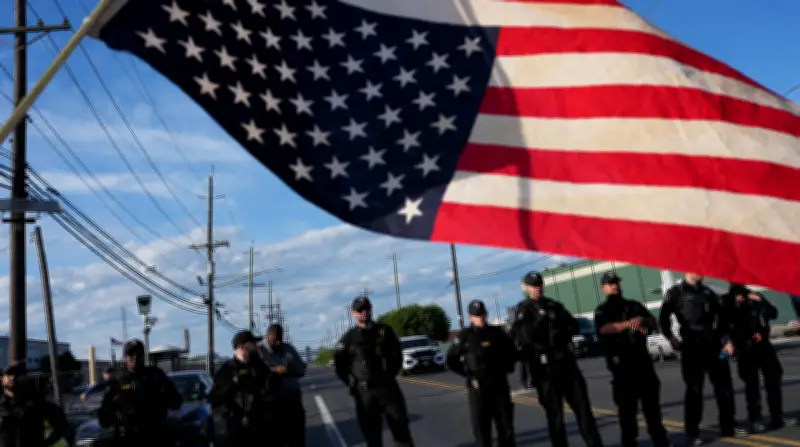
Alex James, the protester struck by a vehicle outside the Delaney Hall immigration detention facility in Newark, New Jersey, on Sunday, stated she is still searching for the driver who hit her and has received no contact from law enforcement regarding the incident. James, whose legal name is Alex Pride, was struck by what appeared to be a red Dodge Charger while waving an upside-down American flag near the entrance of the controversial jail. Protesters and detainees' families had gathered there to mark Father's Day.
Incident Details and Aftermath
James, still shaken, told HuffPost in a phone interview Tuesday that she and her attorney are working to identify the driver to pursue a lawsuit. “I saw a red sports car whiz past as I was tumbling,” James recounted. “I realized, ‘Oh hey, I’m being hit!’” Protesters have occasionally blocked the driveway to the employee parking lot to heckle Immigration and Customs Enforcement (ICE) agents or GEO Group employees, the private prison contractor operating the site. However, James said she would have moved out of the way if she had known the car was behind her. “I was not standing there with the intention of blocking anybody,” she said.
Law Enforcement Response and History
Law enforcement—primarily ICE, with occasional state and local police—have sometimes been aggressive toward protesters at Delaney Hall, using chemical munitions like tear gas and pepper balls. Drivers entering or exiting the parking lot have hit others in the past. After a hospital visit confirmed no fractures, James returned to Delaney Hall “to show that they don’t get to take that away,” bringing Popeyes for the protesters. James and her attorney, James Cook of Burris, Nisenbaum, Curry & Lacy, said they have not heard from law enforcement. Newark’s Director of Public Safety, Emanuel Miranda, stated the incident “remains under investigation.” An unnamed Department of Homeland Security spokesperson said, “This vehicle was not being driven by an ICE employee. We refer you to GEO group.” GEO Group did not respond to a request for comment. “No one’s coming forward,” James said. “GEO is not saying anything, ICE is not saying anything, as far as I know. I have not been contacted. It’s surreal.”

James's Activism and Personal Connection
James, an event photographer and longtime activist, was active in the Twin Cities during the federal immigration enforcement occupation earlier this year. When a friend told her about supply needs outside Delaney Hall—after law enforcement chemical agents contaminated supplies in a mutual aid tent—she gathered donations. “Over the course of three days, I gathered so many donations of medical supplies and PPE that I had to rent a trailer,” she said. She drove 19 hours from Minneapolis to Newark, planning to stay a week but extending due to community need. “I put my life on hold,” she said. “My credit card is not happy with me right now.”
Legal Context and Detainee Conditions
Cook’s firm is involved in a class action suit against federal law enforcement in Minneapolis and represents a defendant in a federal prosecution alleging conspiracy to impede federal law enforcement. Last month, hundreds of Delaney Hall detainees reportedly launched a hunger and labor strike, demanding freedom, full legal rights, and a visit with Gov. Mikie Sherrill. Letters smuggled from the facility, with dozens to nearly 300 signatures, detailed poor conditions, inadequate food and medical care, lack of due process, and retaliation for speaking out. ICE and Delaney Hall officials denied the strike, suspended visitation, and allegedly retaliated, effectively ending the strike through transfers. “We’re not mad enough,” James said. “Not enough people are aware of the level of these conditions.”

Personal Impact and Risks
The Trump administration’s immigration crackdown is personal for James. Her mother, a naturalized U.S. citizen born in Vietnam, went back to care for James’s grandmother. When her mother planned to return last December, James said, “I had to sit there on the phone with my mom and tell her not to come back—tell her, ‘Don’t you dare come back.’ She comes up to my shoulder. She speaks broken English. I could not guarantee that she would be safe in the country that she calls home. That is terrifying in a way that I have not felt before.” James acknowledged that coming forward risks harassment and targeting by the Trump administration; right-wing trolls have already attempted to dox her. “There does seem to be a pattern of escalation,” she said. “I did recognize that the moment I accepted the interview, that I would be correctly doxed, likely, and that my life would likely be very different for a while. But that is the risk that needs to be taken in order for this to get out there—for people to know what is going on.”