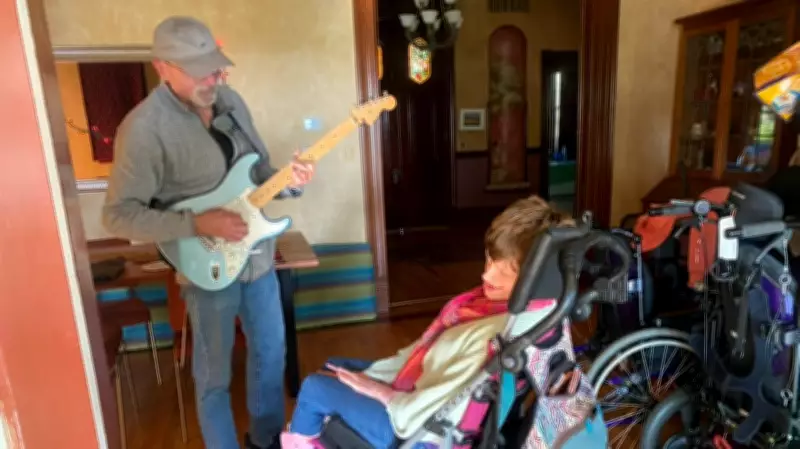
The author's husband, playing for Millie. Photo Courtesy Of Danilyn Rutherford
I often catch my multiply disabled daughter Millie in this pose: leaning forward in her rocker and staring at her lap, frowning. My husband stands four feet from her, picking the first notes of a blues riff on his electric guitar. Millie smiles faintly when she recognizes the clip-clop of the beat. As the G chord gives way to the C, and back to the G, she grins and sets her chair swinging. Next comes D, with its strong pull back to the opening note, and she snorts and cackles as my husband finishes the riff. Sometimes, when he walks past Millie, he just hums the riff — ba-bum ba-bum ba-bum ba-bum — and the simple rhythm sung out loud makes her explode with laughter. I remarried a year ago, and Millie hasn't known my husband long. But she still gets the joke.
Millie is 25 years old. She doesn't walk on her own, or feed herself, or communicate with signs or symbols. Yet she lives along with the rest of us in a world of patterns and predictions, a world in which we wait for "tock" when we hear "tick." "The sense of an ending:" that's what the literary theorist Frank Kermode called this most human of tendencies; he argued that it was the elementary structure of every story. Even though Millie can't tell a story, or to my knowledge, understand one, she shares this sensibility. She lives knowingly in music, at play in the interval between beginnings and ends.

The most profound of beginnings and ends are those marking the opening and closing of a life. Our children die. But we act like they'll live forever. We're the ancestors; they're the descendants — that's how kinship is supposed to work. It's different when our children are profoundly disabled. Their lives are fragile and wondrous. Their life expectancy is more than a statistic; it's a fact to reckon with. The longer you've loved them, the more it overshadows your days. Millie is undiagnosed. Which means many things. Among them is the fact that I have no idea how long she will live.
Millie was 10 months old when the extent of her disabilities became evident. She'd had a normal birth and what looked like a normal early infancy, before missing all the developmental milestones. No smiling, rolling, sitting, crawling. No babbling, looking into my eyes, or following my gaze. Our first geneticist tested her for the usual suspects: Rett Syndrome, Angelman Syndrome, plus some metabolic disorders. The lab techs sequenced, and sequenced again, but ruled all these conditions out. This came as a blow, because Millie's father and I wanted a road map. Back then, we were still thinking like most new parents. Millie's childhood was our term of office. We were obsessed with the first 20 years of our daughter's existence: the slow trip to the top of the roller coaster, not the twists and turns that would confront her on the way back down. When the doctors and therapists told us that Millie was "delayed," we did everything we could to help her catch up. Our job was to help our daughter gather enough momentum to carry her through the rest of her life. We never gave a thought to how long the ride would last.
Then Millie's father died of a heart attack, an end that expunged all thoughts of the future. I stepped off the roller coaster and clung to my children, no longer worrying about who they would become. I made peace with the idea that Millie was just Millie — no labels or game plans required. I went to work getting her the support she needed. The insurance company covered her wheelchair. The school district signed off on her services. I came up with my own answers for family and friends. Then I learned something that made me long for a diagnosis again. Millie had begun taking the most benign drug for seizures when she was 7; in her late teens, it stopped working. I had hoped she would grow out of seizures; instead, she was growing into them. They were getting worse. Millie might not lead a long life.
Millie's doctors still thought that she showed signs of Rett Syndrome. Patients with Rett Syndrome have an average age of death of about 24 years — a year younger than my daughter. People with Rett Syndrome — who are almost always women — sometimes develop intractable seizures in their 20s. Seizures are a common cause of sudden, unexpected death in this population.

The author's favorite photo with her daughter. Photo Courtesy Of Danilyn Rutherford
In 2024, I enrolled Millie in the Undiagnosed Diseases Network, which maintains a database of rare genetic anomalies and conducts cutting-edge testing to identify them. Millie hadn't been tested since 2012, and her full genome had never been sequenced. "I'm pretty sure we'll find something," the genetic counselor told me when she went over the consent forms. Conditions like Rett are caused by what geneticists call "de novo mutations," or random rearrangements of one or more of the genes that control brain development. A stroke of fate had created my daughter. Suddenly, it felt urgent to discover where it had hit. I threw my understanding of statistics to the wind. This wasn't a matter of maybe. I had to be ready for the worst. Would she lose me someday, or would I lose her?
"What are your expectations for this meeting?" The genetic counselor spoke with compassion from the square on my screen, although I suspected she was reading from a script. It was November 2025, and I'd been waiting for this Zoom call for months. I glanced at my sister. She raised an eyebrow. She's a geneticist, and I'd brought her along as backup. "An answer?" I offered meekly. "So I can plan?" The genetic counselor cut to the chase. "Nothing." My sister and I stared at her, slack-jawed. "We found nothing." The furnace kicked on. That morning, on a whim, I had dived from a dock into the Atlantic: a split second of flight, then I hit the freezing water, and time stopped. I felt that way now: shot out of the story I feared I would soon be living. I had spent months preparing myself to bear up under the weight of bad news. Wonder swept through me. The death sentence had been lifted. Millie was unique. Like a snowflake. Or a comet. Or a god.
"I'm sorry," the genetic counselor said. "No," I stopped her. "There's something beautiful about the fact that Millie isn't like anyone else."
After catching our breath, my sister and I peppered the genetic counselor with questions. We wanted details. Did nothing really mean nothing? Apparently, it did. There was a research study Millie could enroll in. Scientists were searching for mutations in the regulatory regions of the genome. This is my sister's specialty. Her eyes lit up.
But the genetic counselor cautioned us. "It will take years to build up that part of the database. I always try to balance hope with being realistic. Even if they find something, 10 years can go by before another patient turns up with the same anomaly. Or longer. We just don't know."
Wonder swept through me again. This quest of mine — to find out how Millie became Millie — it wasn't just about us. "We don't know what caused Millie," I finally said. "We don't know now, and we may not know until long after Millie and I are both dead. But someday someone will know. There's something beautiful about that, as well."
My sister had the last word. "Yes. We'd be doing this for science."
"Grows, dies, grow, dies, grows, dies," the memoirist and computer scientist Becky Taylor repeated one night as a small child with cerebral palsy. "What are you talking about?" her parents asked her. "Life," she replied. Death finds us all. It's simply a matter of when.
After the meeting, my sister went through Millie's paperwork. In fact, there was an anomaly in one of the genes associated with Millie's symptoms; it's called FOXG1. It may not mean anything — the majority of mutations are "silent," non-functional bits of genetic fluff. A website with information on FOXG1 syndrome included a video featuring some of the 1,500 individuals worldwide who have the condition. Most were small children. Either there aren't many who live to adulthood or the geneticists just haven't found them. I watched, my eyes moist, as a little girl materialized on the screen, her face blank, then blossoming into a smile. She could have been my daughter. The FOXG1 gene is associated with Alzheimer's disease, which means there's funding for research. A parents' group is sponsoring a study that has led to a treatment that is close to qualifying for clinical trials. There's talk on the website of a "cure," but the language also suggests that these parents just want to extend their children's lives — the way I'd love to extend Millie's.
Tick, then tock. Stories upon stories. Where will this new one lead? I'm hopeful, but I'm also ready for my daughter to continue to elude me. The disabled lawyer and activist, Harriet McBryde Johnson, called her memoir "Too Old to Die Young." The doctors were sure she wouldn't survive past childhood; the joke was on them. So much for life expectancy. A statistic is just a statistic — not a fact, just a chance. When I told Millie's caregiver Marilyn, who is in her 90s, about the test results, she laughed. "That Millie. There's nothing wrong with her. She's been faking it all along."
Do you have a compelling personal story you'd like to see published on HuffPost? Find out what we're looking for here and send us a pitch at pitch@huffpost.com.