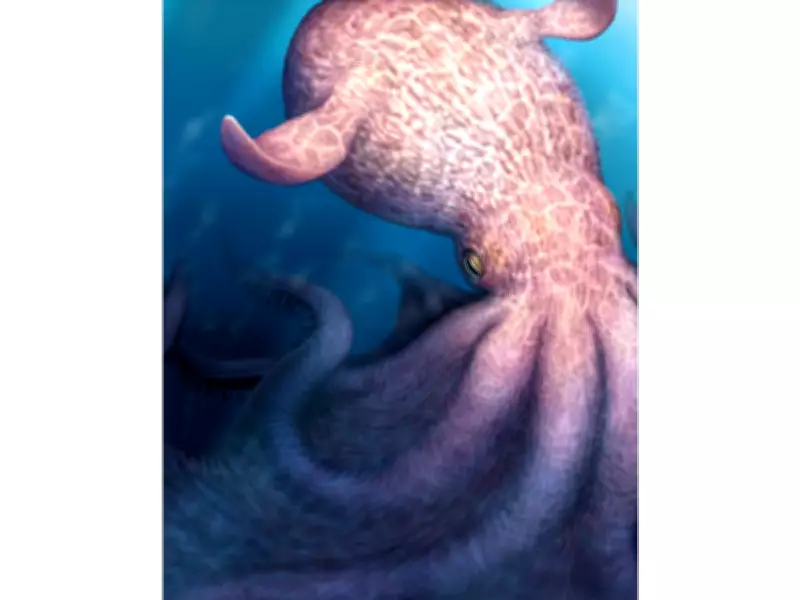
Scientists have discovered that a kraken-like octopus, capable of growing to over 18 meters in length, may have been one of the most formidable predators in ancient oceans. New research from Hokkaido University in Japan challenges the long-held belief that octopuses were not among the dominant marine predators during the Late Cretaceous period, when dinosaurs like Tyrannosaurus rex roamed the Earth.
Massive Size Rivaled Giant Marine Reptiles
The research team studied dozens of jaw fossils from ancient octopus relatives and found that two now-extinct species, Nanaimoteuthis jeletzkyi and N. haggarti, reached lengths between 7 and 19 meters. This size rivals that of other giant marine reptiles of the time, such as mosasaurs and plesiosaurs.
Overlooked in the Fossil Record
Professor Yasuhiro Iba, co-author of the study, noted that invertebrates, especially soft-bodied animals like octopuses, have been largely invisible in the fossil record. Their soft bodies rarely fossilize, leading paleontologists to focus on organisms with hard skeletons or shells. However, new technologies are now providing insights into these elusive creatures.

“In that sense, we are just beginning to see parts of ancient ecosystems that were previously almost invisible,” Iba said.
More Than Just Size
The study revealed more than just the octopuses' colossal size. By analyzing wear patterns on their jaws, including chipping, scratching, cracking, and polishing, the team demonstrated that these octopuses could process hard prey such as shells and bones. This suggests they may have occupied a similar ecological niche to large vertebrate apex predators in the Cretaceous ocean.
“The evidence indicates repeated, forceful interactions with their prey, revealing an unexpectedly aggressive feeding strategy,” Iba added in a news release.
Potential Prey and Ecological Role
The massive mollusks may have preyed on large aquatic reptiles like mosasaurs and plesiosaurs, which were previously considered the main marine predators of the period. The octopuses' powerful arms and beaks likely made them formidable rulers of the oceans.
In comparison, the largest living octopus today, the giant Pacific octopus, typically measures under five meters in length and feeds on shrimp, clams, lobster, and fish, though it has been known to eat larger animals like sharks and birds.
Fossil Discoveries and Advanced Techniques
The fossils were discovered in Japan and on Vancouver Island. The research team used grinding tomography, a 3D imaging technique, along with an artificial intelligence model to analyze the specimens and reach their conclusions.