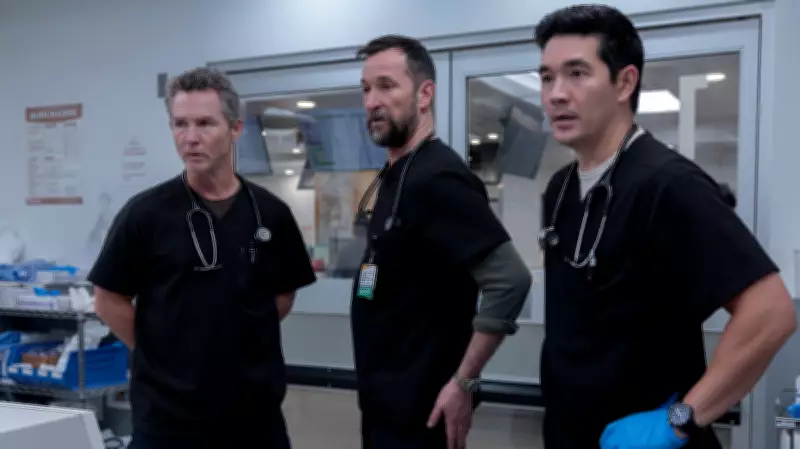
In Season 1 of “The Pitt,” Dr. Heather Collins has a miscarriage in an employee restroom and goes back to work. Charge nurse Dana Evans vows to leave her position after getting sucker punched by a patient but doesn’t. What keeps TV medical personnel on the job through illness, injury, and trauma is a script to follow and a show to produce. For real-life healthcare professionals, it’s more complicated.
When I was a 21-year-old nursing student, I waited until my day off to visit my doctor about abdominal pain and vaginal bleeding. I was diagnosed with a pelvic infection, given a shot of antibiotics, and told to return if things didn’t improve. When Monday arrived, I wasn’t improved, but rather than go to my doctor, I went to work. I cared for my patients through pain and bleeding, but when I started struggling for breath, I finally checked myself into the emergency department. An ultrasound showed a ruptured ectopic pregnancy with blood accumulating in my abdominal cavity. I needed emergency surgery. I was wheeled through the hospital halls, past classmates I had been working with less than an hour before. No one seemed shocked.
Shouldn’t it have been more surprising that a healthcare worker would drag herself to her post while actively hemorrhaging? Although some of it might be explained by my own blind trust—told it was a simple infection, I chose to soldier on—the larger piece that cannot be ignored is the culture pervading healthcare. The hidden curriculum, the unspoken expectation, is that we show up for our patients no matter what.

Residency and the ‘Hero’ Narrative
Residency wasn’t much better. There, we had a saying: “If you call in sick, you’d better have a hospital room and vent settings.” You were expected to work through all but the most life-threatening illnesses. Hence, the stretcher ride through my workplace. Society at large can also hold unrealistic expectations of people who care for the sick. We are often seen as superhumans. This view was amplified during the pandemic when a grateful public banged pots and pans from porches and stoops, holding up “Hero” signs in appreciation of our work. But history is beginning to show that such displays may have caused more harm than good. The valorization of doctors and nurses who died of COVID while caring for infected patients only served to normalize our exposure to risk. This narrative also takes the onus off culpable health institutions responsible for safeguarding employees. Characterizing the care of patients with a deadly and not yet well-understood virus as selflessness only promotes the notion that healthcare workers willingly put themselves at risk for their patients. In fact, many were begging their administrations for the personal protective equipment they needed.
This hero culture has left no room for self-compassion because it has left no room for caregivers’ needs. As healthcare workers, we extend abundant compassion to our patients but save little for ourselves. We are famously perfectionistic, holding ourselves to impossible standards. We feel we can never make a mistake because if we err, patients die. It’s a crushing pressure we put on ourselves. And it is not sustainable.
Stigma and Moral Injury
If we try to find help dealing with this pressure, we might run up against the stigma around healthcare professionals seeking mental health services. According to the Dr. Lorna Breen Heroes’ Foundation, while most state boards of medicine use stigma-free language in their applications—asking only about current impairment, not past mental health diagnoses—most U.S. hospitals still ask stigmatizing questions on credentialing applications. We also experience moral injury when our personal values conflict with the expectations of our employers and the insurance companies that so often dictate medical practice: when we can’t give a patient the time they need due to productivity requirements, when insurance regulations mandate the discharge of a patient who could use more time in the hospital, when a patient suffers on an ineffective medication until the prior authorization appeal is won. All this contributes to the frustration and anger that characterize moral distress.

Then there are the professional codes of ethics that do not acknowledge the need for self-compassion. Comportment and leadership skills are mentioned. Values and ethics are discussed. But the language surrounding professional identity remains patient-centric. Nurses are described as caring and compassionate. Doctors’ good and moral behavior is commented upon. But the concept of self-compassion has not been included in these codes. Without self-compassion being explicitly written into the codes that guide us, the job of reconciling our innate convictions with medicine’s expectations becomes Sisyphean.
Sanctioning Self-Care
Perhaps the language should be patient-focused. After all, we have a duty to serve. But the fact that self-compassion is not highlighted in our codes of conduct leads us to question ourselves when we prioritize our own needs and care for ourselves. This is why research shows that many of us in the field need our self-compassion sanctioned by the institutions that employ us and the organizations that represent us. Not receiving that permission, or denying ourselves it, affects our well-being and our ability to deliver compassionate care. Even in retirement, we don’t grant ourselves much grace. In a 2025 opinion piece for the online physician community Doximity, Dr. Lara Kunschner Ronan writes about her own retirement: “While I clearly needed to move on for myself and have not regretted that decision for one minute, the physician identity development ingrained during my education and training had burrowed deeply into my psyche and is the little voice on my shoulder that even now continues to say, ‘You are selfish to prioritize yourself.’”
Many factors contribute to our lack of self-compassion, from societal hero worship to unforgiving work expectations to a lack of explicit prioritization of self-care by our professional organizations and institutions. The solution is twofold. To be sure, leadership must acknowledge and support the needs of the healthcare team in addition to those of our patients. More hospitals and clinics must employ wellness officers and create robust wellness curricula. Administrators and medical directors must build opportunities for self-care with reasonable work hours, administrative support, and time off to recharge.
At the end of the day, the characters on “The Pitt” are just that: characters. But the challenges, dilemmas, and struggles the show presents are experienced by real doctors and nurses every day. Although burnout rates in healthcare have decreased in recent years, they remain unacceptably high: 41.9% of physicians reported experiencing at least one symptom of burnout in 2025, with emergency medicine topping the list of burnout by specialty at 49.8%. Burnout rates for nurses have fallen more dramatically since the pandemic eased, dropping from 45.6% in 2020 to 24.2% in 2023, but they’re still much too high.
We can do better. Not only do healthcare institutions and organizations need to recognize that we are all only human, but we also need to acknowledge it ourselves. Expecting ourselves to soldier on through our own trauma and pain is not only cruel, it’s dangerous—for us and for our patients. We must be proactive and empowered to take the time we need. To create space to reflect on the enormity of our work. To give ourselves a little grace. To extend to ourselves the same level of kindness and care we provide our patients.
Carolyn Roy-Bornstein is a board-certified pediatrician and former registered nurse. Her work has appeared in the New York Times, Washington Post, Boston Globe, Poets & Writers, JAMA, The Writer magazine, and many other venues. She teaches narrative medicine at the Lawrence Family Medicine Residency program as part of their wellness curriculum. She is the author of “A Prescription for Burnout: Restorative Writing for Healthcare Professionals,” out this month from Johns Hopkins University Press.