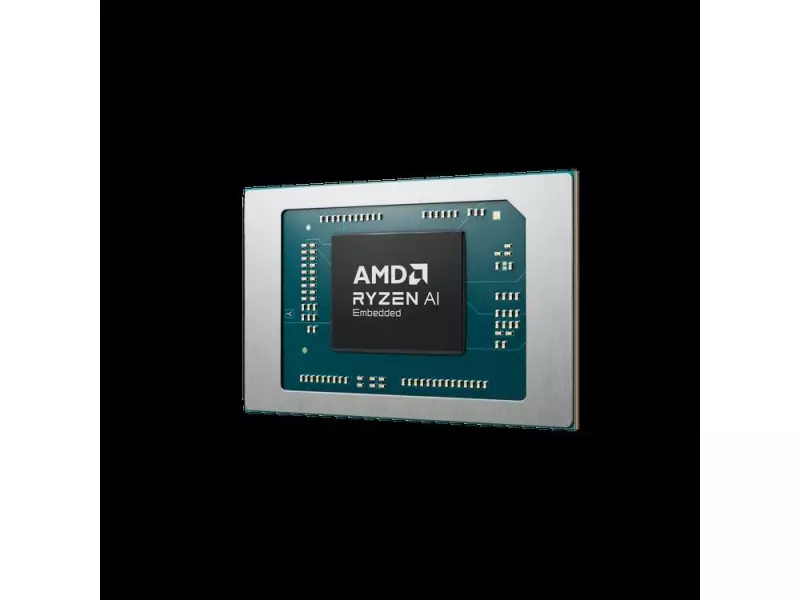
Santa Clara, California – In a significant move for the edge computing and artificial intelligence sectors, Advanced Micro Devices (AMD) announced the launch of its new Ryzen AI Embedded processor portfolio on January 5, 2026. Designed to bring powerful, integrated AI capabilities to constrained environments, these processors target next-generation applications in automotive, industrial automation, and physical AI systems like robotics.
A New Class of Integrated AI Processors
The newly unveiled portfolio consists of the Ryzen AI Embedded P100 and X100 Series. These are x86 processors that uniquely combine three core technologies into a single, compact chip: the high-performance "Zen 5" CPU architecture for control and general compute, an AMD RDNA 3.5 GPU for advanced graphics and visualization, and an AMD XDNA 2 Neural Processing Unit (NPU) dedicated to efficient, low-latency AI acceleration.
This integration is a direct response to industry demands for more immersive and intelligent experiences at the network's edge, where system complexity, power consumption, and physical space are critical constraints.

"As industries push for more immersive AI experiences and faster on-device intelligence, they need high performance without added system complexity," said Salil Raje, senior vice president and general manager of AMD Embedded. He emphasized that the new portfolio brings leadership CPU, GPU, and NPU capabilities together in one device to enable smarter, more responsive systems.
Targeting Automotive and Industrial Innovation
The P100 Series, which is available immediately, is purpose-built for applications like next-generation automotive digital cockpits and industrial human-machine interfaces (HMIs). Featuring 4 to 6 CPU cores, these processors are engineered to deliver real-time graphics for in-vehicle infotainment, enable AI-driven interactions, and ensure multi-domain responsiveness.
Key specifications for the P100 Series include:
- Up to a 2.2X improvement in multi-threaded and single-threaded performance over the previous generation.
- An integrated RDNA 3.5 GPU that provides an estimated 35% faster rendering, capable of driving up to four 4K displays or two 8K displays at 120 frames per second.
- A compact 25x40 mm BGA (ball grid array) package suitable for space-constrained designs.
- A wide operating range of 15 to 54 watts and support for extreme temperatures from -40°C to +105°C.
- Support for long 10-year lifecycles, crucial for automotive and industrial equipment.
The on-device AI acceleration, powered by the XDNA 2 NPU, is cited as delivering up to 50 AI TOPS (Tera Operations Per Second), enabling complex AI workloads to run locally without relying on cloud connectivity.
Powering the Future of Physical AI and Autonomy
For more demanding applications, the Ryzen AI Embedded X100 Series processors will offer higher CPU core counts and increased AI TOPS performance. This segment of the portfolio is aimed at advanced use cases in physical AI and autonomous systems, such as humanoid robots and other intelligent machines that require substantial local processing power for perception, decision-making, and control.
By consolidating high-performance compute, graphics, and dedicated AI acceleration into one energy-efficient chip, AMD is providing OEMs, tier-1 suppliers, and developers with a scalable solution. This architecture reduces system complexity, lowers latency, and minimizes power consumption—key factors for the success of AI at the edge.
The launch of the Ryzen AI Embedded portfolio marks AMD's strategic push to capture a growing market for intelligent edge devices. It positions the company as a direct competitor in providing the silicon backbone for the AI-driven transformation of vehicles, factories, and autonomous systems worldwide.