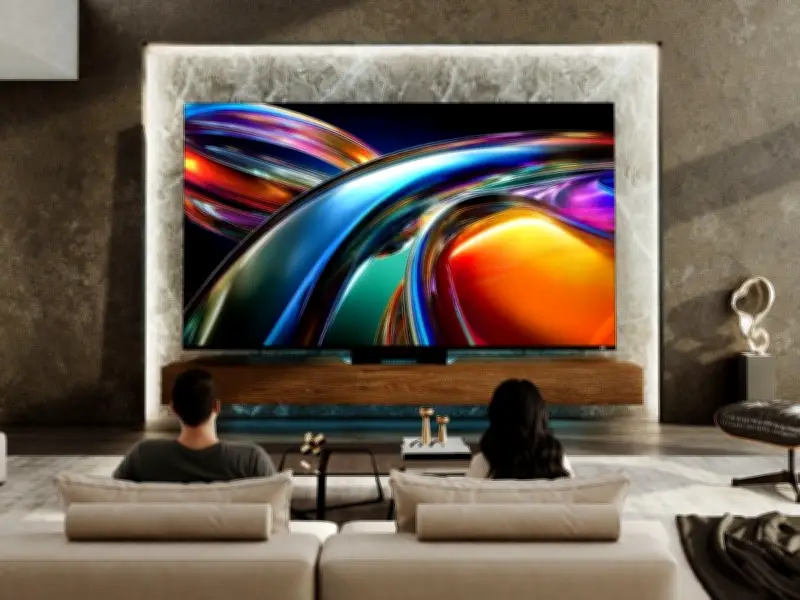
FIFA World Cup fever has taken over Canada and much of the world, and not surprisingly, many fans in the Great White North have upgraded their televisions for the festivities. This includes hosting watch parties, a much more affordable option than attending matches in person.
According to Best Buy Canada, TV sales are up more than 13% year-over-year in June, with a good number of those screens 70 inches and bigger – up 33% over the same period. “Fans clearly want a stadium-like experience at home, and hosting the World Cup in Canada for the first time is fuelling that excitement,” suggests Thomas Funk, Category General Manager and Director of Home Theatre at Best Buy Canada.
Speaking of size, perhaps it’s no coincidence that Hisense – the global leader in 100-inch-plus TVs – has been an official FIFA sponsor for the past eight years. Additionally, the television giant also serves as the official Video Assistant Referee (VAR) screen provider for the FIFA World Cup.

Bigger Screens and New Technology
Bigger screens are just one of the popular TV trends for sports lovers, says Funk. “There’s more at play, as many Canadians bought TVs during the pandemic and are now ready to upgrade, and today’s technology gives them a real reason to.” With that in mind, the following are a few features to look for in a new television – especially for footy fans.
RGB Technology
“RGB LED is the most significant leap in TV picture quality since OLED, and the hype is earned,” believes Funk. Traditional LED TVs use white backlights filtered through colour layers, which could limit accuracy and brightness. RGB televisions generate red, green, and blue light directly at the source – delivering purer colours, higher brightness, and better contrast. “The difference is visible to anyone,” continues Funk. “RGB LED looks stunning in any lighting condition, offers the broadest colour spectrum and handles HDR beautifully.”
“Hisense is the pioneer of RGB MiniLED technology,” maintains Puneet Jain, Senior Director of Marketing at Hisense Canada. “It redefines picture performance, delivering up to 100% BT.2020 colour coverage for richer, more lifelike colour and up to 8,000 nits of peak brightness.” RGB TVs today range in sizes from 50 to 115 inches, to suit varying needs and budgets.
120Hz Refresh Rate
A 120 Hertz refresh rate refers to TVs that update the image on the screen 120 times every second – doubling the speed of a standard 60-frames-per-second picture. This ensures smooth motion when watching fast-paced sports, action movies, and while playing video games. “Especially for sports viewing, you’ll definitely want a native 120 Hertz panel,” recommends Caleb Denison, a veteran tech journalist and host of the CalebRated YouTube channel. “The word ‘native’ is important here, as some manufacturers have fancy marketing words and ways to hedge the refresh rate, like higher multiples of 60, such as 480 or 960, but you then risk seeing that ‘soap opera’ effect, which can look artificial.”
On a related note, Denison says TVs with fast response times are also important for sports. “I would say OLED TVs are inherently better than LCD TVs here because they have near instant pixel response, taking zero time for the electrical stimulus for the pixels to light up or turn off, at least as far as the human eye can see. LCD takes a little bit longer, but OLED TVs tend to be more expensive, especially in larger sizes.”
“Televisions with higher refresh rates and response times mean sharper movement, faster response, smoother gameplay, and a more immersive next-generation viewing experience,” confirms Jain.

High Dynamic Range (HDR)
“HDR” is another ingredient in the jargon soup. Televisions with High Dynamic Range drastically improve picture fidelity as they reproduce a wider range of contrast and brightness levels, resulting in richer colour, too. “HDR is also an important consideration when looking for a new TV, but you need to do some homework to ensure it’s the real deal as TV brands tend to slap the word ‘HDR’ on anything,” cautions Denison. “These televisions may accept the metadata and process the HDR signal, but it might not have the brightness power to add meaning to it.” Denison says don’t expect TVs under $500 USD (about $700 Canadian) to deliver a “meaningful” HDR experience. You might also see more televisions branded with technologies like HDR10+ and Dolby Vision, which are two improved types of HDR.
Size vs. Quality
Unless you’ve got a sizable budget, Denison says you might need to decide between buying a bigger TV and a better TV – as the two may not be one in the same. “My last tip is to weigh size versus quality, as your money can go into one or the other but not necessarily both,” advises Denison, who has been reviewing televisions for 16 years. On the RGB hype, the YouTube star agrees “it’s true that RGB is the latest and greatest” and “has a lot of potential,” but he generally thinks it’s prudent to wait to invest in new technology as it improves over time – just as prices tend to drop. “For the hobbyists, the enthusiasts, they’re often not willing to wait.”
Other Considerations
A few additional thoughts for sports enthusiasts buying a new TV:
- Wide viewing angles are important, so there’s not a bad seat in the room. Visit a big box store to test before purchasing.
- Most TVs today will be “Smart TVs” and you really can’t go wrong with the integrated platform, such as Google TV, Amazon Fire TV, Roku, Samsung Tizen, LG webOS, and so on.
- Don’t forget about the importance of great audio. Budget permitting, consider pairing your new TV with a soundbar and subwoofer. Some retailers offer attractive bundle deals.
- Some retailers offer a second-year warranty on top of the manufacturer’s one-year warranty at no additional cost.
Marc Saltzman is the host of the Tech It Out podcast and author of the book Apple Watch For Dummies (Wiley).