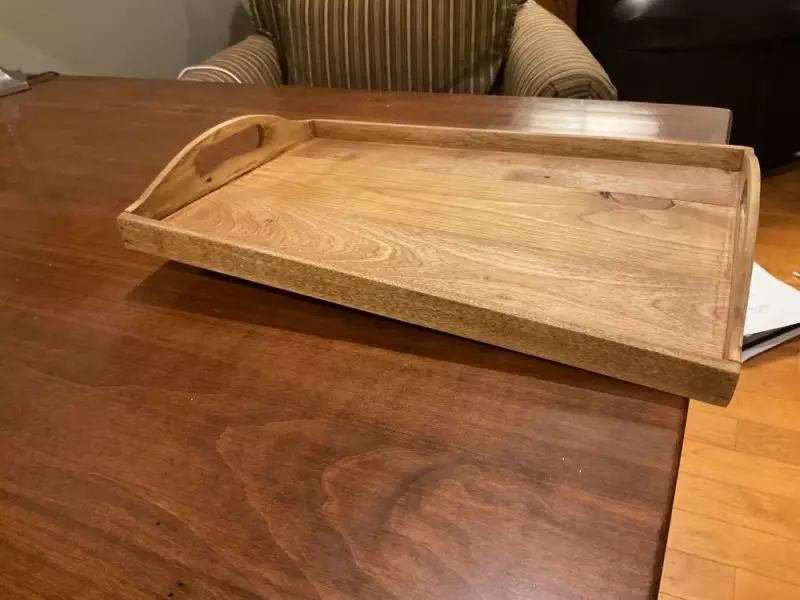
For Canadian DIY enthusiasts, few things are as frustrating as watching a carefully crafted project warp and twist after completion. This common issue, driven by Canada's dry winter indoor air, was at the heart of a recent question posed to home improvement expert Steve Maxwell.
The Problem of the Warped Wooden Tray
A reader contacted Maxwell about a wooden tray built from old pallets. The project was flat upon completion six months ago but had since warped so severely it became unusable. The culprit, as Maxwell explained, is unseen moisture within the wood that continues to escape in the arid indoor climate of a Canadian home during heating season.
Wood can feel dry to the touch during construction, but deep-seated moisture remains. As this moisture gradually leaves the wood fibers in a low-humidity environment, internal tensions change, causing the dramatic warping seen in the reader's photo.

A Steam-Based Solution for Severe Warping
Maxwell outlined a corrective process, though he cautioned it is tricky. The primary method involves using steam to soften the wood fibers, allowing them to be reshaped.
The first approach is to hold the warped tray over a pot of rapidly boiling water, moving it back and forth to evenly heat and soften the entire bottom surface. If that proves insufficient, a more involved method involves building a small enclosure to pipe steam directly onto the wood.
Once the wood is pliable, the key is to over-bend it in the opposite direction of the warp. The tray must then be held firmly in this over-corrected position using weights and props on a workbench. Maxwell advises leaving it clamped for a full week to dry and set.
Patience is critical. Success shouldn't be judged until at least a week after the weights are removed. The process may need to be repeated if the initial over-bending guess was incorrect.
Preventing Future Disappointments with Incremental Woodworking
Beyond the fix, Maxwell emphasized a proactive strategy he calls "incremental woodworking" to avoid such problems from the start. This method acknowledges that wood will move as it dies.
The technique involves allowing time for wood to acclimate and release moisture between major construction steps. After cutting, planing, or shaping components, Maxwell recommends letting them sit for several days with good air circulation. He often uses a room fan to speed the process.
The core principle is to bring wood down to its final shape and thickness only after it has fully dried and any potential distortion has already occurred. This slow, patient approach ensures stable and lasting projects.
Upgrading to a Smarter Home Heating Thermostat
In another query, a reader asked for a smart thermostat recommendation for a hot water (hydronic) home heating system. They sought Wi-Fi controls and a function to automatically exercise the system's pumps during summer to prevent seizing.
While noting he hasn't tested all brands, Maxwell shared positive personal experience with tekmar smart thermostat systems. He highlighted their anticipatory control feature, which learns how a room heats in relation to outdoor temperature.
Unlike standard thermostats that can overshoot the desired temperature by several degrees, Maxwell found the tekmar system maintains room temperature within a precise 0.5°C of the set point. It does this by shutting off heat early, knowing residual warmth in the radiators will carry the room to the perfect temperature.
For the pump exercise function, Maxwell noted this is typically handled by a separate controller module designed specifically for that maintenance task, which can be integrated into the system.
Steve Maxwell continues to explore and share insights on home systems that offer better performance, longevity, and ease of use. Homeowners can find more of his advice through his regular newsletter at BaileyLineRoad.com.