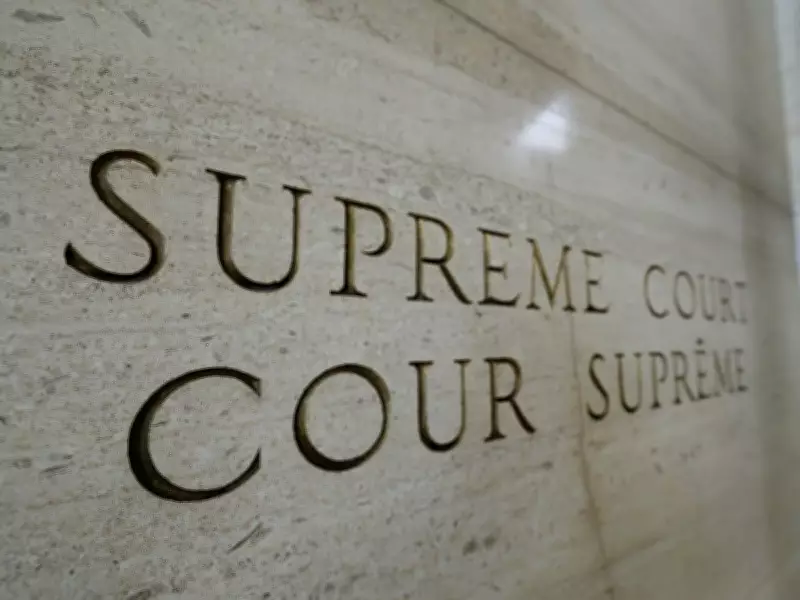
Federal government lawyers appeared before the Supreme Court of Canada this week, presenting arguments that challenge Quebec's utilization of the Constitution's notwithstanding clause in relation to Bill 21, the province's controversial secularism legislation. This legal maneuver represents a significant threat to the foundational balance of power within the Canadian federation, potentially centralizing authority in Ottawa at the expense of provincial autonomy.
The Core of the Constitutional Conflict
Bill 21, enacted in 2019, prohibits public servants including teachers, nurses, police officers, and government clerks from wearing religious symbols while performing their duties. Quebec's National Assembly strategically invoked Section 33 of the Constitution—the notwithstanding clause—to shield this legislation from challenges based on Charter rights violations. Without this constitutional protection, legal experts agree the law would likely be invalidated as a clear infringement on fundamental freedoms of expression and religion.
The federal government's intervention in this Supreme Court case reveals a broader strategic objective: weakening or eliminating the notwithstanding clause entirely. By challenging Quebec's use of Section 33 through this specific case, Ottawa seeks to establish judicial precedent that could restrict or nullify this crucial constitutional provision without requiring the complex and politically difficult process of formal constitutional amendment.

Historical Context and Constitutional Balance
The notwithstanding clause emerged from intense negotiations during Canada's constitutional repatriation under Prime Minister Pierre Trudeau. When Trudeau proposed including a Charter of Rights and Freedoms with expanded judicial review powers, eight provincial premiers—forming what became known as the Gang of Eight—demanded a counterbalance that would preserve legislative authority. Their insistence resulted in Section 33, which allows Parliament or provincial legislatures to override certain Charter rights for renewable five-year periods.
This constitutional compromise was essential to securing provincial agreement for the Charter itself. Without the notwithstanding clause, the Charter as we know it might never have been adopted. The provision represents a deliberate check on judicial power, ensuring that elected representatives retain ultimate authority over certain legislative matters.
Implications for Federal-Provincial Relations
If the Supreme Court accepts the federal government's arguments and restricts the notwithstanding clause's application, the consequences for Canadian federation would be profound. Provincial power to resist federal and judicial demands would be substantially diminished, creating a more centralized governance structure with increased authority concentrated in Ottawa. This shift would fundamentally alter the balance envisioned by Canada's constitutional framers.
Furthermore, such a ruling would elevate judicial authority to unprecedented levels, effectively making courts the final arbiters on numerous political and legal matters that currently fall within provincial jurisdiction. This judicial supremacy would represent a dramatic departure from Canada's constitutional tradition of balanced powers between legislative, executive, and judicial branches.
Contemporary Trends and Future Concerns
In recent decades, Canadian courts have increasingly utilized their review powers to strike down provincial legislation, a trend that has accelerated significantly over the past ten years. This pattern raises legitimate concerns about the erosion of provincial autonomy and the concentration of decision-making authority in judicial rather than elected hands.
The Carney government's determination to challenge the notwithstanding clause through this Supreme Court case demonstrates a clear political strategy to reshape Canada's constitutional landscape. By targeting Quebec's Bill 21—a particularly contentious piece of legislation—federal lawyers hope to achieve broader constitutional changes that would limit provincial powers across the country.

This constitutional confrontation occurs at a critical juncture for Canadian federation, testing the resilience of the delicate balance between federal and provincial powers that has defined Canada's governance structure for generations. The Supreme Court's eventual ruling will have far-reaching implications not only for religious freedom and secularism debates but for the fundamental architecture of Canadian federalism itself.