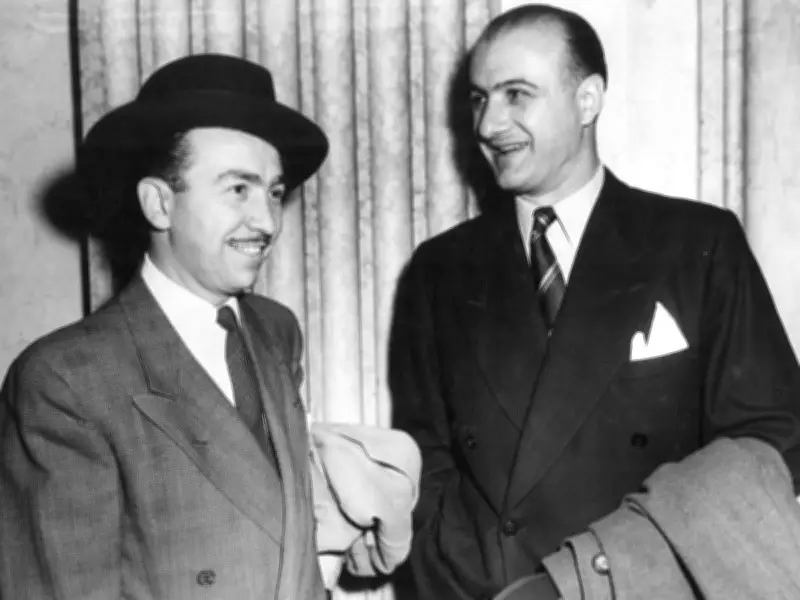
Montrealer Frank Roncarelli's Legal Triumph: A Gold Medal for Rule of Law
As Canadians eagerly follow Team Canada's performance in Milan, many are also reflecting on the enduring importance of the rule of law, especially in light of recent political turbulence south of the border. This principle, championed by leaders like King Charles and Prime Minister Mark Carney, has deep roots in Canadian history, with one Montrealer's story standing out as a pivotal moment.
The Unlikely Hero from Milan's Ice Rinks
Few Canadians realize that our nation's strong embrace of the rule of law can be traced back to the ice rinks of Milan a century ago. While today we cheer on stars like Sidney Crosby and Connor McDavid, in the 1920s, a Canadian named Frank Roncarelli was making his mark on HC Milan's hockey team. This experience would profoundly shape his worldview and, ultimately, transform Canadian law and politics.
Roncarelli was an unlikely figure to challenge the political establishment. Born to Italian immigrants who achieved economic success in Montreal, he attended prestigious institutions like Lower Canada College and McGill University, where he studied engineering and played hockey. After graduating in the mid-1920s, he moved to Italy for a decade, working as an engineer and playing for HC Milan and the Italian national team.

A Transformation in Fascist Italy
In 1934, Roncarelli received the Fascist regime's National Medal of Athletic Merit, awarded personally by Mussolini. However, the Fascist press in Milan viciously attacked him for being Canadian and for having his wife and son adopt Canadian citizenship, with one paper hoping the medal would "burn his chest." This hostile environment, coupled with the strong ties between the Catholic Church and Mussolini's regime, led Roncarelli to abandon his Catholic faith and become a Jehovah's Witness.
Returning to Montreal in the mid-1930s, Roncarelli operated a popular restaurant on Crescent Street. In Quebec, Jehovah's Witnesses were viewed as enemies of both the Church and the state under Premier Maurice Duplessis, who used the law to suppress their activities. As a man of means, Roncarelli posted bail for hundreds of his co-religionists, drawing Duplessis's ire.
The Legal Battle That Changed Canada
In retaliation, Duplessis instructed the provincial liquor commission to revoke Roncarelli's liquor licence. During a busy lunch hour in December 1946, agents stormed into the restaurant and announced the cancellation, leading to its closure within six months. Rather than accept defeat, Roncarelli took the surprising step of suing Duplessis for shutting his restaurant without sufficient legal basis.
Against all odds, this immigrant restaurateur triumphed over Quebec's most powerful man. In 1959, the Supreme Court of Canada ruled in Roncarelli's favour, proclaiming that even the premier was subject to the law. This landmark decision established Roncarelli's name as synonymous with the rule of law—the principle that all government actions must be authorized by law and that no one, regardless of power, is above it.
A Legacy for Today's Challenges
Roncarelli's contribution to Canadian democracy deserves a gold medal, as his case continues to resonate in an era where the rule of law is tested globally. His story, from the ice rinks of Milan to the courtrooms of Canada, serves as a powerful reminder of the importance of legal accountability. As Canadians watch the Olympics in Milan, they can draw inspiration from Roncarelli's courage, which provides a much-needed distraction from turbulent times and reaffirms our commitment to justice.
Adam Dodek is a professor of law at the University of Ottawa and the author of Constitutional Challengers: The Heroes, Villains, and Crusaders Behind Canada's Biggest Cases.