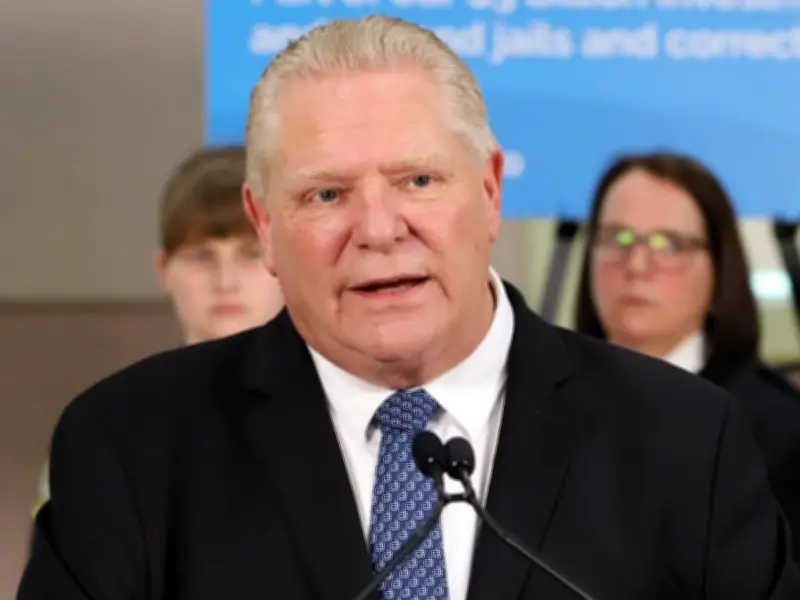
After years of merely speaking out against the federal government's gun buyback program, Ontario Premier Doug Ford is taking action. He is joining his counterparts in Alberta and Saskatchewan in challenging the program in court.
Ontario's Decision to Join the Legal Battle
Every provincial government except British Columbia and Quebec has refused to support the federal gun buyback program, citing its ineffectiveness. However, until recently, only Alberta and Saskatchewan were willing to take legal action. They asked the Supreme Court to declare the program unconstitutional. Ontario will now join them. The challenge was originally brought forward by the Canadian Coalition for Firearm Rights, which argues that the government overstepped its mandate by banning firearms through cabinet decree rather than federal legislation.
Announcing the Ford government's decision, Solicitor General Michael Kerzner made the province's stance clear. He stated, "The federal government's gun buyback program has done nothing to address the root causes of gun violence in our communities. We share the concerns raised by the Ontario Provincial Police on the federal government's approach to the gun buyback program. Local police resources should be focused on combating crime and keeping our communities safe — not attending residential addresses and confiscating firearms that were previously lawful but are now prohibited."

Key Problems with the Gun Buyback Program
There are two major issues with the federal government's gun buyback program. The first is its effectiveness. Clayton Campbell, president of the Toronto Police Association, said, "We know that the gun buyback program is going to have, essentially, zero impact on crime in Toronto." The same applies to crime across the country. As Mount Royal University Professor Doug King explained, "Individuals who have registered firearms are much less likely to commit criminal offences."
Canada's gun problem is primarily driven by illegal guns smuggled from the United States. Roughly 90% of guns involved in crime in Canada can be traced back to the U.S. Many of the remaining guns cannot be traced because their serial numbers have been removed. Thus, the percentage could be even higher. Illegal guns are the real issue. To solve gun violence, the federal government should focus on border enforcement and preventing smuggling, rather than targeting law-abiding gun owners who have owned their firearms for years, including thousands of models Ottawa suddenly declared illegal.
The National Police Federation, representing the RCMP, recognizes this. They stated that the buyback program "diverts extremely important personnel, resources and funding away from addressing the more immediate and growing threat of criminal use of illegal firearms."
Cost Concerns
The second major issue is cost. The federal government has already committed $742 million to the gun ban and confiscation scheme in the 2025 budget. However, Gary Mauser, professor emeritus from Simon Fraser University, estimates the cost could be closer to $6 billion. The federal government is running a deficit well over $60 billion and plans to continue deficit spending. There is no reason to waste billions on a program that infringes on Canadians' rights and that law enforcement says won't solve the problems Ottawa claims to address.
Ford is right to join Alberta Premier Danielle Smith and Saskatchewan Premier Scott Moe in challenging the program at the Supreme Court. If other premiers are wise, they should join the legal fight as well. It is time for Ottawa to focus on the real cause of gun violence—illegal guns—rather than going after law-abiding gun owners.