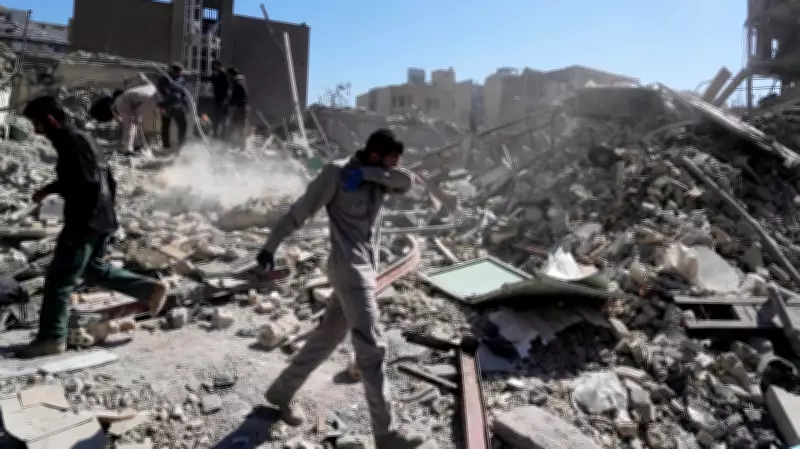
Iran Strikes US Embassy in Riyadh as US-Israel Airstrikes Pummel Iran
VIENNA (AP) — Iran targeted the United States Embassy in Saudi Arabia's capital with drones early Tuesday, igniting a limited fire and causing minor damage as retaliatory strikes continued across the region. Simultaneously, the United States and Israel conducted extensive airstrikes against Iranian targets, with President Donald Trump indicating this marked only the beginning of a campaign that could extend for over a month.
Embassy Attacks and Evacuations
According to Saudi Arabia's Defense Ministry, two drones struck the US Embassy in Riyadh, prompting the embassy to advise American citizens to avoid the compound. This assault followed an attack on the US Embassy in Kuwait, which announced its closure until further notice. The US State Department ordered the evacuation of non-emergency personnel and families from Kuwait, Bahrain, Iraq, Qatar, Jordan, and the United Arab Emirates as a precautionary measure.
Expanding Conflict and Casualties
The conflict has resulted in hundreds of fatalities, with the majority occurring in Iran. Explosions reverberated throughout Tehran overnight into Tuesday, accompanied by aircraft overhead, though specific targets remained unclear. The International Atomic Energy Agency reported that Iran's Natanz nuclear enrichment site sustained recent damage, though no radiological consequences are expected. This site was previously attacked by the US during the 12-day Iran-Israel war in June.

In Lebanon, Israel launched additional strikes against Hezbollah, an Iran-backed militia group, with explosions and smoke visible in a southern suburb of Beirut. Israel confirmed its soldiers were operating in southern Lebanon, while Lebanon's state-run news agency reported the army was evacuating some positions along the border.
Regional and Global Implications
The escalation of Iranian retaliation across the Gulf, combined with the intensity of US and Israeli attacks, the killing of Iranian Supreme Leader Ayatollah Ali Khamenei, and the absence of an exit strategy suggest a potentially prolonged conflict with far-reaching consequences. Iran has targeted numerous Middle Eastern countries deemed safe havens, including strikes on Amazon data centers in the UAE and Bahrain, energy facilities in Qatar and Saudi Arabia, and ships in the Strait of Hormuz. This critical waterway, through which a fifth of global oil trade passes, has seen closures threatened by Iranian officials, driving up oil and natural gas prices worldwide.
US Warnings and Military Strategy
The US State Department urged American citizens to leave more than a dozen Middle Eastern countries due to safety risks, though many remain stranded as airspace closures complicate departures. President Trump stated operations could last four to five weeks but emphasized readiness to extend further, boasting of a virtually unlimited supply of munitions and pre-positioned high-grade weaponry. He asserted that wars could be fought successfully using these resources indefinitely.
Casualty Reports and Military Actions
The Iranian Red Crescent Society reported at least 787 deaths from the US-Israeli operation, while 11 people were killed in Israel from Iranian missile strikes. In Lebanon, Israeli retaliatory strikes against Hezbollah resulted in 52 fatalities. The US military confirmed six American service member deaths in Kuwait, all Army soldiers from a logistics unit. Additional casualties included three in the UAE, and one each in Kuwait and Bahrain.
In a chaotic incident, Kuwait mistakenly shot down three American fighter jets during an Iranian attack, though all six pilots ejected safely, according to US Central Command.

Nuclear and Infrastructure Targets
Iranian state television reported explosions at a broadcasting facility in Tehran with no injuries. Reza Najafi, Iran's ambassador to the IAEA, stated that airstrikes targeted the Natanz nuclear enrichment site on Sunday, dismissing claims that Iran seeks nuclear weapons as false. Israel and the US have not acknowledged strikes at Natanz, but Israel has declared it is targeting Iranian leadership and nuclear infrastructure. Trump outlined objectives to destroy Iran's missile capabilities, eliminate its navy, prevent nuclear weapon acquisition, and curb support for groups like Hezbollah.
Proxy Forces and Regional Spread
The conflict has drawn in proxy forces, with Hezbollah firing missiles at Israel on Monday, prompting Israeli retaliation. Lebanon reported at least 52 deaths and 154 injuries. Israel conducted airstrikes in Beirut targeting Hezbollah command centers and weapons storage, while Hezbollah launched drones at an Israeli air base, two of which were downed. An Iranian-linked militant in Iraq claimed strikes on US military facilities, and Israeli troops maintained a forward defense posture in southern Lebanon.
Contributions to this report came from David Rising in Bangkok, Melanie Lidman in Tel Aviv, Hallie Golden in Seattle, Giovanna Dell'Orto in Miami, with additional reporting from Athens and Cairo.