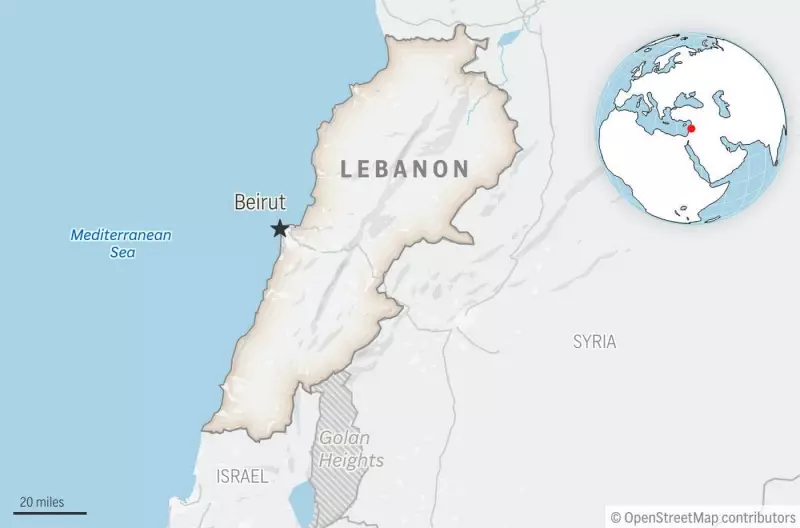
Israeli military forces launched targeted strikes against positions belonging to the militant groups Hezbollah and Hamas in Lebanon on Monday, January 5, 2026. The operation, confirmed by international reports, comes at a moment of heightened regional tension, directly preceding a key meeting focused on disarmament efforts in the volatile area.
Details of the Military Operation
The strikes, which occurred in the afternoon hours, targeted what Israeli officials described as operational infrastructure used by both Hezbollah and Hamas. While the exact locations within Lebanon were not fully disclosed in initial reports, the action represents a significant escalation. The timing is particularly critical, as it unfolds just ahead of a scheduled high-level diplomatic meeting intended to address weapons proliferation and militia disarmament in the region.
The date, January 5, 2026, marks a pivotal moment in ongoing cross-border hostilities. Israel has long considered Hezbollah, which is based in Lebanon and backed by Iran, as one of its most formidable adversaries. Hamas, the Palestinian group governing Gaza, also maintains some presence and support networks in Lebanon. Simultaneously targeting both groups signals a broad Israeli security calculus aimed at neutralizing perceived immediate threats.

Context and Rising Tensions
This military action did not occur in a vacuum. The region has experienced a steady simmer of violence and political deadlock for years. The planned disarmament meeting, now overshadowed by these strikes, was seen by some international observers as a fragile opportunity to de-escalate tensions and discuss a pathway toward greater stability.
By choosing to act just before this diplomatic gathering, Israel has dramatically altered the backdrop for talks. The move will likely compel participants to address the fresh hostilities immediately, potentially diverting the agenda from longer-term disarmament goals to crisis management. The Israeli government has historically stated that it reserves the right to defend its sovereignty and citizens from any threat, a principle it cites to justify preemptive and retaliatory strikes.
Potential Consequences and Regional Impact
The immediate consequence of these strikes is a severe increase in the risk of a wider conflict. Both Hezbollah and Hamas are expected to respond, though the scale and timing of any retaliation remain uncertain. Past exchanges have involved rocket fire into northern Israel and Israeli airstrikes deep within Lebanese territory.
For the people of Lebanon, already grappling with profound economic and political crises, this new military action spells further instability. The nation's capital, Beirut, and surrounding areas could once again become focal points in a conflict that extends beyond its borders. The international community, including key players involved in the upcoming meeting, now faces the urgent task of preventing a localized strike from spiraling into a full-scale war.
Furthermore, this development complicates the diplomatic landscape. The disarmament meeting's original purpose—to negotiate the scaling back of militant capabilities—may now be viewed as unrealistic or secondary by parties directly involved in the fresh fighting. Trust, a scarce commodity in the region, has been further eroded.
As of January 5, 2026, the situation remains fluid. The world watches to see if the planned diplomatic channel can withstand this new wave of violence or if the region is poised for another protracted period of conflict. The coming hours and days will be crucial in determining whether the path leads back to the negotiation table or toward a more dangerous and expansive confrontation.