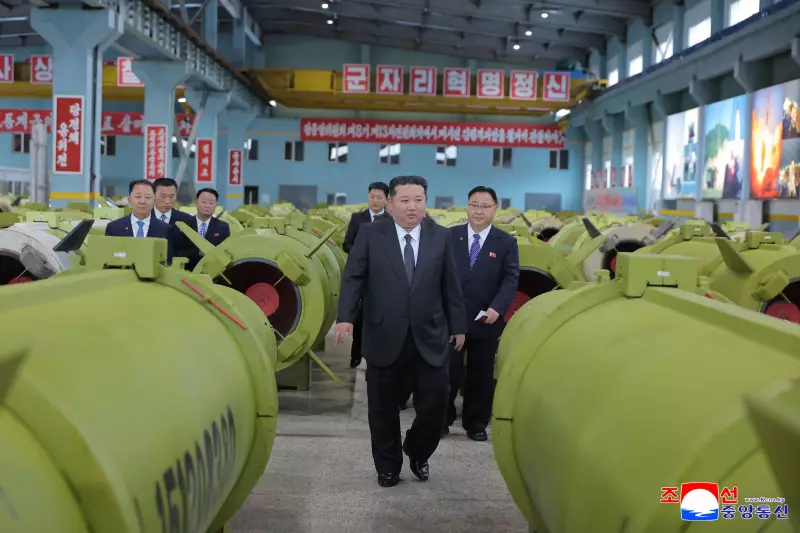
North Korea has carried out a test launch of long-range cruise missiles, the country's state media confirmed on Sunday, December 28, 2025. The announcement marks the latest in a series of weapons tests conducted by the isolated regime, continuing a pattern of military development that has drawn international concern.
Details of the Missile Test
The test-firing was reported by the official Korean Central News Agency (KCNA). While specific details regarding the number of missiles fired, their exact flight path, and the launch location were not fully disclosed in the initial report, the classification as "long-range" suggests a weapon system with significant operational reach.
The timing of the test follows closely on the heels of a related state media release. On Friday, December 26, 2025, KCNA published undated photographs showing North Korean leader Kim Jong Un inspecting missile and shell production at an undisclosed factory within the country. The imagery served as a public display of the regime's ongoing commitment to advancing its military capabilities.

Context and Regional Implications
This latest missile test contributes to an increasingly tense security environment in Northeast Asia. North Korea has consistently pursued the modernization and expansion of its arsenal, which includes ballistic missiles, cruise missiles, and other strategic weapons, despite multiple United Nations Security Council resolutions imposing sanctions.
Long-range cruise missiles pose a distinct challenge for regional defense systems. Unlike ballistic missiles, which follow a high, arching trajectory, cruise missiles fly at lower altitudes and can maneuver, making them potentially more difficult to detect and intercept. The development of such systems enhances North Korea's ability to project power and threaten targets across the region.
International Response and Analysis
While an immediate official reaction from allied governments such as the United States, South Korea, and Japan was not included in the initial report, such tests typically prompt strong condemnation and calls for renewed diplomatic efforts. Analysts monitor these tests to gauge technological progress in North Korea's weapons programs and to assess potential shifts in the regime's strategic posture.
The test underscores the persistent challenges in achieving denuclearization and lasting peace on the Korean Peninsula. It serves as a stark reminder of the complex geopolitical dynamics that continue to define the region, where military posturing and diplomatic stalemates often intersect.
International observers and intelligence agencies will be scrutinizing the data from this launch to better understand the performance parameters and capabilities of this specific missile system, informing future security assessments and policy responses.