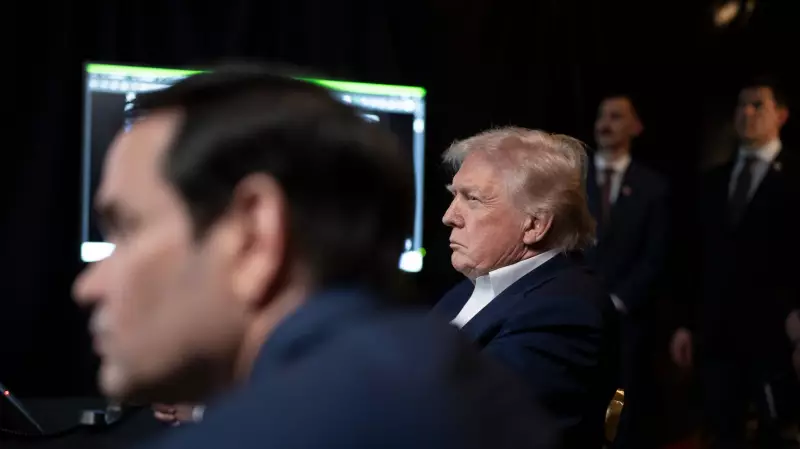
In the wake of a bold U.S. military operation in Venezuela, President Donald Trump has dramatically escalated his administration's rhetoric across the Western Hemisphere, renewing controversial calls for the United States to assume control of Greenland and issuing stark warnings to the governments of Colombia and Cuba.
Hemispheric Strategy Takes Assertive Turn
The comments from Trump and Secretary of State Marco Rubio, following the ouster of Venezuela's Nicolás Maduro, signal a clear intent for a more expansive and forceful U.S. role in the region. This approach, outlined in last month's National Security Strategy, aims at restoring "American preeminence in the Western Hemisphere" as a central goal for Trump's potential second term.
Trump has pointedly referenced historical justifications like the 19th-century Monroe Doctrine and the Roosevelt Corollary to support his assertive stance. He has even joked that some now call it the "Don-roe Doctrine." This posture, featuring thinly veiled threats, is unsettling both allies and adversaries, raising a global question: Who might be next?

Greenland in the Crosshairs, Denmark Pushes Back
On Sunday, while returning to Washington from Florida, Trump intensified his long-standing interest in Greenland, a vast, mineral-rich Danish territory. He framed the potential acquisition as a critical national security need, citing the presence of Russian and Chinese ships.
"We need Greenland from the standpoint of national security, and Denmark is not going to be able to do it," Trump told reporters. He mockingly dismissed Denmark's security efforts in Greenland, saying they had added "one more dog sled" to the territory's arsenal.
Danish Prime Minister Mette Frederiksen responded firmly, stating Trump has "no right to annex" Greenland and reminding him of existing NATO security agreements that already grant the U.S. broad access. "I would therefore strongly urge the U.S. to stop threatening a historically close ally," she said.
Tensions were further inflamed by a social media post from former Trump official Katie Miller, which showed an illustrated map of Greenland in American colours with the caption "SOON." Denmark's ambassador to Washington, Jesper Møller Sørensen, publicly demanded "full respect for the territorial integrity of the Kingdom of Denmark."
Trump's focus on Greenland was recently highlighted by his announcement to appoint Louisiana's Republican Governor, Jeff Landry, as a special envoy to the territory. Landry stated he would help Trump "make Greenland a part of the U.S."
Warnings to Cuba and Colombia Escalate
The administration also turned its attention to Venezuela's allies. Secretary of State Marco Rubio delivered a stern warning to Cuba's communist government, which he declared is "in a lot of trouble." He alleged that Cuban bodyguards, not Venezuelans, protected Maduro and managed internal intelligence for his government.
The Cuban government stated that 32 of its officers were killed in the U.S. operation in Venezuela. Trump predicted Cuba's economy, already battered by the U.S. embargo, would decline further without subsidized oil from Maduro. "It's going down for the count," he said.
Trump also directly threatened Colombia and its leftist President, Gustavo Petro. He accused Colombia of being "run by a sick man who likes making cocaine and selling it to the United States." When asked if he might order a U.S. operation against Colombia, Trump replied, "It sounds good to me."
The Trump administration imposed sanctions on Petro and his associates in October over alleged drug trade involvement. In a significant move last September, the U.S. added Colombia, a top aid recipient, to a list of nations failing to cooperate in the drug war for the first time in nearly 30 years, leading to slashed American assistance.
This multi-front pressure campaign underscores a sharp and confrontational shift in U.S. policy towards its neighbours, blending historical doctrine with modern-day threats and creating profound diplomatic unease from the Arctic to the Caribbean.