In a bold move to arrest Venezuela's leader, President Donald Trump has demonstrated a willingness to assert American dominance in its own hemisphere. This action, which Trump himself linked to a revitalized Monroe Doctrine, sends a powerful message not only to Latin America but to global rivals Russia and China, who are observing the precedent it sets for unilateral intervention.
The 'Donroe Document' and a Renewed Doctrine
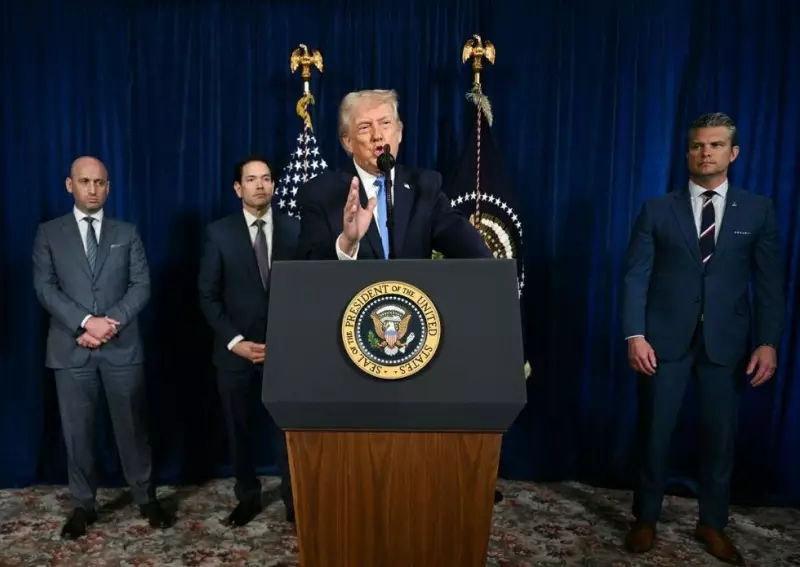
Following the operation aimed at seizing leftist President Nicolas Maduro, Trump invoked the 1823 Monroe Doctrine, a policy declaring Latin America off-limits to European colonization. He claimed to have "superseded" it, jokingly dubbing it the "Donroe document." The core message was unequivocal: "American dominance in the Western Hemisphere will never be questioned again." This rhetoric was prefigured in a White House national security strategy outlining a "Trump Corollary," authorizing U.S. intervention in the region for objectives ranging from seizing strategic assets to combating crime and migration.
The justification for the Venezuela raid cited the country's vast oil reserves—the world's largest—and allegations of drug-smuggling involving Maduro. China, as Venezuela's top oil partner, has a direct stake in the outcome. The raid occurred shortly after China conducted major military exercises simulating a blockade of Taiwan, with a Chinese envoy having met Maduro just hours before his capture.

A Precedent for Global Powers
Analysts warn that the U.S. action establishes a concerning precedent that other major powers could exploit. Military analyst Jennifer Kavanagh of Defense Priorities posed a critical question: "If the U.S. can declare a leader illegitimate, go and remove him and then run the country, why can't other countries?"
This concern is not abstract. Russia's President Vladimir Putin invaded Ukraine in 2022 after challenging its sovereignty and vowing to remove its elected leader. Similarly, China has consistently refused to renounce the use of force to bring Taiwan under its control and asserts expansive claims in the South China Sea. The U.S. maneuver in Venezuela provides a contemporary case study in power projection that these rivals are sure to analyze.
Shifting Superpower Dynamics and Allied Anxiety
Trump's intervention also alarms U.S. allies, following a pattern of threats over resources he deems strategic. He recently appointed an envoy openly discussing the seizure of Greenland, an autonomous Danish territory, and has mused about taking back control of the Panama Canal.
Kavanagh noted that while she once dismissed talk of taking Greenland, the Venezuela operation gave her pause. "It wouldn't be that hard for the U.S. to put a couple hundred or a couple thousand troops inside of Greenland, and it's not clear to me who could do anything about it," she stated, highlighting the raw power dynamic now in play.
The event, dated to early January 2024, underscores a volatile moment in international relations. It tests the limits of U.S. power under the Trump administration while offering a potential blueprint for other nations to follow in their own spheres of influence, fundamentally challenging norms of sovereignty and intervention.