U.S. and Israel Intensify Airstrikes on Iranian Capital and Cities
The United States and Israel launched a series of airstrikes on Wednesday, targeting Iran's capital, Tehran, and multiple other cities. This marks the fifth day of the ongoing conflict between the nations, with Israel focusing on Iranian leadership and security forces. In response, Iran unleashed missile barrages and drone attacks against Israel and various locations across the region.
Dawn Blasts and Destruction in Tehran
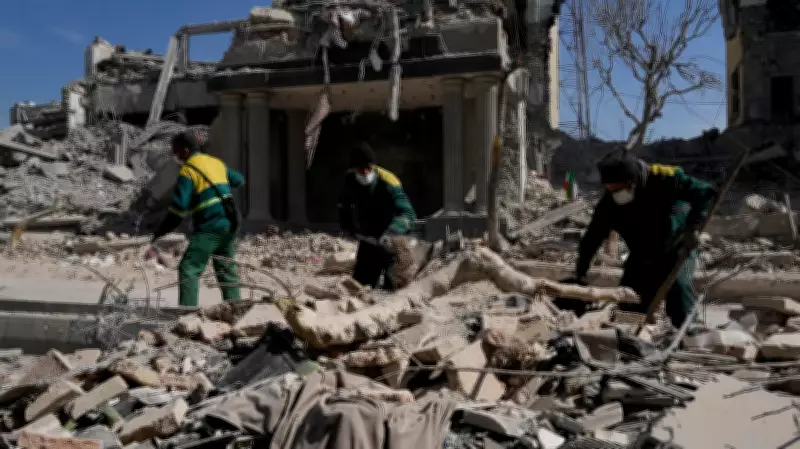
Residents in Tehran were awakened by early morning explosions, as Iranian state television broadcast images of ruined buildings in the city center. The strikes also hit the Shiite seminary city of Qom and several other urban areas. Workers were seen clearing rubble from a police facility damaged in the U.S.-Israeli military campaign.
With fighter jets roaring overhead, anxiety gripped those remaining in Tehran. A local clothing shop owner, speaking anonymously due to fears of reprisals, expressed his dilemma: "If I leave the city, how am I supposed to earn money and survive?"

Military Engagements and Regional Impact
The Israeli military reported that an F-35 stealth fighter jet shot down a piloted Iranian Air Force YAK-130 fighter over Tehran. Israeli air defenses were activated to intercept Iranian missiles aimed at targets around the country, with explosions heard near Jerusalem.
In a separate incident, an Iranian naval frigate was reported in distress off the coast of Sri Lanka. Sri Lankan authorities responded, rescuing 32 people, though the fate of the ship and its total crew remains unclear.
Economic and Infrastructure Fallout
Iran's control over tanker movement through the Strait of Hormuz, a critical chokepoint for about one-fifth of global oil shipments, has driven Brent crude prices to $84 a barrel. This represents a more than 15% increase since the conflict began, reaching the highest level since July 2024.
Global stock markets have suffered due to concerns that rising oil prices could stifle the world economy and erode corporate profits. Iran has also targeted regional infrastructure, with Saudi Arabia reporting another drone attack on its Ras Tanura oil refinery, one of the world's largest. The Saudi oil ministry stated the latest attack caused no damage and did not affect supplies.
Diplomatic and Security Developments
The American Embassy in Saudi Arabia and the U.S. Consulate in the United Arab Emirates faced drone attacks on Tuesday. In response, the U.S. State Department authorized the evacuation of non-emergency government personnel from Saudi Arabia.
U.S. Navy Admiral Brad Cooper, head of U.S. Central Command, disclosed that Iran has launched over 500 ballistic missiles and 2,000 drones so far. "We've already struck nearly 2,000 targets, with more than 2,000 munitions. We have severely degraded Iran's air defenses and destroyed hundreds of Iran's ballistic missiles, launchers and drones," Cooper said in a prerecorded message.
Escalating Attacks and Casualties
Five days into the conflict, nearly 800 people have been killed in Iran, including individuals U.S. President Donald Trump mentioned as potential future leaders. Air sirens sounded in Bahrain, home to the U.S. Navy's 5th Fleet, and Qatar's Ministry of Defense reported Iran launched two ballistic missiles, one hitting Al-Udeid Qatari Base without causing casualties.
Lebanon experienced multiple strikes, with Israel retaliating against Hezbollah militants after the Iran-backed group fired on Israel. Lebanese state media said at least five people were killed in an Israeli strike on a residential complex in Baalbeck, bringing the total to over 50 deaths and 300 injuries in Lebanon, according to the Health Ministry.
Leadership Targeting and Internal Strife
Initial U.S.-Israeli strikes killed Iranian Supreme Leader Ayatollah Ali Khamenei, though senior U.S. officials later clarified that regime change was not the goal. Trump suggested that "someone from within" the Iranian regime might be the best choice to assume power post-conflict.

Israeli Defense Minister Israel Katz warned that whoever Iran selects as the next supreme leader will be "a target for elimination." The Israeli military also struck buildings in Tehran linked to the Basij, the volunteer force of Iran's Revolutionary Guard involved in crackdowns on protesters.
Iran's judiciary chief, Gholam Hosseini Mohseni Ejehei, threatened supporters of the U.S.-Israeli campaign, stating they are "on the enemy's side and must be dealt with on revolutionary, Islamic principles." Iran's leaders are now scrambling to replace Khamenei, with his son Mojtaba Khamenei among possible candidates.
Humanitarian Toll and International Response
The Red Crescent Society reports at least 787 deaths in Iran from the strikes, while 11 people have been killed in Israel. Kuwait confirmed an 11-year-old girl died from falling shrapnel during interceptions of hostile aerial targets, with additional fatalities in the United Arab Emirates and Bahrain. Six U.S. Army Reserve soldiers were killed in a drone strike on a command center in Kuwait.
The conflict's spiraling nature raises urgent questions about its conclusion, as both sides continue unrelenting attacks with no immediate end in sight.