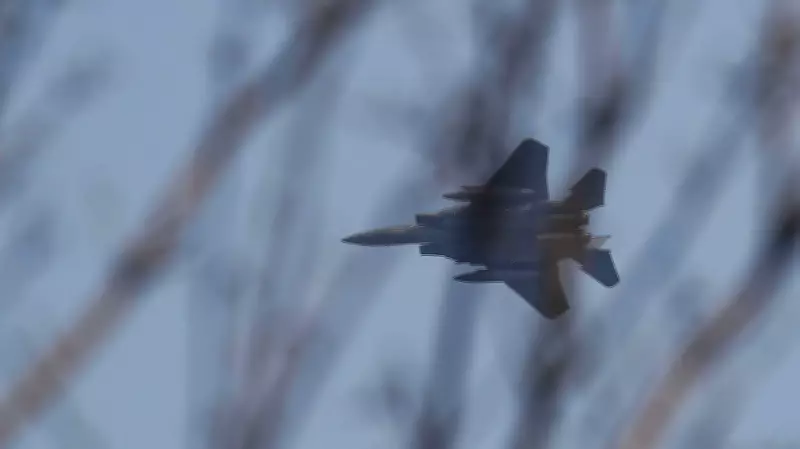
Missing U.S. Service Member Rescued After Iran Downs Fighter Jet
WASHINGTON (AP) — A U.S. service member who had been missing since Iran shot down a fighter jet has been successfully rescued, according to two U.S. officials who spoke early Sunday on condition of anonymity ahead of an official announcement. This development follows a frantic search-and-rescue operation that unfolded after the crash of the U.S. F-15E Strike Eagle on Friday.
Escalating Conflict and Rescue Efforts
The crew member had been missing since Friday, when Iran downed the U.S. F-15E Strike Eagle, marking the first U.S. aircraft to crash in Iranian territory since the conflict began in late February. A second crew member from the same aircraft was rescued earlier. The search operation focused on a mountainous region in Iran’s southwestern province of Kohgiluyeh and Boyer-Ahmad, with Iran even offering a reward for anyone who turned in the "enemy pilot."
In a separate incident, a second U.S. Air Force combat aircraft, an A-10 attack aircraft, also went down in the Middle East on Friday. The status of its crew and the exact location of the crash remain unknown, with conflicting reports on whether it was shot down or crashed, and if Iran was involved. Iranian state media claimed it was struck by Iran’s defense forces and crashed in the Persian Gulf.

Broader War Context and Threats
The war, which began with joint U.S.-Israel strikes on Feb. 28, has resulted in thousands of deaths, shaken global markets, cut off key shipping routes, and spiked fuel prices. Both sides have targeted civilian infrastructure, raising warnings of possible war crimes. President Donald Trump recently stated that the U.S. had "decimated" Iran and would finish the war "very fast," but Iran's ability to shoot down U.S. military planes demonstrates ongoing perils.
Trump renewed threats on Saturday, demanding Iran open the Strait of Hormuz—a crucial waterway for global energy shipments blocked by Tehran—by Monday or face "devastating consequences." In response, Gen. Ali Abdollahi Aliabadi of Iran’s joint military command warned that "the doors of hell will be opened" if U.S. infrastructure is attacked, threatening all U.S. military assets in the region.
Diplomatic Moves and Regional Tensions
Amid the hostilities, diplomatic efforts are underway. Pakistan’s Foreign Ministry spokesperson, Tahir Andrabi, indicated that efforts to broker a ceasefire are "right on track," with Pakistan set to host talks between the U.S. and Iran. Iran’s foreign minister, Abbas Araghchi, confirmed willingness to engage, and mediators from Pakistan, Turkey, and Egypt are working to bring both sides to the negotiating table. A proposed compromise includes a cessation of hostilities to allow a diplomatic settlement.
Iran’s parliamentary speaker, Mohammad Bagher Qalibaf, issued a veiled threat to disrupt traffic through the Bab el-Mandeb Strait, another strategic waterway linking the Red Sea with the Gulf of Aden and the Indian Ocean, through which over a tenth of global oil shipments pass.
Casualty Toll and Regional Impact
The conflict has inflicted significant casualties: more than 1,900 people killed in Iran, over two dozen in Gulf Arab states and the occupied West Bank, 19 in Israel, 13 U.S. service members, and more than 1,400 in Lebanon with over 1 million displaced. Ten Israeli soldiers have also died in Lebanon.
Reporting contributions came from Jon Gambrell in Dubai, Samy Magdy in Cairo, and others in Islamabad, Tallinn, and Washington, highlighting the international scope of this ongoing crisis.