The United States military announced on Tuesday that it executed targeted strikes on three vessels allegedly involved in drug smuggling operations within Latin American waters, resulting in the deaths of eleven individuals. This incident marks one of the deadliest episodes in the Trump administration's ongoing, months-long campaign against suspected traffickers, which it labels as "narcoterrorists."
Escalating Campaign Against Traffickers
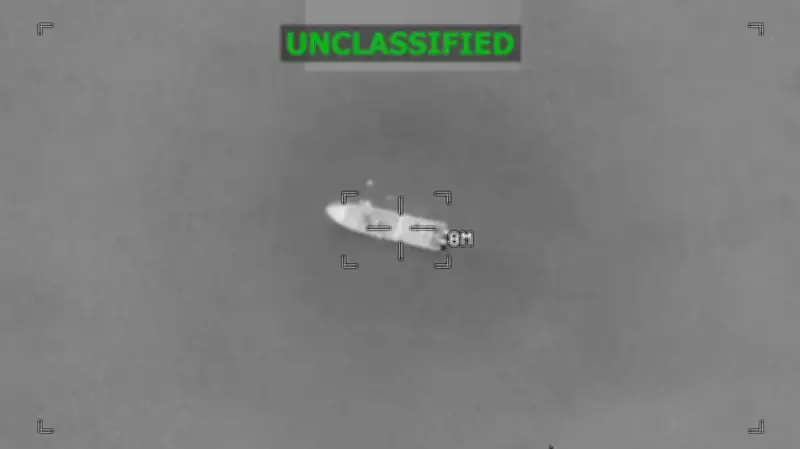
The series of strikes, carried out on Monday, has elevated the total death toll to a minimum of 145 people since the administration initiated its offensive against small vessels in early September. According to U.S. Southern Command, the military targeted alleged drug traffickers along established smuggling routes, consistent with most of the 42 known strikes documented thus far. Specifically, two vessels, each carrying four people, were struck in the eastern Pacific Ocean, while a third boat with three individuals was hit in the Caribbean Sea.
While the military did not provide direct evidence that the vessels were transporting drugs, it posted videos on the social media platform X, showcasing the boats being destroyed. The footage depicts the vessels either in motion or stationary on the water before explosions engulf them in flames. In two of the small, open boats, people are visible prior to their destruction.

Political and Legal Controversies
President Donald Trump has asserted that the United States is engaged in an "armed conflict" with cartels in Latin America, defending the attacks as a necessary escalation to curb drug flow. However, critics have raised significant concerns regarding the legality and effectiveness of these strikes. They argue that much of the fentanyl responsible for fatal overdoses in the U.S. is typically trafficked over land from Mexico, where it is produced using chemicals imported from China and India, questioning the strategic impact of targeting maritime routes.
The boat strikes have also faced intense scrutiny following revelations that the military killed survivors of an initial boat attack with a subsequent strike. The Trump administration and numerous Republican lawmakers have justified these actions as legal and essential, whereas Democratic lawmakers and legal experts have condemned them as potential murder or war crimes.
Broader Military Buildup and Regional Implications
These attacks are part of a larger military buildup in Latin America, one of the most significant in generations, which culminated in the capture of former Venezuelan President Nicolás Maduro. Following a raid by American forces on January 3, Maduro was brought to the United States to face drug trafficking charges. In the aftermath, the U.S. military has reported several additional boat strikes and seized oil tankers linked to Venezuela, as part of broader efforts to assert control over the country's oil resources.
Simultaneously, geopolitical tensions have influenced naval deployments. The world's largest aircraft carrier, the USS Gerald R. Ford, was ordered to the Caribbean late last year but was recently redirected to the Middle East amid growing tensions between the U.S. and Iran. According to a Navy official speaking anonymously due to the sensitivity of ship movements, the Ford and three accompanying destroyers were in the mid-Atlantic on Tuesday, no longer within U.S. Southern Command's operational area. It will join other U.S. warships, including the USS Abraham Lincoln aircraft carrier, in the Middle East.
In Congress, Republicans have successfully thwarted Democratic-led initiatives aimed at restricting President Trump's authority to conduct further attacks in Venezuela, highlighting the deep political divisions surrounding this aggressive military strategy.