U.S. Torpedo Attack on Iranian Frigate Raises Geneva Convention Concerns
The United States Navy's torpedoing of an Iranian frigate off the coast of Sri Lanka this week has ignited a significant debate over potential violations of the Geneva Conventions. Legal experts argue that the failure to assist sailors from the stricken warship could endanger American service members in current and future conflicts, setting a dangerous precedent in international warfare.
The Attack and Immediate Aftermath
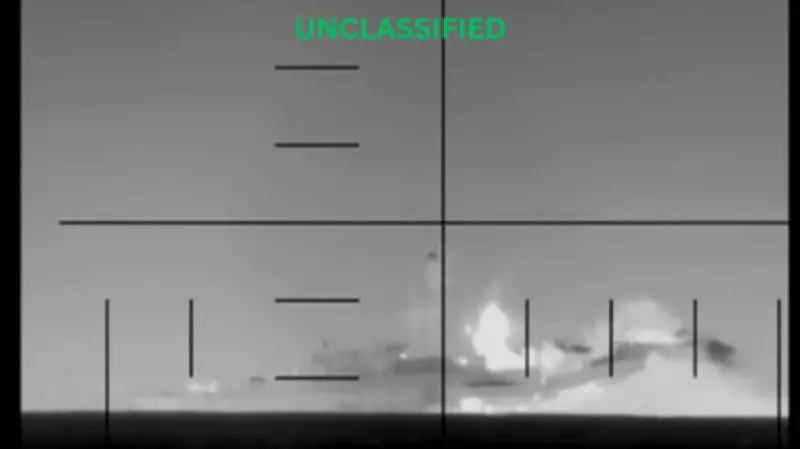
The 312-foot Iranian frigate Dena, carrying 130 crew members including many musicians from the Iranian navy band, had just completed participation in an Indian government naval exercise and cultural exchange. The U.S. Navy had also participated in this multinational event. On Wednesday, as the vessel was returning home after clearing Sri Lankan waters, it was struck by a torpedo fired from a U.S. Navy submarine approximately 20 miles from the island's southern tip.
The weapon appears to have ruptured the hull from beneath, causing the warship to sink rapidly. Notably, the attacking submarine did not attempt to rescue Iranian sailors who found themselves in the water following the explosion and sinking.

Official Responses and Legal Implications
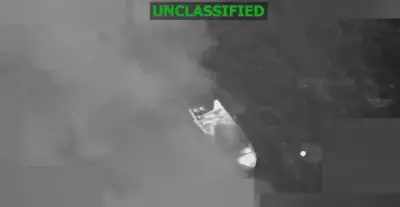
White House press secretary Karoline Leavitt publicly highlighted how this attack marked the first American use of a torpedo to sink a ship since World War II. Defense Secretary Pete Hegseth adopted a similarly triumphant tone while narrating video footage of the incident, stating, "An American submarine sunk an Iranian warship that thought it was safe in international waters. Instead, it was sunk by a torpedo. Quiet death."
Hegseth had previously mocked what he called "stupid rules of engagement" designed to limit civilian casualties and prevent actions that could constitute war crimes.
"There is an affirmative duty to rescue under the Geneva Conventions," emphasized Mark Nevitt, a former Navy lawyer in the judge advocate general corps who now serves as a law professor at Emory University. He and other legal specialists warn that disregarding these and other established rules invites potential mistreatment or even death to Americans who might become shipwrecked or captured in future engagements.
Geneva Convention Requirements
The Geneva Conventions, established in 1949 to govern international armed conflict, explicitly state that following naval engagements, "parties to the conflict shall, without delay, take all possible measures to search for and collect the shipwrecked, wounded and sick, to protect them against pillage and ill-treatment, to ensure their adequate care, and to search for the dead and prevent their being despoiled."
After sinking the Dena, however, the attacking submarine appears to have taken none of these required actions, instead leaving Sri Lankan authorities to find survivors and recover the bodies of those killed. It took at least one hour for Sri Lankan rescuers to arrive at the scene, and it remains unknown how many of the 87 confirmed dead might have survived if the U.S. submarine had surfaced to assist as the Iranian frigate was sinking.
Legal Analysis and Military Practicalities
Laurie Blank, another international law professor at Emory University, clarified that the rescue obligation applies to submarines as well. Even if the submarine lacked the capacity or space to care for shipwrecked sailors, the crew still had an obligation to take whatever possible measures to save lives.
"This rule reflects and maintains the long-standing customary duty to rescue and save lives at sea," Blank explained. "In such case, taking all possible measures would mean that the submarine should pass the location of possible survivors to other vessels, aircraft or coastal facilities that are able to render assistance, or at a minimum to higher headquarters, at the earliest possible moment."
When questioned about the submarine's actions, a Defense Department spokesman responded, "We're not going to discuss operational details regarding the submarine or actions following the engagement. Sri Lankan authorities responded promptly to distress signals from the vessel and conducted search and rescue operations that recovered survivors. We defer to the government of Sri Lanka for additional details regarding those efforts."

The Submarine Dilemma
The U.S. Navy's own "Handbook on the Law of Naval Operations" largely echoes the Geneva Conventions language but includes an important caveat: "As far as military exigencies permit, after each engagement all possible measures should be taken without delay to search for and collect the shipwrecked, wounded, and sick and recover the dead."
Nevitt suggested this clause, "as far as military exigencies permit," could potentially be used by the Navy to justify the submarine's failure to participate in rescue operations.
Submarines present unique challenges in such situations. While virtually undetectable underwater, they become uniquely vulnerable to attack when surfacing. Their limited deck space and relatively small size also make them poorly suited for search and rescue missions.
"It's a submarine, it's secret, it's very small," Nevitt noted, adding that the Navy carefully guards the locations of all its submarines, both nuclear-armed missile boats and attack submarines.
Marko Milanovic, professor of international law at the University of Reading in England, stated, "The basic idea is that any ship, including a submarine, should do its best to rescue shipwrecked enemy sailors. Attacking them would be a war crime. The problem is that submarines are not best equipped to do this kind of mission, and that to do this they'd have to surface, which could expose them to attack."
In this specific instance, however, it remains unclear how surfacing to assist in rescue operations would have endangered the submarine, given that the sinking occurred 1,600 nautical miles from the Persian Gulf, where virtually all naval combat is currently taking place.
Broader Implications and International Response
Whether the submarine crew's failure to aid in the rescue technically violates the Geneva Conventions may be considered an academic question by some, particularly since the United States is not party to the International Criminal Court. The Trump administration has openly criticized the concept of international law, most recently demonstrated through extrajudicial killings of suspected drug smugglers in the southern Caribbean and eastern Pacific.
More significantly, Nevitt and other experts argue that by ignoring the spirit if not the letter of the Geneva Conventions, the United States endangers the lives of service members in current and future conflicts.
"That is a fundamental problem with the way this Pentagon operates," said Brian Finucane, who spent a decade in the State Department's legal office. "This secretary of defense has a long track record of denigrating the law of war."
Iranian Foreign Minister Seyed Abbas Araghchi alluded to this concern in a social media post following the sinking, writing, "The U.S. has perpetrated an atrocity at sea, 2,000 miles away from Iran's shores. Frigate Dena, a guest of India's Navy carrying almost 130 sailors, was struck in international waters without warning. Mark my words: The U.S. will come to bitterly regret precedent it has set."
Military Perspectives and Strategic Context
Joint Chiefs of Staff Chair Dan Caine described the attack as showcasing American military prowess, stating, "This is an incredible demonstration of America's global reach. To hunt, find and kill an out-of-area deployer is something that only the United States can do at this type of scale."
In reality, locating and sinking the Dena likely presented minimal difficulty, as the vessel had been openly docked in a south Indian port just days earlier during the multinational naval exercise where U.S. Navy personnel had also participated, including in anti-submarine warfare drills.
Steve Koehler, commander of the Navy's Pacific Fleet, had emphasized in a press release a week before the attack, "Our partnership is grounded by our shared values and strategic interests. When we operate and exercise together in the Indian Ocean like here at MILAN, we strengthen our capabilities which leads to stronger, credible deterrence which maintains peace and security in the region."
The incident raises profound questions about the balance between military effectiveness and adherence to international humanitarian law, with potential consequences extending far beyond this single engagement in the Indian Ocean.