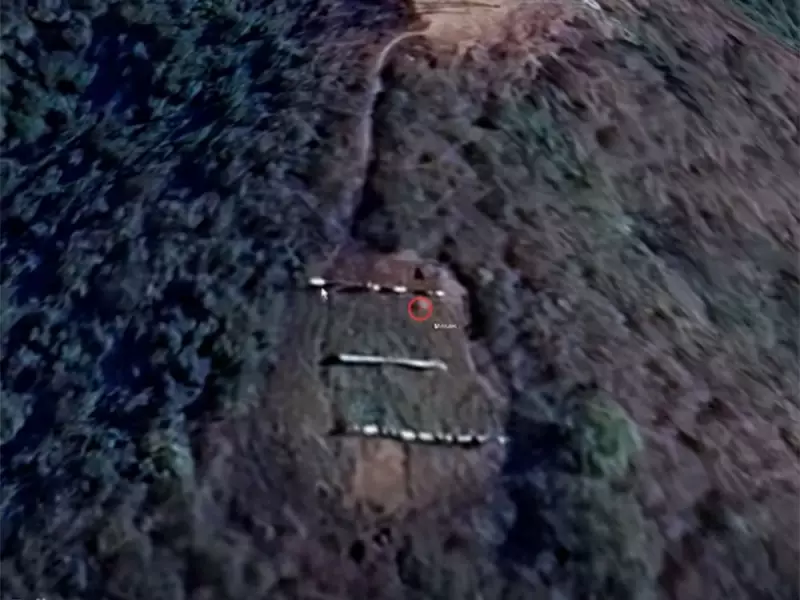
In the days leading up to a dramatic U.S. military operation to capture Venezuela's president, a group of private intelligence analysts presented a startling claim: satellite imagery appeared to reveal a potential ballistic missile launch site in the Venezuelan mountains, capable of threatening targets as far north as Washington, D.C.
Amateur Sleuths Point to Mountain Clearing
The analysis, spearheaded by former U.S. Army technology developer Lee Wheelbarger, focused on a clearing on a mountain near Caracas. The group suggested the imagery showed three rows of what could be missile "tubes," potentially indicating launch sites for intermediate-range ballistic missiles. Their findings, compiled in a video, were presented at a meeting of the Toronto-based Mackenzie Institute, a defence think tank, shortly before the American strike on January 3, 2026.
Wheelbarger was unequivocal in dismissing the U.S. government's stated justification for its actions around Venezuela—targeting alleged drug-smuggling vessels. "I don't think it has a damn thing to do with the drug boats," he stated. "I think the drug boats are completely irrelevant. That's an excuse." The analysts theorized that real reason for U.S. movements was military developments in Venezuela, where Russian, Chinese, and Iranian troops are reportedly stationed.

Expert Analysis: Plausible but Unproven
Reaction from established experts has been cautious. Evan Ellis, a research professor at the U.S. Army War College and a leading expert on the region, said the group's interpretation "could be true" given Venezuela's long-standing military partnerships with U.S. adversaries. "The things they said were plausible and they were consistent with more than 15 years of engagement with China, Russia and Iran," Ellis noted.
However, he emphasized that the satellite images alone do not constitute definitive proof. "Not everything that they claimed by showing a satellite image was necessarily proven by that image," Ellis said, rating the claims as plausible but unproven. "It's not nothing but I don't regard it as a significant 'Ah-hah.'" He added that even if such launch sites existed, they could be relatively vulnerable to aerial bombardment.
Official Silence and Wider Context
The U.S. Southern Command has declined to engage with the specific claims. Spokesman Steven McLoud stated the organization does not comment on "speculative reporting or unverified premises," reiterating that its mission focuses on regional stability and combating illicit activities.
The speculation occurs against a backdrop of deepening military ties between Venezuela and other nations. A Russian lawmaker recently suggested Moscow could supply its new Oreshnik ballistic missiles to Venezuela. Furthermore, internal U.S. documents indicate Venezuelan President Nicolás Maduro has requested missiles and equipment from Russia, China, and Iran.
Separately, the same group of analysts points to imagery of a Cuban airfield holding a collection of Russian "Kitchen" missiles, designed to destroy warships, suggesting a broader pattern of strategic posturing in the region that may have influenced U.S. military calculations.