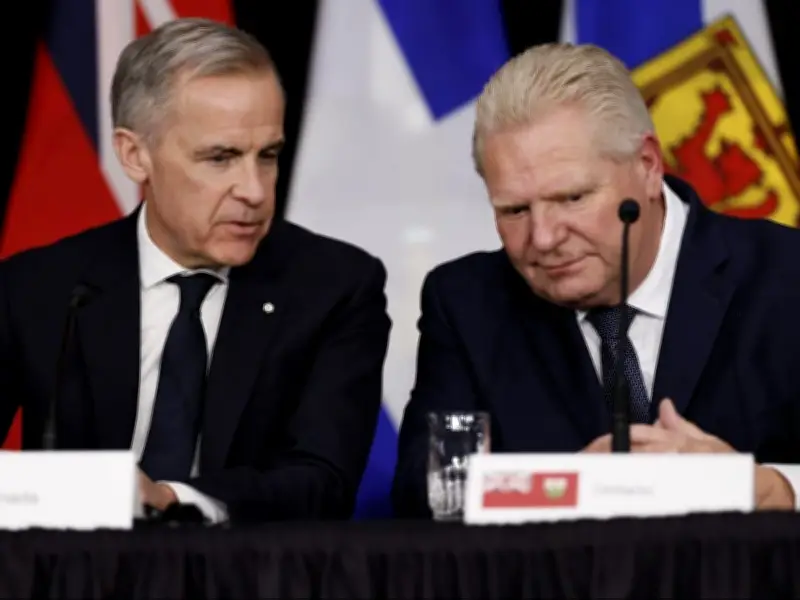
Based on their respective budgets this year, it is now clear that both Ontario Premier Doug Ford and Prime Minister Mark Carney are unwilling to tackle their government debt problems, expecting future political leaders to clean up the mess they leave behind.
Throughout their time in office, Ford and Carney have discussed the importance of being good fiscal managers. Ford, for instance, criticized his predecessor for “reckless” spending and borrowing habits in Ontario, while Carney promised a “very different approach” to federal finances compared to his predecessor, Justin Trudeau.
For both policymakers, however, their actual fiscal policy has borne little resemblance to their rhetoric. The Ford government projects a $13.8-billion budget deficit in 2026-2027 — its eighth deficit in nine years of Ford’s tenure. Due to these persistent budget deficits — combined with longer-term borrowing on items such as hospitals, schools and highways — Ford has amassed a projected $162.1 billion in net debt since taking office. Moreover, per-person program spending in Ontario (adjusted for inflation) is now higher than at any point during the Kathleen Wynne government’s tenure.

Meanwhile, the Carney government forecasts budget deficits exceeding $53 billion annually from now until at least 2030-2031. These deficits are substantially larger than what the Trudeau government had planned.
Of course, taxpayers will pay the price. For example, for the 2025-2026 fiscal year, Ontario’s provincial net debt was $459.4 billion. And with a provincial government net debt of $28,254 per person, Ontarians had the second-highest government debt burden among all provinces, behind only Newfoundland and Labrador ($35,540).
But their debt burden does not end there. Ontarians are also responsible for shouldering a portion of federal government debt. If federal net debt is allocated to each province based on their share of the total Canadian population, Ontarians’ combined (federal and provincial) net debt surpassed $1.0 trillion in 2025-2026. On a per-person basis, that translates to $63,574 in federal and provincial government debt for every Ontarian.
Given the additional borrowing forecasted by both Ottawa and Queen’s Park in the years to come, the burden will continue to grow for Ontarians. This is a problem, as government debt imposes real costs on Ontarians and their families.
Ontarian taxpayers, for instance, must pay interest on government debt. In 2025-2026, the Ford government expects to spend $16.0 billion to cover the interest on its debt — roughly $2.0 billion more than the province will spend on post-secondary education that year. Simply put, debt interest costs divert hard-earned taxpayer dollars away from programs such as health care and education.
When governments borrow money, it can also result in higher taxes and/or fewer services for younger generations in the future. Today’s deficits are tomorrow’s taxes.
Ontarians are among the most indebted residents in the country, in terms of both federal and provincial government debt. The Ford and Carney governments should stop paying lip service to their massive debt problems and start fixing them — with taxpayers in mind.
Jake Fuss is director of fiscal studies at the Fraser Institute.