Poilievre Calls for Economic Resilience in Face of U.S. Tariff Threats
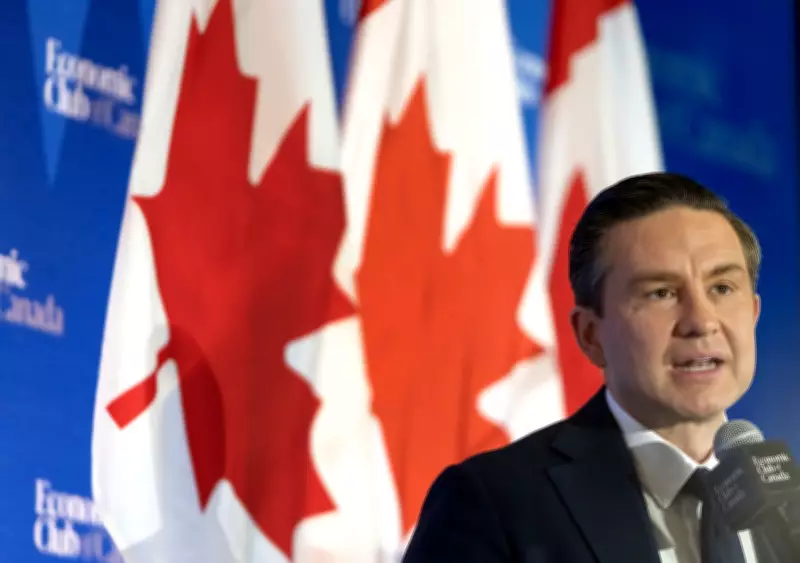
As Prime Minister Mark Carney embarked on an international tour to India, Australia, and Japan, Conservative Leader Pierre Poilievre addressed a business audience in Toronto on Thursday, February 26, 2026. Poilievre's speech focused on strategies for Canada to succeed despite the economic uncertainties posed by U.S. President Donald Trump's tariff policies.
Contrasting Approaches to Canada-U.S. Relations
While Poilievre spoke at the Economic Club of Canada's keynote event at Toronto's Delta Hotel, Dominic LeBlanc, Carney's minister responsible for Canada-U.S. relations, was nearby updating another business group on border issues. LeBlanc emphasized that the recent U.S. Supreme Court decision on tariffs had minimal impact on Canada compared to existing tariffs on steel, aluminum, and automobiles.
LeBlanc clarified that the ongoing review of the Canada-U.S.-Mexico Agreement (CUSMA) does not constitute a renegotiation. "The review is not a renegotiation," LeBlanc stated. "If there's no consensus in the review, the agreement continues on."

Trump's Willingness to Abandon Trade Agreement
This assurance comes despite Trump's expressed willingness to potentially withdraw from CUSMA. In a New York Times interview published just over a week prior to Poilievre's speech, Trump's chief trade negotiator Jamieson Greer indicated the president's openness to leaving the agreement.
"The president's been quite clear," Greer told the Times. "He's half inclined to leave. So we'll see how that goes."
Poilievre's Economic Vision for Canada
In response to this uncertainty, Poilievre outlined a comprehensive economic vision centered on strengthening Canada's domestic capabilities. "Canada cannot control the decisions of foreign presidents. We cannot control global shocks or the volatility of the world," Poilievre acknowledged. "But we can control the strength of our own country."
Poilievre's plan includes several key components:
- Unleashing Canada's energy sector to export oil and natural gas globally
- Investing in defense and technology to enhance self-reliance
- Reducing regulatory barriers to accelerate homebuilding and address affordability challenges
"No foreign government can tariff homes built in Canada," Poilievre emphasized regarding his housing proposals.
Balancing Relations with the U.S. and China
Poilievre cautioned against severing ties with the United States while simultaneously embracing China. He acknowledged Canadian frustration with the uncertainty created by Trump's policies but argued that distancing from the U.S. would be counterproductive.
"The most effective response to uncertainty is not outrage," Poilievre stated. "It's results."
He proposed that by making Canada's economy more resilient domestically and less dependent on the United States, the country would gain stronger negotiating positions internationally. "When we are stronger at home, we have leverage abroad," Poilievre explained.
Proposal for Cross-Party Cooperation
In a gesture toward collaboration, Poilievre encouraged the Carney government to adopt elements of his economic plan and proposed establishing an all-party CUSMA working group of parliamentarians.
"I propose an all-party CUSMA working group of parliamentarians to help the government get the best deal for Canada," Poilievre offered. "But co-operation cannot mean silence. We will work together where we can and we will oppose where we must."
Focus on National Sovereignty Through Economic Strength
Poilievre concluded his address by urging Canadians to concentrate on factors within their control rather than external uncertainties like Trump's social media commentary.
"Economic strength is national strength. Energy security is national security. Self-reliance is sovereignty made real," Poilievre declared. "Sovereignty is not declared, it is built — deliberately, decisively and without excuses."
While the long-term impact of Poilievre's proposals remains uncertain, his Toronto speech presented a confident response to the challenges posed by U.S. trade policy under the Trump administration, advocating for a stronger, more independent Canada through domestic economic fortification.