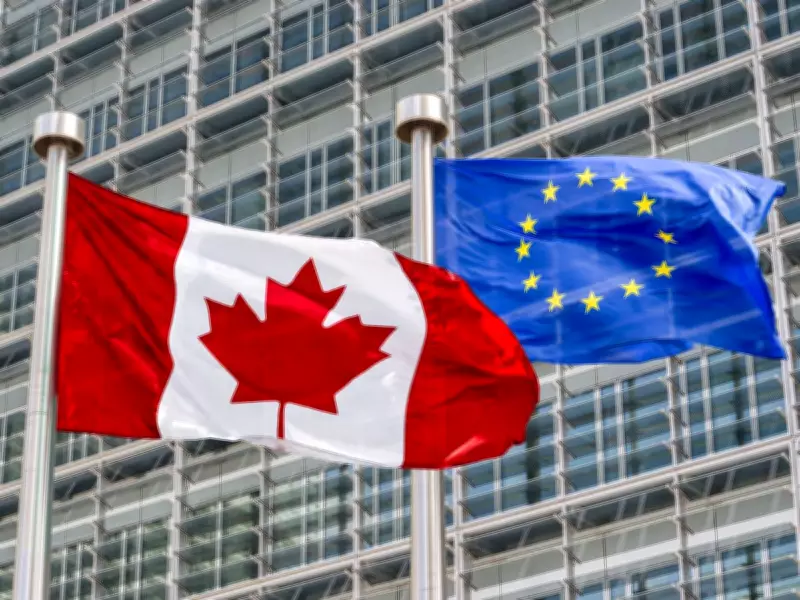
Canada's economic strength has always been its flexibility as a middle power, not its willingness to be an adjunct to Europe. As prime minister, Mark Carney claims to be guided by pragmatism, albeit 'principled pragmatism.' But his enthusiastic pursuit of deeper alignment with the European Union risks selling out Canadian sovereignty for romantic symbolism and a mountain of red tape.
The Economic Reality of the EU
In his now-famous speech in Davos, Carney said that 'nostalgia isn't a strategy.' Yet his approach to the EU reveals a deeply nostalgic view of Europe as a vibrant counterweight to North American realities. But the numbers say Europe's economy, far from being vibrant, is in decline. Forecasts for this year project growth of one per cent or less. The EU is beset by stagnation, demographic decline, high energy costs and chronically poor competitiveness. Why would Canada seek even tighter alignment with a bloc that's in decline when it already enjoys comprehensive trade access through the Canada-EU Comprehensive Economic and Trade Agreement (CETA) and other multilateral channels?
Public Naivety and Symbolic Appeal
Recent polls suggesting there is support in Canada for becoming a full EU member mainly reflect public naivety about closer ties to the EU. Anxiety over U.S. relations and ignorance of the practical downsides of deeper integration are a dangerous combination. For most Canadians, Europe means picturesque cities, good food and beautiful architecture, not the economy-crushing regulation that would come with deeper integration.

The Regulatory Burden
The European Parliament is also supporting closer ties with Canada and in March adopted a recommendation for enhanced EU-Canada co-operation, including regulatory alignment in trade, energy, environment and other sectors. That sounds nice but in practice it would mean importing the full apparatus of the EU's notorious model. Full membership would require Canada to accept the entire corpus of EU law — all 170,000 pages of it. And there would be no opt-outs from core climate policies, including the European Green Deal and Fit for 55, which legally binds member states to a 55 per cent net GHG reduction from 1990 levels by 2030 and then full climate neutrality by 2050. For Canada, this would mean binding national targets on emissions, energy, transport, buildings, agriculture and land use that overrode domestic priorities.
Impact on Agriculture
Deeper regulatory alignment with the EU would come at a steep cost to Canadian agriculture. To meet the EU's Green Deal and Farm to Fork targets, Canadian farmers would face mandatory reductions of 50 per cent in pesticide use and 20 per cent in fertilizer application, as well as a mandated shift to organic production, from under 2.2 per cent today all the way to 25 per cent by 2030. To satisfy the EU's precautionary restrictions, genetically-modified canola, which dominates Prairie fields, would require costly segregation or outright phase-outs. Studies of similar policies project declines in yields of 10-20 per cent, sharply higher production costs and major economic hits to export-oriented operations.
Impact on Oil and Gas
The oil and gas sector would fare no better. Fit for 55's expanded emissions trading system, carbon pricing, methane rules, upstream caps and Carbon Border Adjustment Mechanism would pressure aligned countries to adopt equivalent standards. Alberta's oilsands, with their higher upstream emissions intensity, would face extra scrutiny, tougher compliance rules and de facto market barriers under the EU's precautionary philosophy, which is often hostile to hydrocarbons.