Opinion: Edmonton Public Schools' travel ban teaches a lesson of fear
Author of the article: By Stephen Murgatroyd, J-C Couture
Published Jun 11, 2026

Last updated 0 minutes ago
4 minute read
You can save this article by registering for free here. Or sign-in if you have an account.
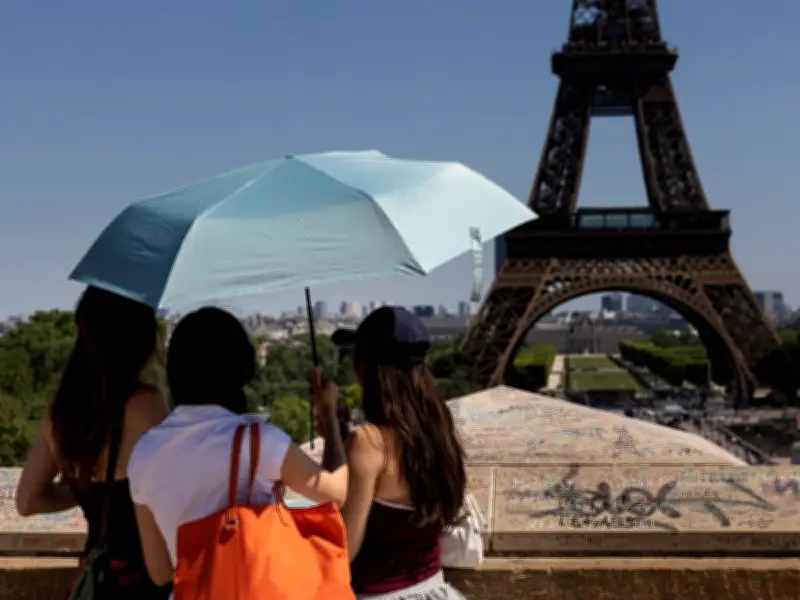
Tourists use an umbrella to shield themselves from the sun as they stand in front of the Eiffel Tower in Paris on May 27, 2026. Photo by JOEL SAGET /AFP via Getty Images
The recent decision by Edmonton Public Schools to suspend all international student travel and school exchanges for the 2026–27 school year deserves much closer scrutiny. The division cites a “complex global landscape of evolving political, economic and public health challenges” and says the decision was made “out of an abundance of caution.” Parents have expressed confusion and disappointment, particularly given the absence of any specific threat or identified risk.
THIS CONTENT IS RESERVED FOR SUBSCRIBERS ONLY
Subscribe now to read the latest news in your city and across Canada.
Exclusive articles by David Staples, Keith Gerein and others, Oilers news from Cult of Hockey, Ask EJ Anything features, the Noon News Roundup and Under the Dome newsletters.
Unlimited online access to Edmonton Journal and 15 news sites with one account.
Edmonton Journal ePaper, an electronic replica of the print edition to view on any device, share and comment on.
Daily puzzles, including the New York Times Crossword.
Support local journalism.
SUBSCRIBE TO UNLOCK MORE ARTICLES
Subscribe now to read the latest news in your city and across Canada.
Exclusive articles by David Staples, Keith Gerein and others, Oilers news from Cult of Hockey, Ask EJ Anything features, the Noon News Roundup and Under the Dome newsletters.
Unlimited online access to Edmonton Journal and 15 news sites with one account.
Edmonton Journal ePaper, an electronic replica of the print edition to view on any device, share and comment on.
Daily puzzles, including the New York Times Crossword.
Support local journalism.
REGISTER / SIGN IN TO UNLOCK MORE ARTICLES
Create an account or sign in to continue with your reading experience.
Access articles from across Canada with one account.
Share your thoughts and join the conversation in the comments.
Enjoy additional articles per month.
Get email updates from your favourite authors.
THIS ARTICLE IS FREE TO READ REGISTER TO UNLOCK.
Create an account or sign in to continue with your reading experience.
Access articles from across Canada with one account
Share your thoughts and join the conversation in the comments
Enjoy additional articles per month
Get email updates from your favourite authors
Sign In or Create an Account
or View more offers
Article content
Story continues below
This advertisement has not loaded yet, but your article continues below.
Article content
To some, this might seem like a prudent administrative decision. School boards have legal responsibilities. They must manage risk and ensure student safety. No reasonable person disputes this. But at another level, this decision tells students something profound about how the adults in charge understand the world. It risks teaching an unintended and damaging lesson: that the world “out there” is fundamentally something to be feared.
Article content
Article content
Headline News
Get the latest headlines, breaking news and columns.
By signing up you consent to receive the above newsletter from Postmedia Network Inc.
Thanks for signing up!
A welcome email is on its way. If you don't see it, please check your junk folder.
The next issue of Headline News will soon be in your inbox.
We encountered an issue signing you up. Please try again
Article content

A growing body of scholarship suggests that Western education systems are increasingly organized around what researcher Marta Estellés calls the “safetyfication of education” — the tendency to make safety the dominant organizing principle of school life. Schools gradually shift from being places where young people learn to navigate complexity, uncertainty and risk, to institutions primarily focused on minimizing exposure to these defining features of contemporary life. Safety becomes not just a stated value, but a curriculum — a curriculum of fear.
Article content
This matters especially right now. Levels of anxiety and depression among young people are at record highs across Canada and globally, with worries about an uncertain future at the centre of their distress. Precisely at such a moment, “the adults in the room” should be modelling courage, confidence and thoughtful engagement with the world — not institutionalized avoidance. When the institutions responsible for educating young people signal that the world is too dangerous to be experienced directly, they deepen the very anxiety they claim to be managing.
Article content
Story continues below
This advertisement has not loaded yet, but your article continues below.
Article content
Ron Thompson, superintendent for Edmonton Public Schools, has made the decision to halt all international travel for the division in the 2026-27 school year. Photo by Liam Newbigging /Postmedia
Article content
There is also a question of equity that cannot be ignored. For many students — particularly those from low-income, newcomer or working-class families — a school-organized international trip is the only realistic opportunity they will have to travel beyond their province before adulthood. Research confirms that financial resources are the primary barrier to travel for young people, and that school-organized trips are essential for bridging this divide.
Article content
Studies of educational travel consistently show that students who participate gain higher confidence, deeper curiosity and stronger intercultural competence. These are benefits that carry into the classroom and later life. When policy-makers cancel all international travel, it is not students from well-resourced families who lose out.
Article content
Those families will travel anyway. It is students who depend on public education as their gateway to the wider world who are left behind. The decision quietly privatizes the experience of global learning while publicly claiming to prioritize safety.
Article content
The language used to justify the ban is telling. “Abundance of caution” has become one of the defining phrases of public administration in the post-pandemic era. It sounds prudent and is difficult to oppose. Yet it carries the hidden assumption that we cannot distinguish between risk and recklessness.