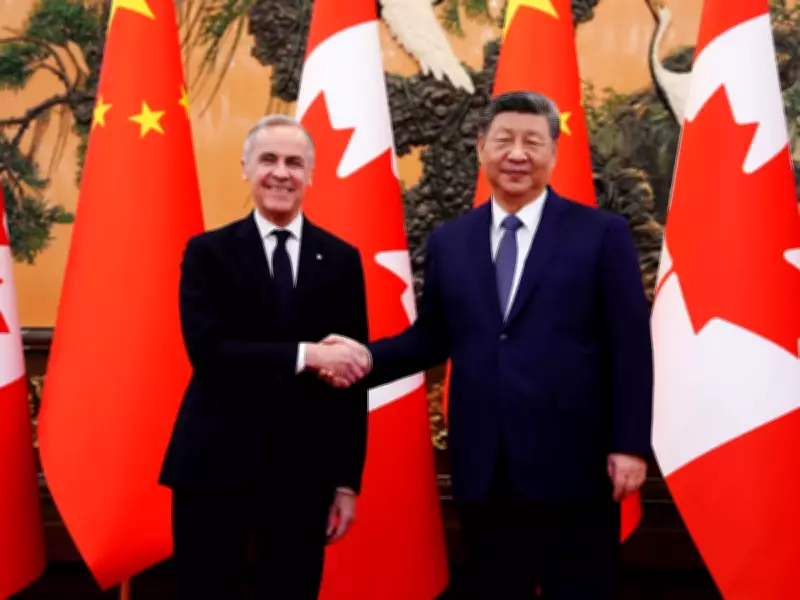
Carney's Diplomatic Tightrope: Navigating China Relations in the Indo-Pacific
Prime Minister Mark Carney has returned from a pivotal diplomatic tour across the Indo-Pacific region, having visited key allies in Delhi, Canberra, and Tokyo. This strategic journey aimed to strengthen partnerships with middle-power nations facing similar geopolitical challenges. However, the most delicate aspect of Canada's foreign policy remains its approach to China, which experts warn could undermine Canadian sovereignty and democratic principles.
The Illusion of Stabilization with Beijing
During his travels, Carney encountered leaders who have attempted to stabilize relations with China through moderated political rhetoric and increased economic engagement. Prime Ministers Narendra Modi of India, Anthony Albanese of Australia, and Takaichi Sanae of Japan have all pursued this cautious approach, seeking to maintain trade and investment flows without directly challenging Beijing's policies. Yet this strategy carries significant risks that Canada must carefully consider.
The fundamental problem lies in the distinction between stabilization and normalization. When dealing with the Chinese Communist Party, efforts to stabilize relations can inadvertently normalize engagement with a state that operates outside conventional international norms. This creates dangerous dependencies and exposes nations to arbitrary political decisions that can devastate economies and compromise sovereignty.

Historical Lessons from Indo-Pacific Nations
Recent history provides sobering examples of the costs associated with accommodating Beijing's demands:
- Canada endured the Meng-Michaels affair, a diplomatic crisis that strained relations and highlighted Beijing's willingness to use arbitrary detention as political leverage.
- India faced a border conflict that resulted in the deaths of twenty soldiers, demonstrating China's territorial ambitions and willingness to use military force.
- Australia suffered billions in trade losses after spending years in Beijing's diplomatic doghouse as punishment for policy disagreements.
- Japan currently faces economic retaliation following public statements about Taiwan that contradicted Beijing's preferred narrative.
These cases illustrate a consistent pattern: accommodating Chinese demands typically yields only temporary relief while often encouraging further aggressive behavior. The uncomfortable reality is that Beijing views compromise as weakness to be exploited rather than good faith to be reciprocated.
China's Geopolitical Ambitions and Economic Strategy
The Chinese Communist Party is actively contesting regional power balances throughout the Indo-Pacific. Beijing's objectives extend beyond merely supplanting American influence; China seeks to divide, co-opt, and weaken any nations that might collectively constrain its expansionist ambitions. To achieve these goals while supporting its own unbalanced economic growth, China has implemented the largest industrial policies in modern history.
Beijing's strategy focuses on three key areas:
- Dominating advanced technology and manufacturing sectors
- Increasing other nations' economic dependence on China
- Reducing China's own reliance on foreign partners
Despite official rhetoric supporting free trade and opposing tariffs, China's aggressive mercantilism generated an unprecedented $1.2 trillion trade surplus last year. This economic approach has directly contributed to rising global trade tensions and what economists are calling a "Second China Shock" affecting the world economy.
The Hidden Costs of Economic Engagement
When democracies like Canada provide market access that sustains China's overproductive economic model, they inadvertently strengthen the industrial capacity, technological advancement, and capital accumulation that underpin Beijing's geopolitical influence and military power. The benefits of increased business with China must be weighed against three significant costs:

- Economic displacement: Canadian companies and jobs destroyed by unfair competition from state-subsidized Chinese industries
- Security expenditures: Higher spending on defense, national security, and economic resilience measures
- Geopolitical risks: Trade and investment that provide resources helping China achieve objectives threatening to Canada and its allies, including control over Taiwan and regional domination
Assessing Carney's China Optimism
While Canadians rightly support their prime minister's efforts to strengthen partnerships with India, Australia, and Japan, they should maintain critical scrutiny of the outcomes from Carney's January visit to Beijing. Despite the prime minister's optimism about "enormous opportunities" in China, the reality is more complex. While select Canadian companies might achieve short-term success in the Chinese market, the broader national interest requires careful calculation.
Once the costs to Canadian democracy, sovereignty, and long-term security are properly accounted for, the net benefit of deepened engagement with China appears minimal at best. Canada's foreign policy must balance economic opportunities against fundamental values and strategic interests, recognizing that relationships with authoritarian regimes require different calculations than partnerships with fellow democracies.
The challenge for Carney's government is to develop a China strategy that protects Canadian interests without falling into the trap of believing that economic engagement alone can moderate Beijing's behavior or secure lasting benefits for Canada. As the prime minister continues his diplomatic efforts, maintaining this delicate balance will prove crucial for Canada's future in an increasingly contested Indo-Pacific region.