Disabled Guest Arrested at State of the Union for Standing During Trump Speech
When President Donald Trump extended birthday wishes to a centenarian World War II veteran during his State of the Union address, Aliya Rahman rose from her seat to applaud. Moments later, when the president made disparaging remarks about Minneapolis' Somali community, alleging their cultures normalize "bribery, corruption and lawlessness," Rahman stood again—this time in silent protest, withholding applause.
Such calculated displays of support or dissent are commonplace during the annual presidential address, with members of Congress and their guests strategically choosing when to rise in approval or remain seated in opposition. However, on Tuesday night, Rahman's silent standing resulted in her arrest—a development her attorney describes as "unprecedented" for a State of the Union event.
A Violent Removal from the Gallery
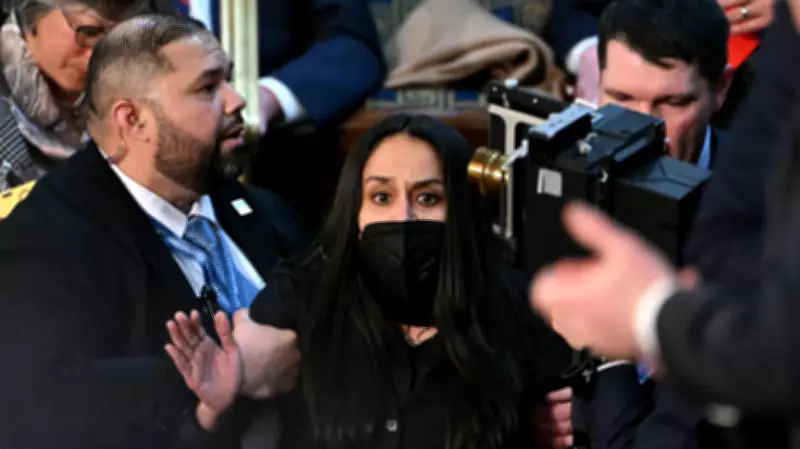
Rahman, a 43-year-old Bangladeshi American software engineer from Minneapolis and guest of Representative Ilhan Omar (D-Minn.), says Capitol Police officers approached her after she had stood multiple times during the speech. They informed her she "couldn't stand up," a directive she initially dismissed as unserious. Moments later, officers seized her by the shoulders and dragged her from the House chamber.

"I just stood up," Rahman recounted in an interview. "I stood silently, with no signs. I was not blocking anyone's view of the hall. And then I was arrested."
The removal proved particularly traumatic given Rahman's preexisting conditions. The autistic engineer has physical disabilities and was recovering from shoulder injuries sustained just weeks earlier during what she describes as a violent encounter with Immigration and Customs Enforcement agents. That incident, captured on video and widely circulated online, left her requiring hospitalization for assault-related injuries.
Witnesses Attempt Intervention
Several women seated near Rahman recognized her from recent congressional testimony about her ICE detention experience and attempted to intervene as officers removed her. Dr. Anita Patel, a guest of Representative Joaquin Castro (D-Texas) who was aware of Rahman's injuries, documented the confrontation on Instagram.
"She stood up silently, did not make a noise, and was [descended] upon as if she was a criminal while she wore an n95 mask and used a cane," Patel wrote.
In a video statement, Patel described confronting officers: "I jumped over the railing and said, 'You need to let her go. She has bilateral shoulder injuries. She has a traumatic brain injury, and she's neurodivergent.' They subsequently continued to pull her. Then I got in front of them. They told me, either I step aside or I get dragged out with her."
Police Defend Their Actions
The U.S. Capitol Police issued a statement asserting Rahman was arrested for "demonstrating" during the address. "The guest was told to sit down, but refused to obey our lawful orders," the statement reads. "It is illegal to disrupt the Congress and demonstrate in the Congressional Buildings."
A police spokesperson elaborated that "standing (not just standing momentarily with the crowd) is a form of demonstration," adding officers had no knowledge of Rahman's background or whose guest she was. "They told her to sit down multiple times. She refused. It's simple."
Rahman was charged under D.C. Code §10-503.16 for "Unlawful Conduct, Disruption of Congress," an offense carrying potential six-month imprisonment.
Aftermath and Legal Response
Following her removal, officers handcuffed Rahman, confiscated her cane, and detained her in a stairwell. When she repeatedly requested her mobility aid, one officer responded, "You are walking," implying she didn't need it. "Bullying, intimidating, not listening," Rahman characterized the interaction. "Who takes a cane away from a disabled person? I'm trying to slow them down. I'm not resisting, I'm disabled."
The confrontation necessitated medical treatment at George Washington University Hospital before she was booked at Capitol Police headquarters.

Rahman's attorney, Jessica Gingold of the MacArthur Justice Center, contends her client violated no laws. "Our reading of the statute, we're assuming it's the part about uttering 'loud, threatening or abusive language,' or engaging in 'disorderly or disruptive conduct,'" Gingold explained. "She did none of that. She stood up."
Gingold noted that while "many other people" have been outspoken at past State of the Union addresses, "Aliya is a uniquely situated person, the only one charged with this kind of offense." The legal team hopes to have the case dismissed before Rahman's scheduled hearing.
Political Reactions and Implications
Rahman suspects she was targeted as the guest of Representative Omar, a frequent Trump critic who routinely faces racist attacks from the administration. Omar condemned the police response on social media, stating, "The heavy-handed response to a peaceful guest sends a chilling message about the state of our democracy. I am calling for a full explanation of why this arrest occurred."
The incident raises significant questions about protest rights, disability accommodations, and selective enforcement within the halls of Congress. As Patel warned in her social media post: "Don't let them twist her story into something that it's not."