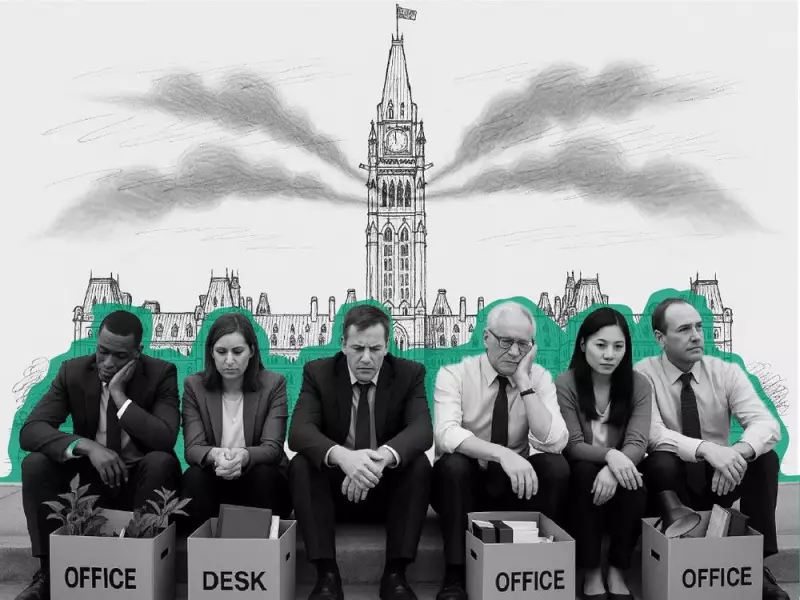
Federal Workforce Reduction Faces Attrition Limitations
The Canadian government's ambitious plan to reduce the federal public service by approximately 40,000 positions by the 2028-29 fiscal year faces significant hurdles, with analysis suggesting that relying solely on attrition will prove insufficient for many departments. Despite early retirement incentives and natural turnover, the scale of required cuts exceeds what voluntary departures can accomplish across the entire public service.
By the Numbers: The Scale of Public Service Reductions
According to Budget 2025, the government aims to achieve a 10 percent reduction from the 2023-24 peak of federal employees. Current Treasury Board data shows the public service grew to 367,772 employees in 2024 before declining to 357,965 this year, representing approximately 10,000 positions already eliminated. The ultimate target is to reach 330,000 federal public servants by 2028-29, leaving another 30,000 positions to be cut.
The federal public service typically experiences an annual attrition rate of about 4 percent, translating to between 10,000 and 12,000 employees leaving voluntarily each year through retirement or other factors. The government's early retirement incentive program, announced in the budget, is expected to encourage additional departures among qualified older workers.

Departmental Disparities Create Implementation Challenges
While the aggregate numbers suggest attrition might cover the reductions, the reality varies significantly across departments. Some agencies will experience attrition rates that exceed their required staffing reductions, allowing them to avoid involuntary job losses. However, other departments face much deeper cuts that outpace their natural turnover rates.
The Canada Revenue Agency (CRA) exemplifies this challenge. The agency has already reduced its workforce by 6,500 employees from a peak of 59,000 in 2024 to approximately 52,500 currently. Despite these cuts, Budget 2025 requires the CRA to find another $4.1 billion in operational savings, with roughly one-third expected to come from personnel expenditures.
This translates to an additional 8,000 to 9,000 positions that need to be eliminated at CRA. With a 4 percent attrition rate applied to its current 52,500 employees, the agency would struggle to achieve its remaining staffing reductions solely through voluntary departures by the 2028-29 deadline.
Workforce Adjustment and Redeployment Opportunities
For employees affected by reductions who wish to remain in the federal public service, workforce adjustment mechanisms may provide alternatives. Priority referrals and deployment opportunities could allow transitions to growing agencies such as the new Build Canada Homes agency or departments with expanding budgets like the Department of National Defence.
Nevertheless, the process of being notified and navigating workforce adjustment creates significant anxiety and uncertainty for many public servants. The government has structured the reductions over several years specifically to minimize the impact and allow early retirement incentives to absorb as much of the reduction as possible.
Former clerk of the Privy Council Michael Wernick and other observers have praised the inclusion of early retirement incentives as a measure to protect younger workers from the brunt of staffing reductions. The extended timeline also provides departments with flexibility to manage the transition more humanely.
The government maintains that attrition will play a substantial role in achieving the targeted reductions, but acknowledges that additional measures will be necessary in departments where required cuts exceed voluntary departure rates. The coming years will test whether this balanced approach can achieve the fiscal objectives while minimizing disruption to both public services and the careers of dedicated public servants.