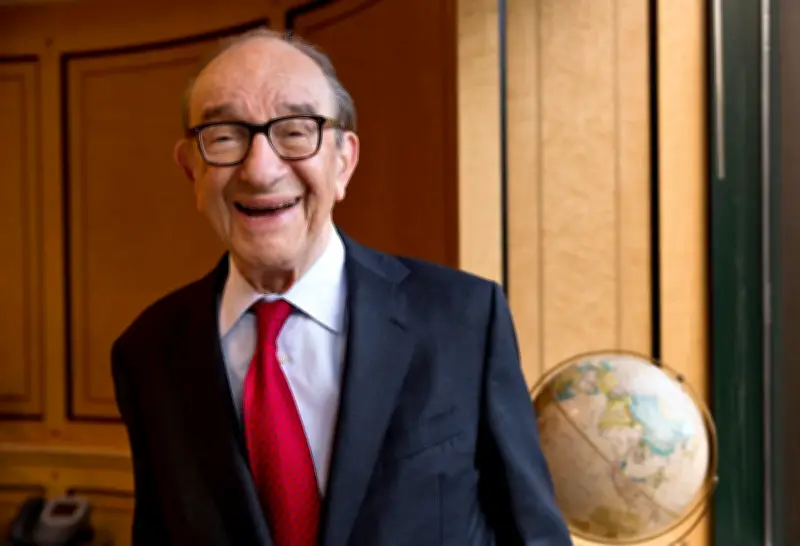
Alan Greenspan, the former chairman of the U.S. Federal Reserve who served from 1987 to 2006, has died at the age of 100. His death was announced by his family on June 22, 2026. Greenspan was one of the most influential central bankers in American history, presiding over a period of economic expansion, the dot-com bubble, and the early stages of the 2008 financial crisis.
Early Life and Career
Born on March 6, 1926, in New York City, Greenspan studied economics at New York University, earning a bachelor's degree in 1948 and a master's degree in 1950. He later pursued a doctorate at Columbia University but left before completing his dissertation. Greenspan began his career as an economic consultant and later founded his own firm, Townsend-Greenspan & Co., in 1954. He served as an economic advisor to President Richard Nixon and later chaired the Council of Economic Advisers under President Gerald Ford from 1974 to 1977.
Federal Reserve Chairmanship
President Ronald Reagan appointed Greenspan as chairman of the Federal Reserve in 1987, succeeding Paul Volcker. Greenspan's tenure was marked by significant economic events, including the 1987 stock market crash, the savings and loan crisis, the dot-com boom of the late 1990s, and the aftermath of the September 11 attacks. He was known for his cryptic speaking style and his focus on price stability and low inflation. Under his leadership, the Fed implemented policies that contributed to a period of low unemployment and steady growth, but critics argue that his low interest rate policies helped inflate the housing bubble that led to the 2008 financial crisis.

Legacy and Criticism
Greenspan's reputation suffered after the 2008 crisis, as many economists and policymakers blamed his deregulatory stance and monetary policies for exacerbating the meltdown. In a 2008 congressional hearing, Greenspan admitted that he had found a flaw in his free-market ideology. Despite this, he remained a respected figure in economic circles. After leaving the Fed, he established his consulting firm, Greenspan Associates LLC, and wrote several books, including his memoir The Age of Turbulence (2007). He was married to journalist Andrea Mitchell since 1997.
Reactions
Current Fed Chairman Jerome Powell praised Greenspan's contributions, stating, 'Alan Greenspan was a giant in the field of central banking. His commitment to economic stability and his deep understanding of financial markets shaped the modern Federal Reserve.' Others, however, remained critical. Nobel laureate economist Joseph Stiglitz said, 'Greenspan's legacy is mixed. He presided over an era of growth but also laid the groundwork for one of the worst financial crises in history.'
Personal Life and Death
Greenspan was known for his love of tennis and his analytical approach to economics. He died peacefully at his home in Washington, D.C., surrounded by family. No cause of death was disclosed. He is survived by his wife, Andrea Mitchell, and his stepchildren. A private funeral service will be held later this week.