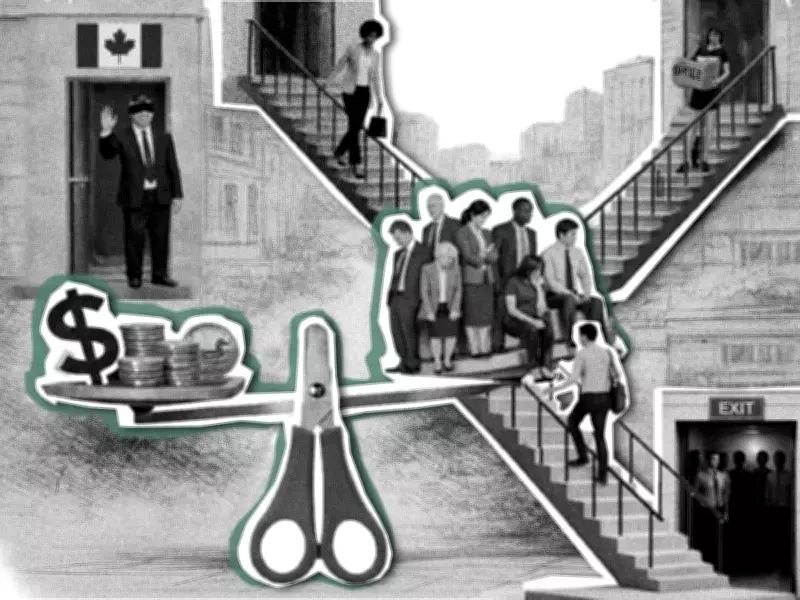
Government Job Cuts: Is Widespread Panic the Intent Behind Workforce Adjustment?
A federal public servant has raised a provocative question about the ongoing workforce reduction initiatives within the Canadian government: Is the widespread uncertainty and anxiety generated by the workforce adjustment process deliberately designed to encourage voluntary attrition among employees?
The inquiry comes as thousands of public servants receive notifications about potential job losses, creating what many describe as an atmosphere of profound uncertainty and distress throughout federal departments.
The Core Question: Strategic Uncertainty or Bureaucratic Inefficiency?
The public servant's central concern focuses on whether the vague, sweeping, and unpredictable nature of the cuts serves a strategic purpose. Specifically, they question if the government aims to create such widespread panic that employees choose to leave voluntarily, thereby accelerating the downsizing process without formal layoffs.

"Is the belief that only poor employees with no other options will leave," the public servant asks, "or is there truly such contempt for the public service that factoring in the losses of institutional memory and the most marketable candidates isn't of concern?"
This question highlights a fundamental tension between the government's stated priorities and its implementation methods. The public servant notes apparent contradictions, such as promoting expanded trade partnerships while simultaneously implementing blanket cuts across Global Affairs Canada's trade groups.
Government's Stated Rationale and Direction
According to Daniel Quan-Watson, a former deputy minister with nearly 15 years of federal service experience, the government's central direction stems from historically high spending levels over the past decade and the need to align public service size and structure with current fiscal, economic, and societal realities.
"The government's central direction is to align spending levels, investment choices, as well as the size and shape of the public service with the fiscal, economic and societal realities facing Canada in 2026 and beyond," Quan-Watson explains. "Not those of 2016 and 2021."
This repositioning involves what Quan-Watson describes as "a significant recasting of spending levels, priorities, as well as the size and nature of the public service," with the thousands of Workforce Adjustment Directive letters representing the implementation of this strategic shift.
Mechanisms for Managing the Transition
The Workforce Adjustment Directive and Selection of Employees for Retention or Lay Off process include specific provisions designed to address concerns about implementation quality and fairness:
- Reverse order of merit: Employees demonstrating the lowest merit are prioritized for layoffs rather than simply using seniority as the sole criterion
- Performance integration: Managers are expected to incorporate performance assessments into their merit evaluations and decision-making processes
- Corporate memory preservation: Retention criteria explicitly consider organizational needs, including maintaining essential institutional knowledge
- Future-focused planning: SERLO processes require managers to consider future organizational requirements rather than simply replicating past structures
Quan-Watson emphasizes that these tools provide "important provisions allowing the public service to shape its future rather than to simply rebuild a lesser version of its past."
The Human Dimension and Support Systems
Acknowledging the emotional toll on affected employees, Quan-Watson notes the "shock, disbelief, sense of betrayal and struggle to understand 'Why me?'" that many public servants experience during this transition period.
The Public Service Health Care Plan offers confidential counseling, therapy, and mental health support options for affected employees, with no requirement for managerial permission or oversight of utilization.
Quan-Watson identifies three simultaneous realities confronting the public service:

- Canada faces profound transition and uncertainty, with citizens turning to public institutions with significant expectations
- The public service experiences substantial loss and pain through the downsizing process
- The demand for excellence within the public service has reached generational highs given Canada's current challenges
"These separate realities will not be easy to navigate simultaneously," Quan-Watson concludes, "but the consequences of succeeding or failing will be felt for generations."
The ongoing workforce adjustment process continues to generate questions about implementation methods, strategic intent, and the long-term impact on Canada's public service capacity and institutional knowledge.