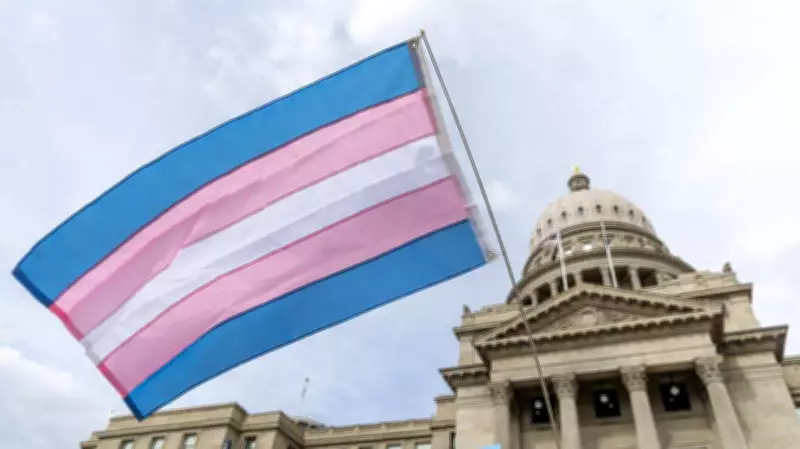
Six transgender Idahoans filed a federal lawsuit on Wednesday challenging the state's new bathroom law, which civil rights experts say is the most restrictive in the nation.
The law, set to take effect in July, imposes criminal penalties for individuals who enter a bathroom or locker room that does not align with their sex assigned at birth, covering both government-owned buildings and private businesses. Anyone who "knowingly" enters such a restroom could face up to a year in jail for a first offense or up to five years in prison for a second offense.
Idaho's bathroom law is the "most punitive and broadest sweeping law in the country," said Paul Carlos Southwick, legal director for the ACLU of Idaho. It is the only state to criminalize transgender people's bathroom usage in private businesses.

The plaintiffs, represented by the American Civil Liberties Union and Lambda Legal, argue the law forces them to risk arrest and harassment every time they need to use a public restroom. They say it could exacerbate gender dysphoria and lead to medical issues like urinary tract infections from avoiding public facilities.
One plaintiff, Diego Fable, a 32-year-old transgender man living in Boise, said he has used the men's restroom for a decade without issues. He now fears the law would force him to use the women's restroom, exposing him to potential violence and harassment. "I now have no choice but to relocate to a different state to protect myself," Fable said. "Idaho is my home, but living in fear is not sustainable. This law is forcing me to leave my friends and family behind."
The civil rights groups argue the law is "unconstitutionally vague" and discriminates against transgender people based on sex and transgender status, also infringing on privacy rights. The law bars people from restrooms "designated for use by the opposite biological sex" but does not define "biological sex," causing confusion. Exceptions exist for single-use bathrooms or "dire need," but "dire" is not defined. "This makes it incredibly difficult for law enforcement to know how to approach enforcement," said Kell Olson, a staff attorney at Lambda Legal. "It just creates a whole lot of chaos and confusion across the board."
The law passed the Republican-led legislature and was signed by Republican Gov. Brad Little despite opposition from Idaho's Fraternal Order of Police, who noted "significant practical enforcement challenges" for officers in determining biological sex without invasive questioning.
Twenty-one states have enacted some form of ban on transgender people's bathroom usage, including Utah, Florida, and Kansas, which restrict access in government-owned buildings such as schools, universities, and airports.