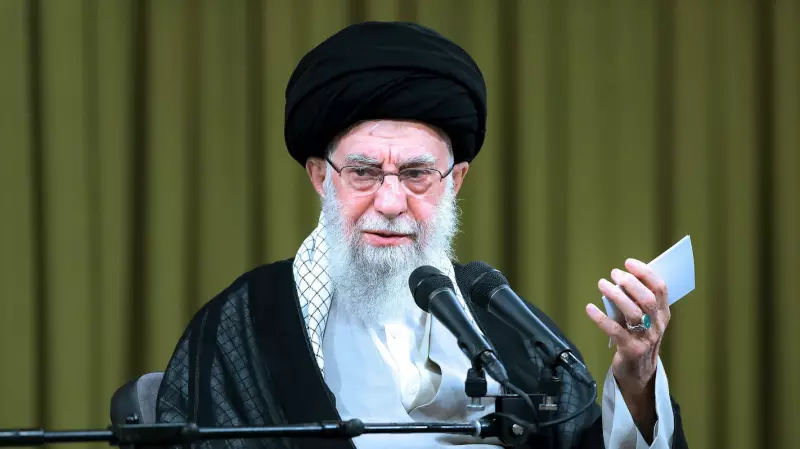
Iran's supreme leader, Ayatollah Ali Khamenei, has broken his silence on a week of nationwide protests, delivering a stark warning that likely signals a more aggressive security crackdown. In his first public comments on the unrest, the 86-year-old leader insisted that "rioters must be put in their place," drawing a line between legitimate protesters and those he claims are backed by foreign enemies.
Khamenei's Warning and Foreign Accusations
The remarks, aired on state television on Saturday, came as human rights activists reported at least 15 people killed and over 580 arrests during demonstrations sparked by Iran's collapsing economy and the plummeting value of the rial. Khamenei attempted to separate economic grievances from the actions of demonstrators, stating officials should talk to protesters but that there was "no benefit to talking to rioters."
He reiterated long-standing claims by the Iranian theocracy that foreign powers, specifically Israel and the United States, were behind the unrest, though he provided no evidence. "A bunch of people incited or hired by the enemy are getting behind the tradesmen and shopkeepers and chanting slogans against Islam, Iran and the Islamic Republic," Khamenei said. He also blamed "the enemy" for the country's severe economic woes.

Escalating Violence and International Tensions
The protests, which have reached over 170 locations in 25 of Iran's 31 provinces, represent the most significant challenge to the regime since the 2022 demonstrations following the death of Mahsa Amini. While not yet as widespread or intense, the current wave is rooted in deep economic despair, with demonstrators also chanting against the ruling theocracy.
Violence escalated overnight into Saturday. In the holy city of Qom, a grenade explosion killed one man, with state media alleging he was carrying it to attack others. In the town of Harsin, a member of the Basij—the volunteer arm of Iran's powerful Revolutionary Guard—was killed in a reported gun and knife attack. The Basij, whose members often ride motorcycles, have a history of violently suppressing dissent.
The situation has drawn sharp international reaction. On Friday, U.S. President Donald Trump warned that if Iran "violently kills peaceful protesters," the United States "will come to their rescue." Iranian officials responded with threats to target American troops in the Middle East. The exchange gains further complexity following Trump's claim on Saturday that the U.S. military captured Venezuelan President Nicolás Maduro, a key Iranian ally.
Internal Divisions and a History of Crackdowns
Analysts note a potential internal divide within Iran's leadership. While hard-liners are believed to be pushing for a forceful response, President Masoud Pezeshkian has reportedly sought talks to address protester demands. However, the Revolutionary Guard, which includes the Basij, answers solely to Supreme Leader Khamenei, whose comments suggest a green light for suppression.
Iran has a bloody history of quelling unrest. The crackdown on the 2022 Amini protests resulted in over 500 deaths and 22,000 detentions. In 2019, protests over a gasoline price hike reportedly left more than 300 people dead. The regime retains a vast security apparatus, and analysts from the Eurasia Group suggest it "would likely suppress such dissent without losing control of the country," despite the spontaneous nature of the current protests.
The economic backdrop remains dire. Iran's economy has struggled to recover following a brief war with Israel in June, during which the U.S. also bombed Iranian nuclear sites. While Iran recently stated it had halted uranium enrichment at all sites—a potential overture for sanctions relief—talks have not materialized amid warnings from Trump and Israeli Prime Minister Benjamin Netanyahu.