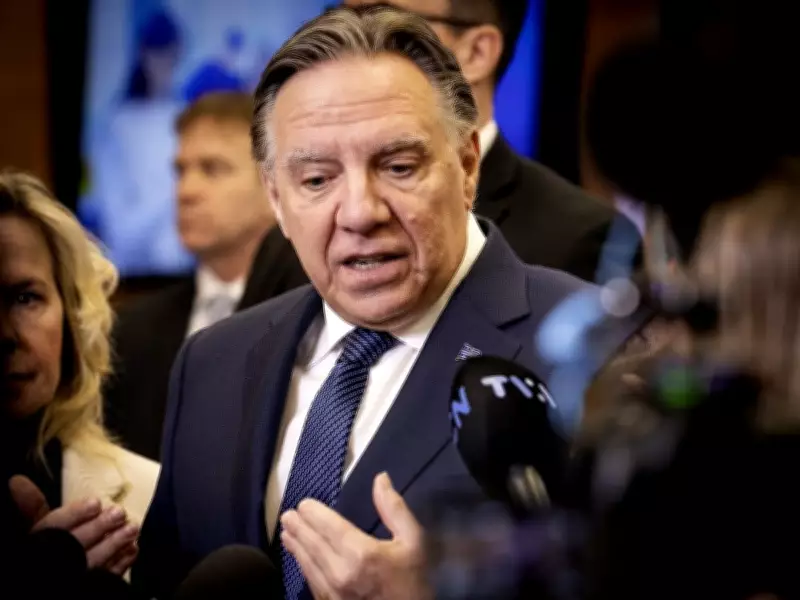
Legault Downplays Referendum Risk as Montreal Bids to Host NATO Defense Bank
Premier François Legault has dismissed concerns that political instability from potential separation referendums could jeopardize Montreal's eligibility to host a proposed NATO defense bank. Speaking at a presentation in Montreal's financial district, Legault emphasized that the majority of Quebecers oppose separation and referendums, making it a non-issue for the city's bid.
Montreal's International Credentials Highlighted
Citing Montreal's robust financial sector, aerospace industries, and international presence, Legault and Montreal Mayor Soraya Martinez Ferrada made their case for the city to become the host of the Defence, Security and Resilience Bank (DSRB). The presentation at National Bank headquarters drew dozens of politicians, industry officials, and academic leaders.
"Montreal is Canada's most international city, recognized for its expertise in finance, defence and innovation," Legault stated. "We join our voices today to send a strong message to the government of Canada: we are counting on its support to ensure Montreal is chosen."

Economic Benefits and Job Creation
The proposed defense bank would create an estimated 3,500 jobs and generate economic spinoffs exceeding $600 million for the local economy, according to Legault. This significant economic boost is a key selling point as Montreal competes with other Canadian cities like Toronto, Halifax, and Ottawa, which have also submitted bids.
Stéphane Paquet, CEO of Montréal International, reinforced this in a news release, calling Montreal "the one and only Canadian city that meets all the winning conditions" for hosting the DSRB. The city's bid highlights its nearly 70 international organizations, including six UN offices and the NATO Climate Change and Security Centre of Excellence.
Addressing Political Stability Concerns
Some critics have questioned whether Montreal's eligibility is at risk due to the Parti Québécois's promise to launch another separation referendum if elected. Legault countered this by pointing to public opinion, asserting that most Quebecers do not favor separation or holding a referendum, thereby minimizing political instability concerns.
Mayor Ferrada added that Montreal's strengths include its international port with close access to Europe, multiple universities, and research facilities, further bolstering its case as an ideal host city.
NATO Defense Bank's Purpose and Structure
The Defence, Security and Resilience Bank, spearheaded by NATO countries, aims to reduce borrowing costs for nations seeking to increase military spending by pooling credit strength. Member countries would act as owners, investing equity to back loans at lower interest rates. However, it has not yet been finalized which country will host the bank or if it will be created.
Federal Support and Competition
Legault noted that there has been no word yet from the federal government or Prime Minister Mark Carney regarding whether Montreal's bid will be favored over others. The federal government has mandated Isabelle Hudon, CEO of the Business Development Bank of Canada, to represent Canada in these efforts.
Ontario Premier Doug Ford has expressed support for Toronto's bid, indicating strong competition among Canadian cities. As the process unfolds, Montreal's bid leverages its aerospace, finance, defence, and technology expertise to stand out in the global race for the NATO defense bank.