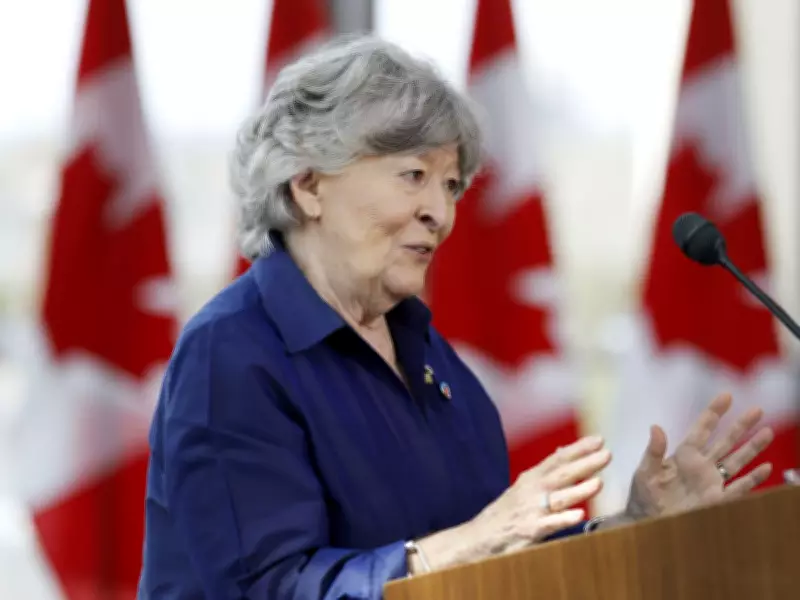
On Tuesday, Prime Minister Mark Carney announced former Supreme Court justice Louise Arbour as Canada's next governor general. Here's what to know about her.
Who is Louise Arbour?
The governor general of Canada is the federal representative of the monarch, currently King Charles III. The office dates back to the colony of New France in the 1500s. In modern times, 30 men and women have held the position since 1867. Arbour will be the 31st, and the first to see her tenure begin during Charles' reign. At age 79, she is also the oldest person to hold the office in Canadian history.
Carney said he had submitted his recommendation to Charles, who approved the appointment.

Born Feb. 10, 1947, in Montreal to hotel chain owners Bernard and Rose, Arbour attended convent school, where she was editor of the school magazine. In 1970 she graduated from the University of Montreal with a degree in civil law, and in 1977 she was admitted to the Ontario bar.
She lived for 27 years with common-law partner Larry Taman before they separated. She has three adult children with Taman — Emilie, Patrick and Catherine — and three grandchildren.
What are some of her achievements?
She was appointed to the Supreme Court of Ontario in 1987, and in 1990 became the first Francophone to be appointed to the Court of Appeal in the province.
In 1995 she was named head of a commission to investigate allegations of abuse at the Prison for Women in Kingston, Ont. The result was the Arbour Report.
The following year she was appointed chief prosecutor of war crimes at the International Criminal Tribunal for Rwanda and the former Yugoslavia in The Hague. In 1999, she announced an indictment against Slobodan Milošević for crimes committed in Kosovo, the first indictment against a sitting head of state ever to be issued by an international tribunal.
The indictment would become the basis for the film Hunt for Justice, a Canadian-German co-production with Canadian actress Wendy Crewson starring as Arbour.
That same year she was appointed to the Supreme Court of Canada. The appointment took effect on Sept. 15, 1999, and she remained in the court until 2004, when it was announced she would accept an appointment as United Nations High Commissioner for Human Rights.
What was Arbour's time like at the UN?
She resigned the position in 2008 at the end of her first term. At that time, Conservative MP and Treasury Board President Vic Toews called her "a disgrace" in the House of Commons, noting that her comments in respect of the state of Israel and the people of Israel "are, in fact, a disgrace, and I stand by those words."
A spokesman for then prime minister Stephen Harper said the government congratulated Arbour on her career but added that it "hasn't always agreed with the positions she has taken."
Arbour had made statements in 2006 during the Israel-Lebanon conflict that "those in positions of command and control" might be subject to "personal criminal responsibility." She was heckled during a visit to the Israeli town of Sderot later that year.