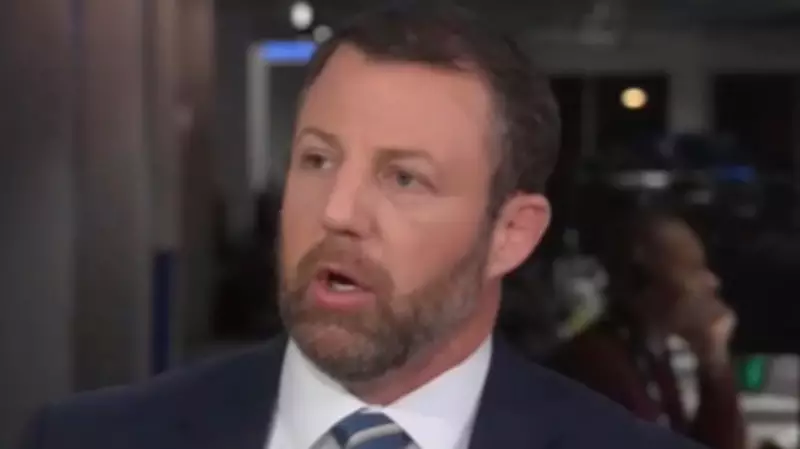
Republican Senator Markwayne Mullin of Oklahoma faced intense scrutiny on Wednesday as he attempted to justify President Donald Trump's conflicting statements regarding potential military action against Iran. The senator appeared on CNN's "The Source" with host Kaitlan Collins, where he argued for intervention based on Iran's alleged nuclear rebuilding efforts, despite the administration's previous assertion that those facilities had been "obliterated."
Contradictory Claims and Tense Exchange
Collins immediately challenged Mullin's position, referencing Trump's announcement in June that U.S. airstrikes had destroyed three Iranian sites, effectively ending the nuclear program. "If we obliterated it last summer, then why are you worried about it right now?" Collins pressed. Mullin responded by echoing Trump's ongoing narrative, insisting that Iran's Supreme Leader Ayatollah Ali Khamenei is actively reconstructing the facilities to develop nuclear weapons.
Unusual Analogies and Defensive Posturing
When Collins highlighted the contradiction between "obliterated" and "rebuilding," Mullin offered a series of peculiar comparisons. "People have car accidents and obliterate their bones and their legs, and yet they can still put metal back in 'em and walk again," he said, attempting to justify how destruction doesn't preclude reconstruction. He further compared the situation to rebuilding a house after a tornado, suggesting the foundation might remain intact.

Collins remained skeptical, pointing to claims from U.S. envoy Steve Wittkoff that Iran is "a week away" from nuclear capabilities. Mullin claimed not to have seen those reports but defended Trump's approach, stating Iran had been given "10 to 15 days" to accept a deal. The senator, who previously expressed opposition to regime change before retracting that stance, praised military service members for accepting the "risk" of potential conflict.
Revealing Comments on Global Implications
Mullin then made a revealing statement about the broader stakes. "There is no way we cannot allow Iran to have a nuclear weapon," he declared. "Can you imagine the destabilization they can have to world trade by controlling the Suez Canal or the majority of the world's oil? Because energy is the backbone of our economy." Collins acknowledged the risks of a nuclear-armed Iran but reiterated the public's confusion over the shifting narrative from obliteration to imminent threat.
Widespread Criticism and Political Fallout
The interview has since sparked widespread condemnation, with critics labeling Mullin's arguments as "idiotic" and logically flawed. His attempts to reconcile the administration's contradictory positions have drawn mockery across political circles, highlighting the ongoing tensions in U.S.-Iran relations. The exchange underscores the challenges in communicating coherent foreign policy, particularly as negotiations stall and military options are floated.
As the debate continues, Mullin's performance serves as a focal point for broader discussions about accountability, transparency, and the rationale for potential conflict in a highly volatile region.