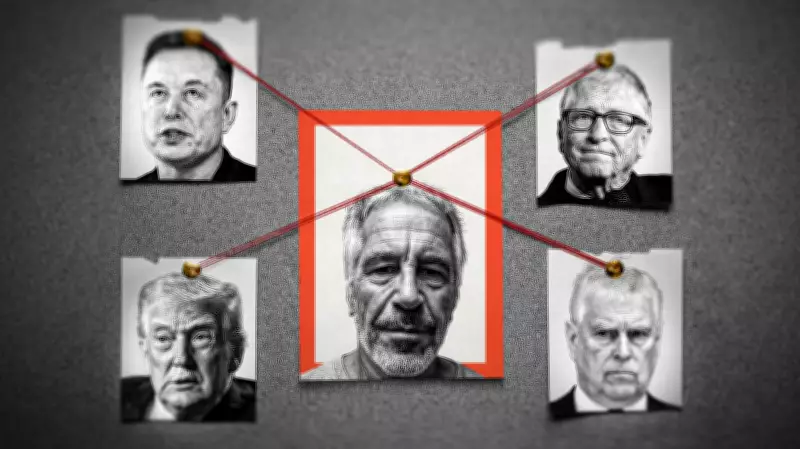
As documents linked to the disgraced former financier and convicted sex offender Jeffrey Epstein continue to be released gradually, critics of the Justice Department's approach to the high-profile case are increasingly vocal. They specifically highlight what they perceive as excessive redactions that shield powerful individuals rather than protect victims. This criticism has crystallized around a new term gaining traction in political discourse.
The Rise of 'Epstein Class' in Political Speeches
Senator Jon Ossoff, a Democrat from Georgia, delivered a pointed speech on February 7th where he explicitly used the phrase "the Epstein class." He argued that the current government administration, which he described as the wealthiest Cabinet in history, represents the interests of the ultra-rich rather than working-class Americans. "We were told that MAGA was for working-class Americans. But this is a government of, by, and for the ultra-rich," Ossoff stated. "They are the elites they pretend to hate."
Ossoff further criticized former President Donald Trump, alleging that his policies favored billionaires like George Soros and Elon Musk at the expense of rural communities through clinic and hospital closures. The term "Epstein class" has circulated for years in online comment sections across platforms such as X, Instagram Reels, and Threads. It attempts to label a troubling social dynamic: a self-protective network of wealth, favors, and information that sustained Epstein's enterprises and criminal activities for an extended period.

Political Figures Champion the Term
By 2026, the expression has permeated public consciousness sufficiently to feature in official political addresses. Representative Ro Khanna, a Democrat from California, was among the early adopters of the term in American politics. In a statement to HuffPost, Khanna explained that he began using "Epstein class" to confront what he views as an elite group of wealthy individuals who operate with impunity and believe they are above the law.
"Americans are sick of elite impunity. There cannot be two tiers of justice, where wealthy men who abused young girls are protected while survivors are silenced," Khanna asserted. "That is what the effort to release the Epstein files has been about, and why I started calling it the 'Epstein class.'"
Khanna emphasized the importance of sustained public pressure, noting his appearances on media platforms across the political spectrum, including Shawn Ryan's podcast. He advocates for congressional action, proposing the formation of a committee to subpoena everyone who communicated with Epstein regarding the abuse of underage girls.
Academic Analysis of the Term's Resonance
Josephine Lukito, a professor of digital communication at the University of Southern Denmark who specializes in political language, observes that "Epstein class" resurfaces whenever the Epstein case reenters public discussion. "I haven't done, like, a systematic analysis of how often it comes up, but I think it has a sort of catchy quality to it that seems to resonate with people when they talk about the Epstein case," Lukito remarked.
She notes that the term possesses a meme-like quality and shares characteristics with other impactful phrases that have galvanized movements, such as "Me Too" and "Black Lives Matter." These phrases are typically concise, and Americans, particularly in political contexts, favor adjective-noun combinations. "I don't know if I'd go so far as to say bring people together," Lukito commented, "but it certainly resonates with a lot of people and can help motivate a movement."
Class Discourse and Wealth in America
Discussing class in the United States can be complex and laden with connotations, yet this may contribute to the term's potency. Lukito points out that historical references like "the ruling class" or "the wealthy class" often serve as quick indicators of affluence. The Epstein case uniquely highlights how wealth transcends partisan lines and professional backgrounds, uniting abusers through their economic power.

"Certainly the U.S. has seen many abuse cases, often involving multiple people, but I think what kind of brings the abusers and the Epstein case together is their wealth, right?" Lukito explained. "They kind of vary by partisanship and by profession, but a lot of the Epstein case itself is really surrounded by an egregious amount of wealth and the ability to use that wealth to exploit children."
Terms like "Epstein class" can circumvent some Americans' reluctance to engage with class issues by directly addressing the intersection of wealth and power. Lukito references Martin Luther King Jr.'s lesser-known advocacy against poverty and wealth inequality, suggesting a contemporary appetite for more straightforward discussions on these topics, especially among economically strained and angry citizens.
"A lot of Americans, especially given economic disparity right now, they have a lot of anger and frustration towards the wealthy and the ruling class," Lukito stated. "The Epstein case certainly is an encapsulation of that, right? We see that rage coming out in so many other contexts: in health care, in frustration towards tech bros and seeing a lot of the relationships between the wealthy and politicians."
Measuring the Term's Impact and Future
Lukito, who has extensively studied catchphrases in political communication, identifies distinctive aspects of "Epstein class." Unlike many terms that gain traction through text-based platforms like Twitter and hashtag activism, "Epstein class" is in a more nascent stage, often appearing in video comments rather than as a dedicated hashtag. A key indicator of its staying power will be its ability to migrate across various social media platforms and resonate with diverse online communities.
The longevity of the Epstein news narrative will significantly influence the term's persistence. "I think when catchphrases are really powerful, it's because there's a sort of staying power when it comes to the news story that's being covered, whether it's police brutality or sexual assault," Lukito noted. "Certainly, this is not going to be even the last time we hear about the Epstein case."
She anticipates that the Epstein story will resurface periodically, and each recurrence will likely revive the "Epstein class" terminology. The adoption by prominent political figures like Ossoff and Khanna is crucial for the term gaining broader acceptance among the American public. "I think when we see that sort of adoption, especially by larger public figures, those are all signs that a term like 'Epstein class' is gaining momentum," Lukito concluded.
The original version of this report was published by HuffPost at an earlier date, highlighting the evolving discourse around accountability, wealth, and justice in contemporary American society.