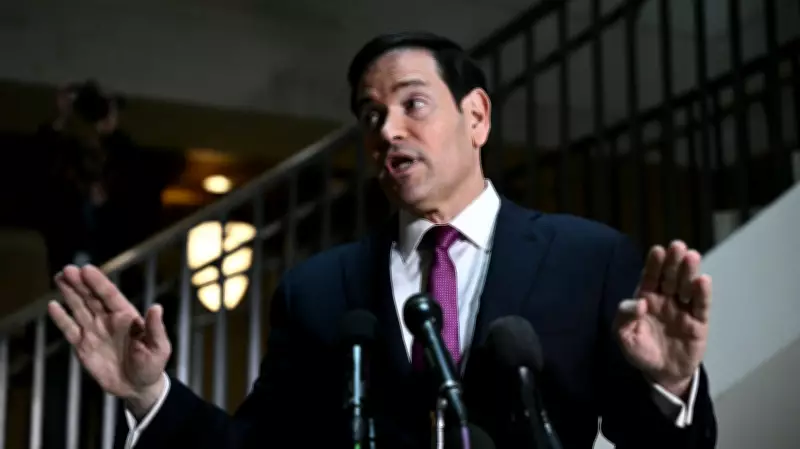
Secretary of State Marco Rubio, on the verge of entering a critical meeting with congressional leaders, directly contradicted information that had been provided to some members of Congress over the preceding weekend regarding President Donald Trump's military strikes against Iran. This discrepancy emerged just as Rubio prepared to brief House and Senate leaders on the U.S. military actions in the region.
Conflicting Accounts of the Threat Level
Senator Mark Warner, a Democrat from Virginia and a member of the so-called "Gang of Eight" group of congressional leaders, revealed on Sunday that he had been informed there was no specific intelligence indicating Iran was on the brink of launching an attack against U.S. assets. This account set the stage for a tense exchange as Rubio addressed reporters on Monday.
Rubio firmly asserted, "There absolutely was an imminent threat, and the imminent threat was that we knew that if Iran was attacked — and we believed they would be attacked — that they would immediately come after us." He elaborated that U.S. officials were aware Israel was planning to take action against Iran, and they believed such strikes would provoke an Iranian retaliation targeting American forces.

Rationale for Preemptive Action
"We knew that there was going to be an Israeli action. We knew that that would precipitate an attack against American forces. And we knew that if we didn't preemptively go after them before they launched those attacks, we would suffer higher casualties," Rubio explained. He characterized the U.S. strikes as a defensive, proactive measure aimed at preventing greater damage. "We went proactively in a defensive way to prevent them from inflicting higher damage," he stated.
Rubio further clarified the objectives of the military operation, noting that while the U.S. "would love" to see a change in Iran's regime, the primary goal was to degrade Iran's ballistic missile and naval capabilities. These comments suggested a dual purpose: addressing an immediate, imminent threat while also undermining Iran's military infrastructure over the long term.
Future Implications and Open-Ended Timeline
Echoing President Trump's earlier remarks, Rubio warned that "the hardest hits" against Iran "are yet to come." He provided an open-ended estimate for the conflict's duration, emphasizing a commitment to achieving strategic objectives. "I don't know how long it will take, we have objectives," he said. "We will do this as long as it takes to achieve those objectives."
This statement underscores the administration's resolve in the face of evolving geopolitical tensions, highlighting a strategy that blends immediate defensive actions with longer-term strategic goals to curb Iran's military prowess.