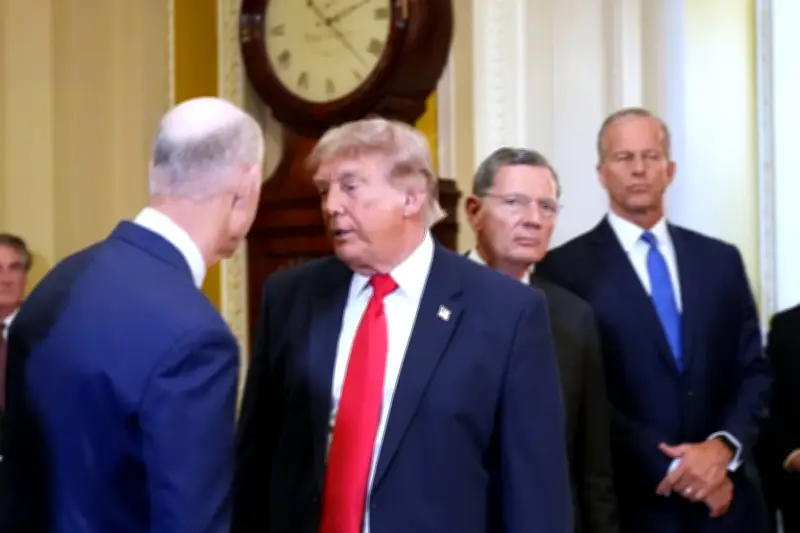
Senate Republicans voted down a war powers resolution on Wednesday, just hours after President Donald Trump berated them during a closed-door meeting at the Capitol, warning that such a measure would undermine his authority to conduct military operations against Iran.
Resolution Defeated Amid White House Pressure
The resolution, introduced by Senator Tim Kaine, a Democrat from Virginia, would have required the president to seek congressional approval before engaging in hostilities with Iran. It failed on a largely party-line vote of 49-51, with only two Republicans—Senators Rand Paul of Kentucky and Mike Lee of Utah—crossing party lines to support it.
Earlier in the day, Trump met with Senate Republicans in a tense session, according to multiple lawmakers who spoke on condition of anonymity. The president reportedly warned that the resolution would send a signal of weakness to Tehran and urged senators to oppose it. “He was very forceful,” one Republican senator said. “He made it clear that he sees this as a direct challenge to his role as commander in chief.”

Trump’s Capitol Confrontation
The meeting, held in the Capitol’s Mansfield Room, lasted about 45 minutes. Trump was accompanied by Vice President Mike Pence and Secretary of State Mike Pompeo. The president’s remarks were described as “blunt” and “at times combative,” according to attendees. He specifically targeted Senator Paul, who has long advocated for a more restrained foreign policy, telling him, “You’re wrong on this, Rand. You’re always wrong on national security.”
Senator John Thune of South Dakota, the Majority Leader, defended the president’s approach after the vote. “The president has the constitutional authority to defend our interests, and this resolution would have tied his hands,” Thune said. “We are not going to hamstring our commander in chief during a time of heightened tensions.”
Bipartisan Debate Over War Powers
The resolution’s defeat marks the latest chapter in a long-running debate over the balance of power between the executive and legislative branches on matters of war. The War Powers Act of 1973 requires the president to notify Congress within 48 hours of committing armed forces to military action and limits engagements to 60 days without congressional authorization. However, many lawmakers argue that successive presidents have ignored these constraints.
Senator Kaine, who has introduced similar resolutions in the past, criticized the vote as a failure of congressional oversight. “This is a sad day for the Constitution,” Kaine said. “Every president—Republican or Democrat—has stretched the limits of their authority, and Congress has been too willing to abdicate its responsibility. Today, my colleagues chose party over principle.”
Senator Paul, one of the Republican defectors, echoed that sentiment. “I took an oath to the Constitution, not to any president,” Paul said. “If we are going to send young men and women into harm’s way, this body should have a say. That is not radical—that is the law.”
Implications for U.S.-Iran Policy
The vote comes amid escalating tensions with Iran, including recent attacks on oil tankers in the Persian Gulf and the downing of a U.S. drone. The Trump administration has blamed Iran for the incidents, though Tehran denies involvement. The president has authorized increased troop deployments to the region and has warned of a “major military response” if provoked.
Critics argue that the resolution’s failure gives Trump a green light to pursue military action without congressional approval. “This vote is a dangerous precedent,” said Senator Chris Murphy, a Democrat from Connecticut. “It tells the president that he can start a war whenever he wants, as long as he has the votes to back him up.”
White House Press Secretary Sarah Sanders defended the outcome, stating, “The president is committed to protecting American lives and interests. This resolution was unnecessary and would have emboldened Iran. We are pleased that the Senate recognized that.”

Looking Ahead
Senate Democrats have vowed to continue pushing for war powers restrictions, possibly attaching similar language to must-pass legislation such as the National Defense Authorization Act. House Speaker Nancy Pelosi, a Democrat from California, indicated that the House may take up its own version of the resolution. “We will not give up on our constitutional duty,” Pelosi said in a statement. “The House will act to ensure that any decision to go to war is made by the people’s representatives, not by one person alone.”
For now, the president has prevailed, but the debate over war powers is far from over. As Senator Kaine put it, “This fight is not about party. It’s about whether we are a democracy or an empire. Today, we took a step toward empire. I intend to reverse that step.”