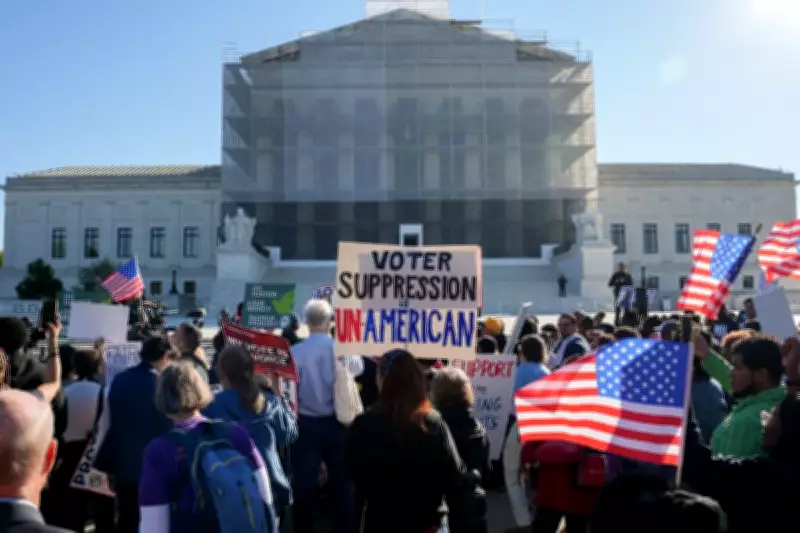
The U.S. Supreme Court has delivered a major ruling that sharply limits the application of the Voting Rights Act in creating election districts with predominantly Black or Hispanic populations. This decision is expected to bolster Republican efforts to maintain control of the House of Representatives in the upcoming midterm elections and beyond.
Court Rejects Louisiana Congressional Map
In a 6-3 decision split along ideological lines, the justices rejected a Louisiana congressional map that included a second majority-Black district. The lower court had previously deemed an earlier version of the map as discriminatory. Writing for the majority, Justice Samuel Alito stated that the current map constituted an “unconstitutional racial gerrymander.”
The ruling effectively weakens what remained of the Voting Rights Act, a landmark law passed in 1965 to combat widespread discrimination against Black voters. While the court did not strike down the law or overturn any precedents explicitly, it established a stringent new standard for those seeking to create heavily minority districts.

Dissenting Opinion Warns of Grave Consequences
Justice Elena Kagan, in her dissent, warned that the ruling's impact “are likely to be far-reaching and grave.” She argued that the decision renders Section 2 of the Voting Rights Act, which prohibits racially discriminatory election rules, “all but a dead letter.”
The ruling is likely to benefit Republicans, as contested districts like the one in Louisiana tend to lean Democratic. Progressive groups have indicated that up to 19 congressional districts with substantial Black or Hispanic populations could be affected, along with numerous state and local districts. A similar case challenging a majority-Black district in Alabama is pending before the Supreme Court, with a decision expected shortly.
Immediate and Future Implications
The ruling comes just weeks before Louisiana's scheduled May 16 primary. State lawmakers may now attempt to quickly draft a new map. Louisiana Secretary of State Nancy Landry stated that her legal team is currently analyzing the opinion. The state currently has four Republican and two Democratic representatives.
Beyond Louisiana, the immediate effect of the ruling on this year's elections remains uncertain. While it may not automatically invalidate other minority-majority districts, it could prompt some states to expedite redistricting efforts. Florida is currently holding a special session to consider a map that could add several Republican seats. Governor Ron DeSantis commented on social media that the ruling implicates a district in Florida, noting that legal issues have been addressed in a newly drawn map.
John Bisognano, president of the National Democratic Redistricting Committee, suggested that the full impact of the decision might not be felt until 2028, as most states have already held primaries or passed candidate filing deadlines.