Trump Administration's Evolving Justifications for Iran War Focus on Israeli Actions
In the tumultuous period leading up to and immediately following the declaration of war on Iran, the administration under President Donald Trump presented a bewildering series of changing reasons for initiating a conflict with profound global consequences. However, after several days of intense public scrutiny, congressional briefings, and numerous interactions between Trump and the media, a more unified explanation has surfaced: the decision was heavily influenced by Israel.
Official Rationale: Preempting Attacks to Safeguard U.S. Forces
Secretary of State Marco Rubio articulated this stance to reporters on Monday, following a briefing with lawmakers at the Capitol. "We were aware that an Israeli operation was imminent, which would likely trigger assaults on American military personnel," Rubio stated. "By acting preemptively before those attacks could be launched, we aimed to minimize potential casualties among our troops."
Rubio's argument centers on the premise that Israel informed the United States of its intention to bomb Iran. In response, Iran was expected to target U.S. forces. Rather than attempting to dissuade Israel from its planned strike, Rubio implied that the U.S. had little alternative but to participate in a war that Israel was determined to initiate.

Republican Support Echoes Israel-Centric Narrative
This justification has now permeated the ranks of war supporters within the Republican Party. Senator Tom Cotton of Arkansas emphasized on Fox News, "Israel confronted an existential threat and was ready to act independently against Iran. Had they done so, Iran would have likely directed its retaliation at our troops, which clarifies the timing of our involvement."
Similarly, Speaker Mike Johnson of Louisiana told reporters, "Israel was resolved to defend itself, regardless of American backing." These statements underscore a consistent theme among GOP leaders, framing the conflict as a necessary response to Israeli security concerns.
Democratic Criticism and Trump's Contradictory Remarks
Democrats, while condemning the decision to escalate hostilities in the Middle East, have acknowledged that the administration's argument hinges on Israel's perceived threats. Senator Mark Warner of Virginia, the leading Democrat on the Senate Intelligence Committee, remarked, "There was no immediate danger to the United States from Iran; the threat was directed at Israel. Equating an Israeli threat with an imminent U.S. threat places us in unprecedented territory." He added, "This remains a war of choice, driven by Israel's objectives and schedule."
In a characteristic move, President Trump contradicted his administration's narrative on Tuesday, asserting, "If anything, I might have compelled Israel to act." Subsequently, Rubio attempted to clarify his earlier comments, telling reporters that "the president made the decision," not Israel. When confronted with his previous quote by CNN's Manu Raju, Rubio evaded the question and shifted to another topic.
Historical Context and Netanyahu's Influence
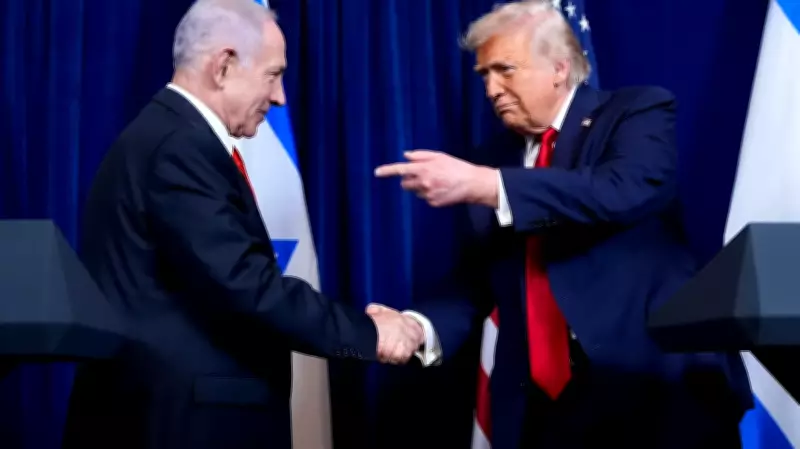
Israel's threat of a preemptive strike emerged as the Trump administration was engaged in diplomatic talks with Iranian leaders. Israeli Prime Minister Benjamin Netanyahu made an unexpected visit to the White House on February 11, reportedly to "keep the American president on the path to war," according to the New York Times. Netanyahu, a staunch opponent of the 2015 nuclear deal negotiated by President Barack Obama and abandoned by Trump in 2017, opposed any diplomatic resolutions.
Following the assassination of Ayatollah Ali Khamenei in a joint U.S.-Israeli operation, Netanyahu boasted that Trump enabled him to "smite the terror regime hip and thigh," a goal he had pursued for decades. This action aligns with a long-standing strategy, as past U.S. presidents from Dwight Eisenhower to George H.W. Bush recognized differing strategic objectives between the U.S. and Israel, often resisting Israeli pressures. In contrast, Trump has aligned closely with Israel's approach of reshaping the region through military force, a strategy also evident during Joe Biden's tenure.

Clean Break Memo and Regional Implications
This strategy is not novel but has gained momentum as Israel seeks to neutralize threats after the October 7 attacks. In 1996, American figures Richard Perle and Douglas Feith, who later played key roles in the Iraq War, assisted Netanyahu in developing the Clean Break memo. This document advised Israel to assert regional dominance by abandoning peace processes and targeting hostile regimes in Palestine, Iran, Iraq, Syria, and Lebanon.
Much of this plan has materialized: Netanyahu advocated for the Iraq War that ousted Saddam Hussein, Syria's Bashar al-Assad is no longer in power, Hezbollah's leader Hassan Nasrallah was assassinated, Gaza lies in ruins, and Israel threatens annexation of the West Bank. Iran remains a focal point, which Netanyahu labeled "the most dangerous of these regimes" in a 1996 congressional speech echoing Clean Break themes.
Initially rebuffed by President Bill Clinton, Netanyahu has since found support in Biden, who backed Israel's actions in Gaza, and now Trump. On Fox News, Netanyahu claimed the war would be "a gateway to peace," echoing his past optimism about the Iraq War's regional benefits, a comparison that invites scrutiny given historical outcomes.