Former President Donald Trump has inserted himself into a growing internal Republican Party conflict by defending conservative media personality Tucker Carlson's decision to interview openly fascist podcaster Nick Fuentes. The controversy has exposed deep divisions within conservative ranks about how to handle rising antisemitism and racism in their movement.
Trump Enters the Fray
On Monday, Trump publicly supported Carlson's right to interview Fuentes, who is known for his racist, misogynist, pro-Hitler and antisemitic rhetoric. "If he wants to [interview Fuentes], get the word out," Trump stated, while claiming he didn't know who Fuentes was. "People have to decide."
The president's comments came as the Republican Party struggles with how to address the increasing influence of unvarnished bigotry against racial minorities, women, and Jewish people within conservative circles. The situation escalated on October 27 when Fuentes appeared on Carlson's popular online show, using the platform to declare that "the main challenge" facing American society is "organized Jewry."

Conservative Movement in Crisis
The fallout from the interview has been substantial. Robert P. George, a prominent Princeton University legal scholar and religious right leader, resigned from the Heritage Foundation's board on Monday. In his resignation statement, George directly attributed his decision to Heritage President Kevin Roberts' initial defense of Carlson for hosting Fuentes.
"I could not remain without a full retraction of the video released by Kevin Roberts, speaking for and in the name of Heritage, on October 30th," George wrote in a Facebook post. "Although Kevin publicly apologized for some of what he said in the video, he could not offer a full retraction of its content."
The controversy has sparked resignations across conservative organizations and revealed significant generational divides. According to right-wing essayist Rod Dreher, "between 30 and 40 percent" of Gen Z conservatives working in Washington are reportedly "fans of Nick Fuentes."
Historical Context and Escalating Tensions
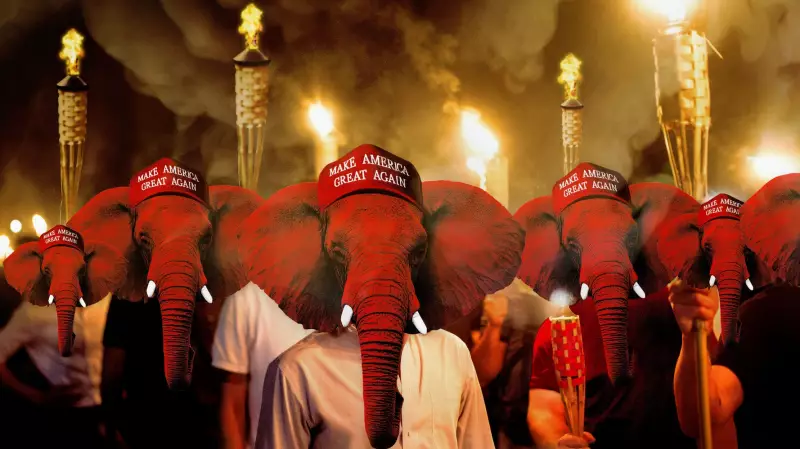
This internal conflict represents the latest in a series of schisms that have plagued the Republican Party since Trump's political ascent. However, current tensions differ from previous disputes because they center on whether the party can separate itself from open bigotry and antisemitism that increasingly permeates right-wing politics.
The situation intensified following the mid-September assassination of conservative activist Charlie Kirk. Rather than uniting the right, Kirk's death created a vacuum that allowed hard-right and openly fascist figures like Fuentes to gain influence. Fuentes, whose show "America First" has over 500,000 followers on Rumble, has been present at major Trump-era events including the Charlottesville Unite the Right rally and pre-January 6 Capitol attack gatherings.
Support for Israel has become a particular flashpoint in the conflict. While elected Republicans overwhelmingly support Israel, many young conservatives increasingly view the country negatively. This shift has created an opening for figures like Fuentes to promote explicit antisemitism under the guise of foreign policy criticism.
The internal battle has pitted prominent Jewish Republicans and pro-Israel conservatives against those seeking to appeal to Fuentes' growing base of young supporters. Ben Shapiro, Mark Levin, and Senator Ted Cruz have all stated that Fuentes should have no place in the conservative movement.
Meanwhile, the Trump administration appears populated with Fuentes sympathizers. White House lawyer Paul Ingrassia saw his nomination to head the Office of Special Counsel derailed after text messages revealed he claimed to have a "Nazi streak" and used racial slurs. Ingrassia was not fired but instead appointed deputy counsel of the General Services Administration.

As Senator Lindsey Graham notably declared himself part of the "Hitler sucks wing" of the party, the ongoing controversy suggests that the most extreme elements of the right are no longer outside the conservative movement but have become embedded within its highest levels of influence.