In a striking public dispute, former U.S. President Donald Trump has rebuked one of his prominent supporters, Riley Gaines, following backlash over an artificial intelligence-generated image he shared on social media. The controversial post, which many interpreted as portraying Trump in a messianic light, has ignited a fierce debate within conservative circles and beyond.
Social Media Sparks Political Firestorm
The controversy erupted when Trump posted an image on his Truth Social platform showing him dressed in white and red robes, seemingly healing an elderly man with a touch of light. The artwork featured patriotic symbols including an American flag, flying eagles, and a radiant sunburst with ethereal figures in the background. While Trump later claimed the image represented him as a medical professional with Red Cross symbolism, many viewers perceived it as depicting the former president in a Christ-like manner.
Gaines' Initial Criticism
Anti-transgender activist and former competitive swimmer Riley Gaines swiftly condemned the image on X (formerly Twitter), expressing bewilderment at Trump's decision to share it. "Why? Seriously, I cannot understand why he'd post this," Gaines wrote. "Is he looking for a response? Does he actually think this?"

Gaines continued with a pointed critique: "Either way, two things are true. 1) a little humility would serve him well. 2) God shall not be mocked." Her comments reflected concerns among some conservative Christians about the potential blasphemy of the AI-generated artwork.
Trump's Sharp Response
Trump fired back during an interview with CBS News senior correspondent Norah O'Donnell, distancing himself from Gaines despite their previous alliance on transgender athlete issues. "I didn't listen to Riley Gaines," Trump stated bluntly. "I'm not a big fan of Riley, actually."
The former president defended his decision to delete the controversial post, claiming it was due to public confusion rather than the criticism from his conservative base. "I viewed that as a picture of me being a doctor in fixing — you had the Red Cross right there, you had medical people surrounding me," Trump explained, offering an alternative interpretation of the image that differed from the religious reading many had applied.
Political Alliance Under Strain
Despite the public friction, Gaines appeared to reconcile with Trump after he removed the image from his social media platform. "I love the President and I'm so grateful he's in the Oval Office," she posted on X. "Of course, I'll continue to support him and the America First agenda."
Gaines suggested Trump's comments weren't personal, writing: "I don't get my feelings hurt easy and I know with the President it's really not personal. I want to spend eternity in a real place called Heaven. I'd love for Trump to be there too."
Shared History on Transgender Issues
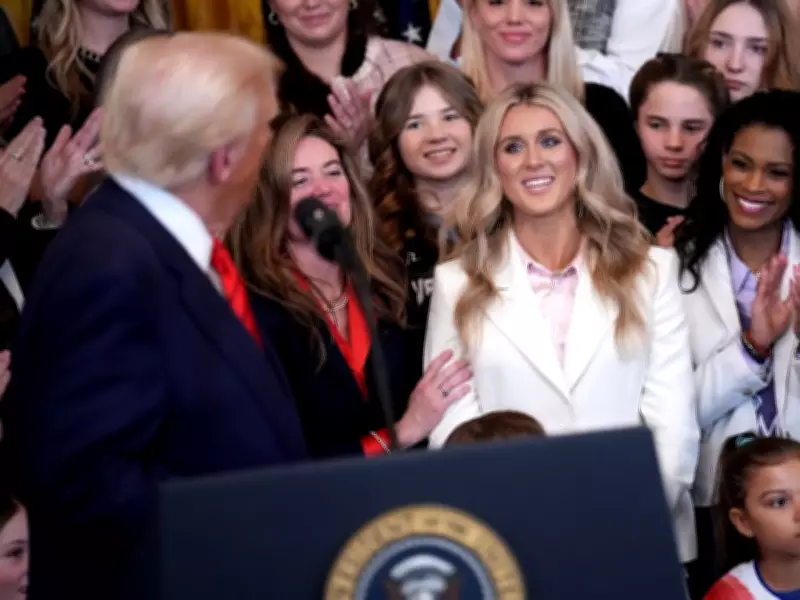
The tension between Trump and Gaines is particularly notable given their previous collaboration on transgender athlete policies. During a 2025 press conference where Trump signed an executive order banning transgender athletes from women's sports, he publicly praised Gaines for her advocacy work.
"I want to thank Riley, she really has been in the forefront," Trump said at the time. "People who are well-versed would say she was the leader, great job, Riley." Gaines became involved in the issue after tying with transgender swimmer Lia Thomas at the 2022 NCAA Championships, making her a prominent voice in the debate over transgender participation in women's sports.
Broader Implications
This public disagreement highlights the complex dynamics within conservative political movements, where cultural and religious values sometimes clash with political loyalty. The incident also underscores the growing influence of AI-generated content in political discourse and the challenges it presents for public figures navigating sensitive cultural issues.
As artificial intelligence technology becomes more sophisticated and accessible, political figures increasingly face scrutiny over how they employ these tools in their communications. The Trump-Gaines controversy serves as a case study in how AI imagery can generate unexpected political consequences, even among ideological allies.

The episode further demonstrates the evolving nature of political alliances in the digital age, where social media platforms serve as both connective tissue and potential fault lines between public figures and their supporters.