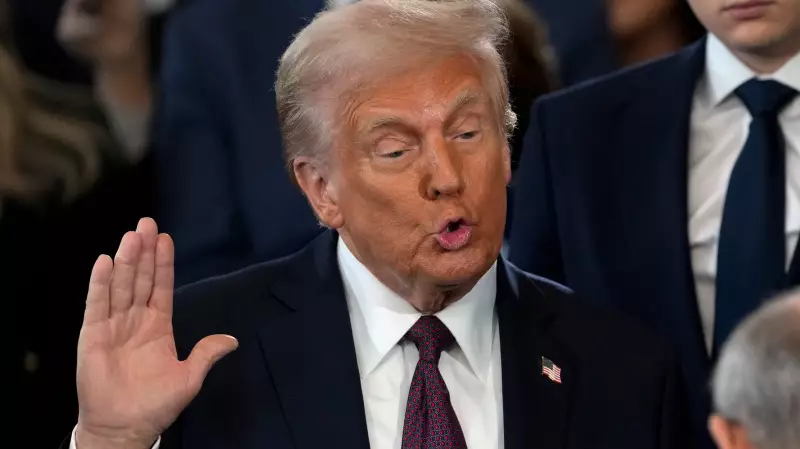
Former President Donald Trump has once again stirred political waters by openly speculating about the possibility of serving a fourth term in office, a move that directly challenges the constitutional limits of the United States presidency. On Thursday, Trump took to his Truth Social platform to post a provocative message that read: "RECORD NUMBERS ALL OVER THE PLACE! SHOULD I TRY FOR A FOURTH TERM?" This remark has reignited widespread discussion and controversy, as it touches on fundamental legal and democratic principles.
Constitutional Constraints and Historical Context
The 22nd Amendment of the US Constitution explicitly prohibits any individual from being elected to the office of President more than twice. Enacted in 1951, this amendment was designed to prevent the accumulation of excessive executive power and ensure regular leadership transitions. Trump's suggestion of a fourth term is therefore unconstitutional, yet it is not the first time he has teased such ideas. Throughout his political career, he has repeatedly floated the notion of serving a third term, despite legal barriers.
Interpreting Trump's "Fourth Term" Remark
It remains unclear exactly what Trump meant by referencing a "fourth" term in his social media post. Analysts and political observers have proposed several interpretations. One possibility is that Trump is alluding to his persistent and unsubstantiated claim that he won the 2020 election against Joe Biden. Under this view, he might consider his current or potential future term as a "third" one, making a subsequent bid a "fourth." Alternatively, the remark could imply a desire to serve two additional terms beyond the constitutional limit, further extending his political influence.

This ambiguity adds to the ongoing speculation about Trump's long-term political ambitions and his willingness to test institutional norms. His post has sparked debates not only about term limits but also about the broader implications for American democracy and the rule of law.
Potential Successors and Political Heirs
Despite these speculative comments, Trump has previously indicated a recognition of constitutional boundaries. In October, he appeared to rule out the idea of a third term, and he has since discussed potential heirs to his political movement, often referred to as the MAGA fiefdom. Figures such as Vice President JD Vance and Secretary of State Marco Rubio have been mentioned as possible successors who could carry forward his agenda. This suggests a strategic balancing act between pushing controversial ideas and planning for a post-Trump era within the Republican Party.
Public and Political Reactions
The reaction to Trump's Truth Social post has been mixed, with supporters cheering his boldness and critics condemning it as a dangerous flirtation with authoritarianism. Legal experts have been quick to reiterate that the 22nd Amendment leaves no room for interpretation—serving beyond two terms is not permissible. This incident highlights the ongoing tensions between populist rhetoric and constitutional governance in contemporary American politics.
As the 2024 election cycle approaches, Trump's comments are likely to fuel further discussions about leadership, legacy, and the limits of presidential power. Whether this is mere political posturing or a serious challenge to established norms remains to be seen, but it undoubtedly adds a new layer of complexity to the national political landscape.