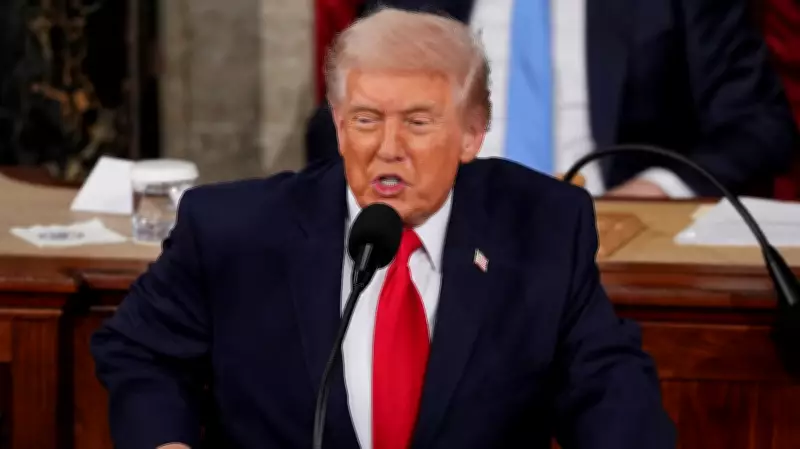
In a notable moment during his State of the Union address on Tuesday, President Donald Trump presided over the presentation of the United States' highest military honor to two distinguished veterans, but quickly turned the spotlight with a lighthearted quip about his own aspirations for the award.
A Tribute to Heroism
First lady Melania Trump presented the Medal of Honor to retired Navy Capt. E. Royce Williams, a 100-year-old Korean War veteran, in the latter part of the president's speech. Trump praised Williams, stating, "This brave Navy captain is finally getting the recognition he deserves. He was a legend long before this evening." The ceremony elicited extended applause from attendees, including Democratic Senators Mark Kelly of Arizona and Elissa Slotkin of Michigan.
An Unusual Interjection
However, as soon as Williams took his seat, Trump shifted gears, injecting humor into the solemn occasion. He remarked, "I've always wanted the Congressional Medal of Honor, but I was informed I'm not allowed to give it to myself, and I wouldn't know why I'd be taking it, but if they ever open up that law, I will be there with you someday." This comment drew attention for its timing during a tribute meant to honor military service.

Honoring Another Veteran
Earlier in the address, Chief Warrant Officer Eric Slover, a U.S. Army helicopter pilot wounded in a raid that led to the capture of Venezuelan dictator Nicolás Maduro in January, also received the Medal of Honor. Trump acknowledged both recipients, saying, "That's our highest honor, Congressional Medal of Honor, and that's a big thing, and it's an honor to be in the same room with you. Thank you both very much."
Protocol and Terminology
Notably, Trump repeatedly referred to the award as the "Congressional Medal of Honor," although its official name is the Medal of Honor, despite being presented "in the name of Congress of the United States," as highlighted by The New York Times. The outlet also observed that awarding the honor during a political speech like the State of the Union is highly unconventional; most presidents since the Vietnam War have conducted such ceremonies at the White House to maintain a non-partisan tone.
This event underscores the blending of military recognition with political theater, raising questions about protocol and the appropriate settings for honoring national heroes. The juxtaposition of heartfelt tribute and personal jest has sparked discussions on the balance between reverence and rhetoric in public addresses.