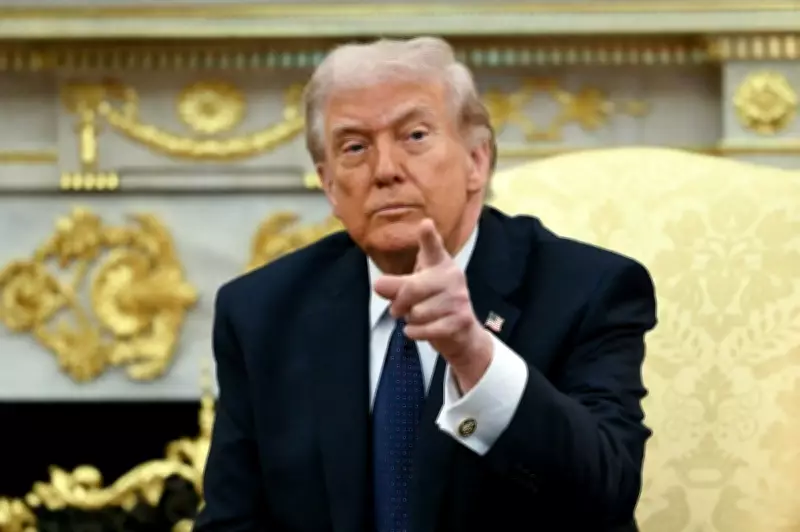
U.S. President Donald Trump has escalated tensions with Spain, threatening to cut off all trade relations with the European nation. The announcement came during a meeting with German Chancellor Friedrich Merz at the White House on Tuesday, where Trump expressed frustration over Spain's stance on international issues.
Trade Threats Over Iran and NATO
Trump's threat centers on two key grievances: Spain's refusal to support U.S. and Israeli military actions against Iran and its resistance to meeting NATO's defense spending targets. "We're going to cut off all trade with Spain," Trump declared. "We don't want anything to do with Spain."
This move follows comments from Spanish Foreign Minister Jose Manuel Albares, who stated that Spain would not permit the use of U.S. bases on its soil for strikes not authorized by the United Nations charter. Albares emphasized that these bases were not utilized in recent attacks on Iran.

NATO Spending Dispute
Trump also criticized Spain for backing out of NATO's goal to increase defense spending to 5% of GDP. Spain has committed to spending only 2.1% of its GDP on defense, a decision Trump labeled as insufficient. "Spain is the only country in NATO that would not agree to go up to 5%," he said, accusing the nation of failing to meet even the 2% benchmark.
German Chancellor Friedrich Merz echoed Trump's concerns, noting efforts to persuade Spain to comply with shared security commitments. In response, a spokesperson for Spanish Prime Minister Pedro Sanchez defended Spain's role, stating it is "a key member of NATO, fulfilling its commitments and making a significant contribution to the defence of European territory."
Broader International Reactions
Sanchez has been vocal in criticizing U.S. and Israeli actions in Iran, describing them as "unjustifiable" and "dangerous." His government has called for de-escalation and dialogue while condemning Iran's regional strikes. Trump, however, dismissed Spain's leadership, saying, "Spain has absolutely nothing that we need other than great people. They have great people, but they don't have great leadership."
The dispute marks another chapter in the strained relationship between Spain and the Trump administration, with Spain also being a critic of Israel's war in Gaza under Sanchez's progressive leadership.
U.K. Also in Trump's Crosshairs
Trump's dissatisfaction extended to the United Kingdom, another close ally. He expressed unhappiness with Prime Minister Keir Starmer for not fully backing the U.S. attack on Iran. "I'm not happy with the U.K.," Trump said, comparing Starmer unfavorably to Winston Churchill.
Starmer authorized the use of two U.K. air bases for limited defensive purposes but restricted access to others, such as those in Cyprus. Trump criticized this decision, referencing logistical challenges and the U.K.'s plan to return the Chagos Islands to Mauritius, which hosts the Diego Garcia base. "I will say the U.K. has been very, very uncooperative with that stupid island that they have," Trump remarked.
Uncertain Enforcement and Legal Context
How Trump intends to enforce these trade threats remains unclear, as Spain is part of the European Union, which negotiates trade deals collectively for its 27 member states. This development follows a recent Supreme Court ruling against Trump's global tariffs, prompting him to assert the authority to impose embargoes unilaterally.
The situation underscores ongoing friction in U.S. foreign relations under Trump's presidency, with allies facing pressure over defense spending and geopolitical alignments.