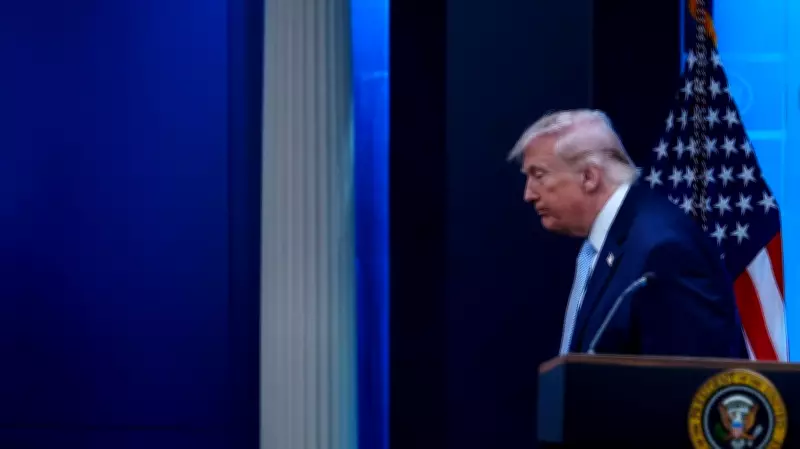
Three months into his self-described “four to five week” war, President Donald Trump appears no closer to achieving his stated goal of compelling Iran to surrender its highly enriched uranium. This predicament stems from his own decision to withdraw from the nuclear agreement negotiated by his predecessor, Barack Obama.
Trump's Conflicting Statements
At a White House Cabinet meeting photo opportunity on Wednesday, Trump reiterated, “They want very much to make a deal. But their navy is gone, as I’ve said a thousand times, their navy is gone, their air force is gone, everything’s gone, and they’re negotiating on fumes. But we’ll see what happens. Maybe we have to go back and finish it.” These remarks came just four days after he claimed an agreement had been “largely negotiated” and that “final aspects and details of the deal are currently being discussed, and will be announced shortly.”
Iran's Stance and the JCPOA Context
While both Trump and Iranian leadership are considered unreliable narrators, reports indicate Iran would only agree to “talks” about handing over its uranium. Trump has repeatedly declared that the goal of the now 88-day-old war, initiated without consulting Congress or traditional U.S. allies, is to prevent Iran from obtaining a nuclear weapon. However, there is little indication Iran plans to relinquish its stockpile of highly enriched uranium. What Trump neglects to mention is that Iran produced this material only after he dismantled the Obama-era agreement.

Since the Joint Comprehensive Plan of Action (JCPOA) was signed in 2015 after two years of negotiations, Trump has falsely claimed it gave Iran permission and means to build nuclear weapons. He repeated this falsehood on Wednesday: “It was the path for Iran to have a nuclear weapon very quickly. Years ago, they would have had a nuclear weapon.” In reality, the Obama administration’s agreement strictly limited Iran’s enrichment capabilities and introduced an intrusive system of international inspectors.
Iran's Compliance and Trump's Withdrawal
Iranian leaders, eager for sanctions relief, were honoring the enrichment prohibition, a fact freely admitted by Trump’s first-term administration. Nonetheless, Trump scrapped the agreement in 2018. Ned Price, a former CIA officer and State Department official under President Joe Biden, noted, “The State Department and intelligence community had repeatedly confirmed that Iran was complying with the terms of the JCPOA when Trump unilaterally withdrew from it.”
Trump has claimed since pulling out that Iran wanted to make a “deal” with him. During his 2020 reelection campaign, he repeatedly said Iran desperately sought a deal but was waiting for his second term. Later, while running to regain the White House after his January 6, 2021, coup attempt failed, he asserted he would quickly strike a deal with Iran upon returning to office. Instead, Trump attacked Iran twice—first in June 2025 and then on February 28—both times when productive negotiations were supposedly underway.
Consequences of the War
Nearly three months into a war that has damaged the global and U.S. economies, spiked oil and gas prices, increased inflation, and resulted in 13 American and at least 1,500 Iranian deaths, Trump continues to claim Iran desperately wants “a deal,” even as its leaders appear to stall. Price commented, “There’s a tendency, especially in the Middle East, to dismiss American diplomacy and assume most problems require military force. Many JCPOA critics mistakenly believed the Iranian nuclear challenge would vanish once we struck its nuclear sites. Trump’s decision to test that proposition has proven it was pure folly and underscored the enduring advantage of a diplomatic resolution.”

Robert Kagan, a former top State Department official under Ronald Reagan and now a foreign policy analyst at the Brookings Institution, stated that Trump’s repeated false claims of a near deal only serve to obscure the war’s reality. He noted that Iran engaged U.S. forces on Monday: “The fact that Iran felt emboldened to target American ships shows they are not afraid of a resumption of war because they know Trump has no good military options and wants out. The war was over in March. The U.S. lost. Everything since then has been aimed at covering this up.” Kagan added that the worst outcome is Iran’s newfound control over the Strait of Hormuz, through which one-fifth of the world’s oil traffic passes. “Iran was deterred from closing the strait by fear of an attack that could threaten the regime’s existence. Now they have proven they can survive an extended bombing campaign and still inflict unacceptable damage, including control of the strait. We are now living in that world, and there can be no return to the status quo ante.”
Expert Views on the Nuclear Issue
John Bolton, one of Trump’s first-term national security advisers and a longtime advocate for attacking Iran to change its regime, said Iran can also win on the enriched uranium issue. “Iran is playing for time. Trump is still desperate for a way to claim victory. Most importantly, there’s no real deal, just an extension of the cease-fire and opening the strait. Iran wins by kicking the nuclear issue down the road.”